
Road safety remains a critical priority for transport authorities, local councils, and road infrastructure planners across Australia. With growing traffic volumes and increasingly complex urban mobility patterns, the margin for error is shrinking. Ensuring safe road networks is not just good practice—it is a national responsibility.
The guidelines developed by Austroads form the backbone of formal Road Safety Audit (RSA) practice across Australia and New Zealand. These guidelines call for objective, evidence-based assessment of safety risks at every stage of road planning, design, construction, and operation.
But as the saying goes, "You can't fix what you can't see." Traditional manual surveys often miss hidden risks, rely on subjective judgement, and struggle to capture the true dynamics of real-world traffic behaviour. This is where AI-powered traffic data and digital survey technologies are transforming road safety management—bringing unprecedented clarity to the audit process.
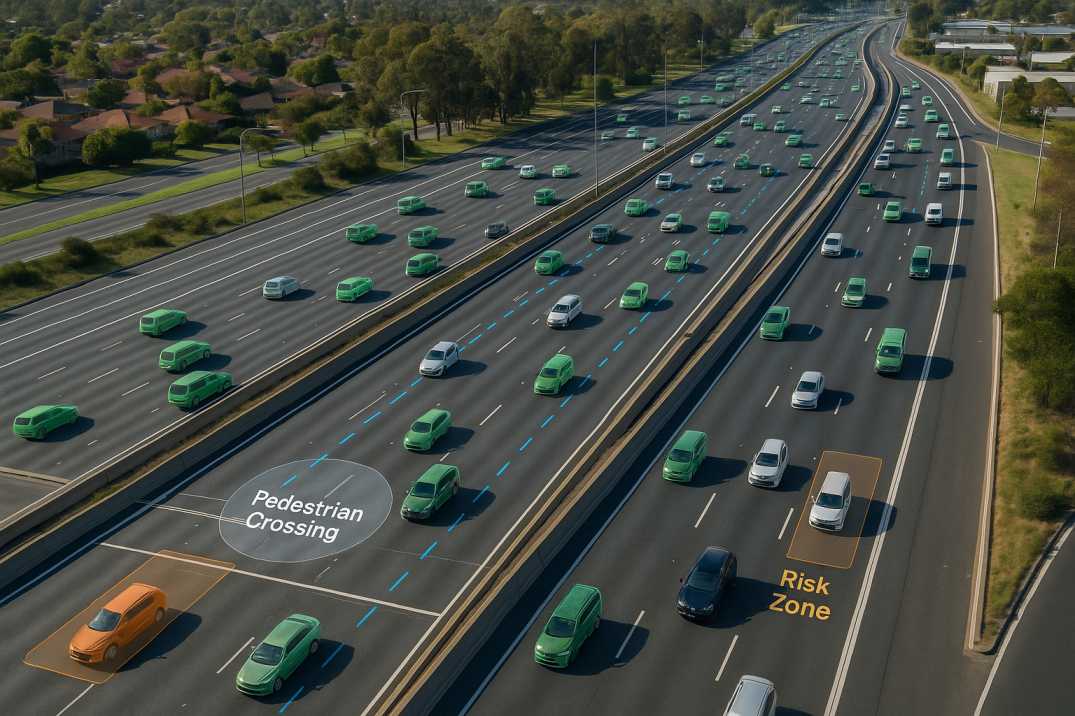
AI-enabled traffic surveys and digital monitoring systems introduce precision, speed, and reliability into the RSA workflow. They help authorities move from reactive problem-solving to proactive, data-driven risk mitigation. Simply put: AI illuminates blind spots that manual audits can't detect.
Key benefits include:
For agencies under pressure to improve safety outcomes while managing tight budgets, AI is the multiplier that elevates capability without compromising quality.
The Austroads RSA framework focuses on identifying and eliminating hazards across four project stages:
The core principles include:
AI naturally complements these principles by supplying the hard evidence that supports robust audit findings through the Road Safety Audit Agent.
AI tools bring new depth to traffic and asset evaluation. Platforms such as RoadVision AI demonstrate how modern digital systems enhance safety audit practices through the following best-practice applications:
3.1 Enhanced Pavement & Asset Condition Assessment
The Pavement Condition Intelligence Agent evaluates how actual traffic loads influence deterioration. This helps:
It's like catching the storm before the clouds gather—identifying risks when intervention is still low-cost and highly effective.
3.2 Comprehensive Road Inventory Inspection
The Roadside Assets Inventory Agent uses AI-driven computer vision to create a live, accurate catalogue of assets:
This supports:
A complete inventory means nothing "falls through the cracks" during safety assessments.
3.3 Digital Traffic Monitoring for Hidden Risk Detection
The Traffic Analysis Agent identifies subtle patterns often invisible to the naked eye, including:
This aligns perfectly with Austroads' recommendation for continuous, real-time safety monitoring and provides evidence that traditional spot observations cannot capture.
3.4 Data-Driven, Predictive Safety Audits
AI-derived traffic behaviour models allow engineers to simulate future conditions. Benefits include:
Data turns assumptions into actionable intelligence, enabling truly proactive safety management.
3.5 Integration of Crash and Traffic Data
The platform correlates crash history with current traffic patterns and asset conditions to:
3.6 Multi-Modal Safety Assessment
AI systems capture interactions between all road users:
This comprehensive view supports Austroads' emphasis on safe systems for all users.
While AI delivers tremendous value, integration into established workflows comes with considerations:
4.1 Data Management
Large datasets require structured storage, cleansing, version control, and quality assurance processes to ensure reliability.
4.2 Skill Gaps
Agencies may need training to interpret AI-generated insights effectively and incorporate them into audit findings and recommendations.
4.3 Technology Adoption Barriers
Legacy systems and procurement frameworks can slow implementation, requiring careful change management and stakeholder engagement.
4.4 Standardisation Needs
Ensuring AI outputs align with Austroads formats, terminology, and reporting requirements is essential for seamless integration.
4.5 Validation and Calibration
AI outputs must be validated against ground truth data to build confidence among audit teams and stakeholders.
4.6 Cost of Implementation
While AI reduces long-term costs, initial investment in technology and training requires budget commitment and demonstrated ROI.
However, with the right platform and onboarding strategy, these challenges become stepping stones rather than roadblocks. RoadVision AI addresses these through comprehensive training, flexible deployment options, and outputs designed to match Austroads requirements.
AI-enabled traffic data is rewriting the playbook for road safety audits in Australia. It strengthens compliance with the Austroads RSA framework, sharpens risk detection, and accelerates the shift toward preventative, rather than reactive, road safety management.
Platforms like RoadVision AI are at the forefront of this transformation—leveraging digital twins, advanced computer vision, and automated assessments through the Road Safety Audit Agent, Traffic Analysis Agent, Pavement Condition Intelligence Agent, and Roadside Assets Inventory Agent to support safer, smarter, and more cost-efficient road networks. Their integrated approach ensures full compliance with Austroads geometric design standards, boosts the accuracy of traffic surveys, and streamlines asset management for councils, contractors, and government agencies.
As the saying goes, "A stitch in time saves nine." With AI, that early stitch becomes faster, smarter, and far more precise—often preventing major safety issues before they ever take shape. By identifying risks hidden in traffic patterns, asset conditions, and road-user behaviour, AI empowers auditors to recommend interventions that truly make a difference.
For agencies committed to the National Road Safety Strategy 2021–30 and the goal of zero fatalities, AI-powered audits are not just an enhancement—they are essential. The ability to see what was previously invisible, to predict what was previously unpredictable, and to prevent what was previously inevitable transforms safety management from a compliance exercise into a life-saving mission.
If your organisation is ready to modernise its road asset management strategy and embrace the next generation of road safety intelligence, book a demo with RoadVision AI today and discover how AI-powered traffic data can elevate your road safety audits and asset management outcomes.
Q1. What is the purpose of Austroads Road Safety Audit Guidelines?
The guidelines help identify potential road safety hazards during all project stages, ensuring safer road networks across Australia.
Q2. How do AI traffic survey tools improve safety audits?
AI tools provide real-time, precise traffic and asset condition data, reducing manual errors and improving decision-making.
Q3. Can AI traffic data help prevent future accidents?
Yes, predictive analytics powered by AI can highlight high-risk areas before accidents occur, enabling proactive safety improvements.

The Autonomous Road Engineer
AI-powered road condition monitoring, asset management, & infrastructure intelligence helping agencies move from reactive maintenance to predictive road management.


.webp)
.webp)
.webp)