
India’s road infrastructure is expanding faster than ever. From national highways and expressways to urban mobility corridors, traffic volumes and road user diversity are increasing every year.
With this growth comes a critical responsibility: ensuring roads are not only efficient, but also safe for everyone — including pedestrians, cyclists, two-wheelers, and vulnerable road users.
That is why Road Safety Audits (RSAs) have become essential across highway and infrastructure projects. In India, the Indian Roads Congress (IRC) provides structured guidance through IRC-SP:72, which defines how audits should be conducted at every stage of a road project.
However, as projects become larger and more complex, traditional inspection methods alone are no longer enough. This is where AI road safety audit technologies are transforming how highway safety assessments are performed across India.
Modern AI-enabled audit systems help authorities and consultants detect hazards faster, improve compliance monitoring, and strengthen decision-making through data-driven infrastructure analysis.
Road crashes remain one of the biggest infrastructure challenges in India, particularly on high-speed corridors and mixed-traffic highways.
Many safety risks are caused not only by driver behaviour, but also by infrastructure gaps such as:
Road Safety Audits help identify these risks early before they lead to serious crashes or fatalities.
But the challenge today is scale.
Auditing long highway corridors manually is time-consuming, resource-intensive, and often inconsistent. This is why agencies are increasingly exploring AI powered road audit systems and digital road safety platform technologies to improve audit efficiency.
IRC-SP:72 is the Indian Roads Congress code of practice for conducting Road Safety Audits on highway and road infrastructure projects.
It provides a structured framework for identifying potential safety concerns for all categories of road users during planning, design, construction, and operational stages.
The framework is now becoming increasingly important as India scales expressway development, smart city infrastructure, and highway modernization programs.
IRC-SP:72 defines multiple audit stages across the project lifecycle:
These requirements form the backbone of modern traffic safety audit system workflows in India.
IRC-SP:72 defines a Road Safety Audit as a formal and independent examination of a road project to identify potential safety issues for all road users.
The code emphasizes reviewing:
However, while IRC-SP:72 provides strong procedural guidance, it does not prescribe how large-scale field data should be collected efficiently.
This is where roadway inspection AI and AI roadway safety management solutions are becoming highly valuable.
Traditional road safety audits depend heavily on manual inspections, drawings, and periodic site visits.
While effective, they face several operational limitations:
As India’s highway network expands rapidly, these limitations directly affect the scalability of IRC-SP:72 implementation.
AI does not replace engineers or certified auditors. Instead, it enhances their ability to detect, measure, and prioritize safety risks using automated analytics and continuous corridor intelligence.
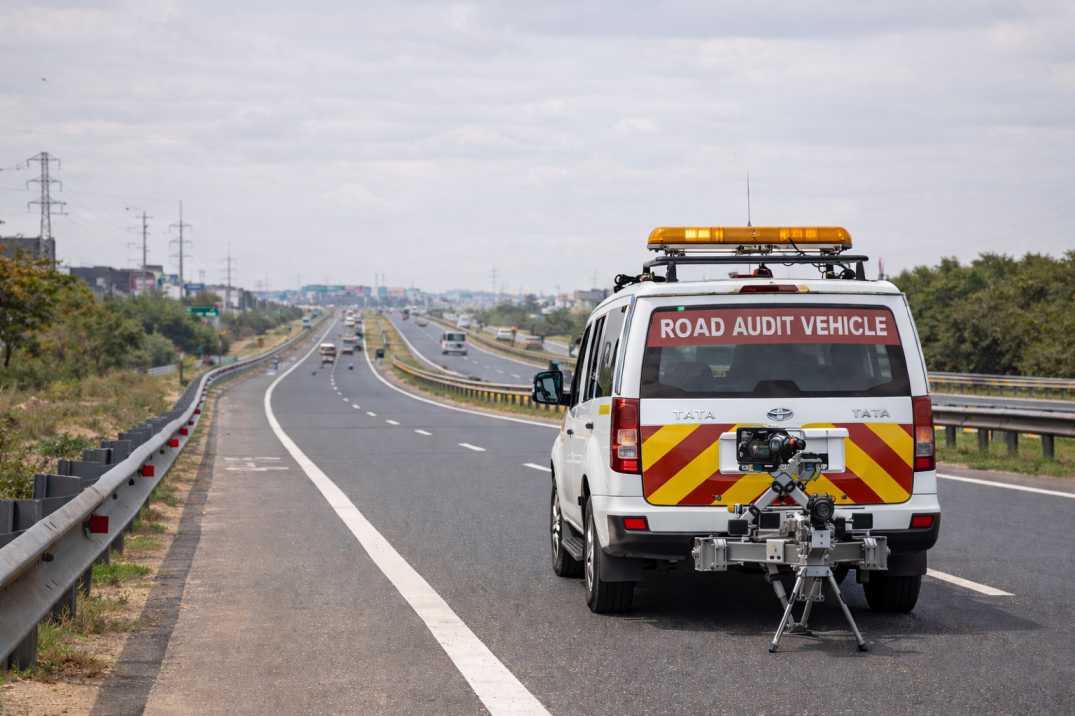
Using vehicle-mounted cameras and sensors, AI systems can continuously capture roadway data at traffic speed across entire highway corridors.
This enables smart road safety monitoring at scale.
AI automatically identifies:
This improves consistency and supports IRC-SP:72 compliance requirements more effectively.
Modern AI road safety monitoring solution platforms can automatically flag:
This significantly reduces manual inspection effort while improving audit coverage.
The result is a more scalable and proactive AI highway safety assessment process.
IRC-SP:72 places strong emphasis on vulnerable road users, especially:
AI-based systems improve visibility into real-world traffic behaviour using AI pedestrian safety systems and behavioural analytics.
These systems help auditors identify:
This supports safer urban corridors and more effective smart city road safety solution planning.
Modern AI systems go beyond static inspections by enabling:
This allows agencies to move toward predictive road safety analytics rather than relying only on historical crash data.
With sufficient corridor data, AI platforms can support:
This creates a proactive approach to infrastructure safety management.
AI can automatically assess:
This strengthens digital road risk assessment capabilities for highway agencies.
AI systems evaluate:
These functions support continuous road safety compliance monitoring system workflows.
AI can identify:
This enables more accurate road hazard mapping software outputs and safer roadway environments.
RoadVision AI enables scalable and repeatable safety audits aligned with Indian road safety standards through its integrated AI-driven platform.
The platform supports:
Using computer vision and digital twin technology, RoadVision AI strengthens AI-based infrastructure safety management for highways, urban roads, and smart mobility corridors.
Its integrated ecosystem combines:
This creates a comprehensive data driven road safety solution for authorities and consultants.
AI-driven safety audits become even more powerful when integrated with broader infrastructure management systems.
For example:
This creates a unified infrastructure safety analytics ecosystem where safety and maintenance decisions are connected through real-time data.
While AI offers significant advantages, implementation must remain engineer-led and standards-compliant.
Key considerations include:
The best outcomes come from combining professional engineering expertise with intelligent AI-assisted analytics.
IRC-SP:72 provides India with a strong framework for conducting road safety audits across the entire road project lifecycle.
By integrating AI road safety inspection technologies into this framework, authorities can significantly improve:
AI platforms now enable agencies to:
RoadVision AI is helping modernize highway safety and autonomous road safety workflows in India through intelligent analytics, digital twin inspections, and AI-driven audit systems aligned with IRC-SP:72.
If you are looking to modernize your road safety audit process while remaining fully compliant with Indian standards, book a demo with RoadVision AI and explore how AI can support safer, smarter roads across India.
No. AI supports auditors by improving data collection, risk detection, and reporting efficiency, while engineering judgement remains essential.
Yes. AI is highly effective for operational-stage audits where continuous monitoring and periodic reassessment are important.
AI improves consistency, corridor coverage, hazard documentation, and safety analytics while helping audit teams identify risks more systematically.
The Autonomous Road Engineer
AI-powered road condition monitoring, asset management, & infrastructure intelligence helping agencies move from reactive maintenance to predictive road management.


.webp)
.webp)
.webp)