

AI road condition monitoring Mexico — NIT-SICT compliant pavement inspection, CAPUFE concession verification, and USMCA freight corridor intelligence for SICT, state Secretarías de Obras Públicas, and private road concessionaires managing Latin America's largest highway network.
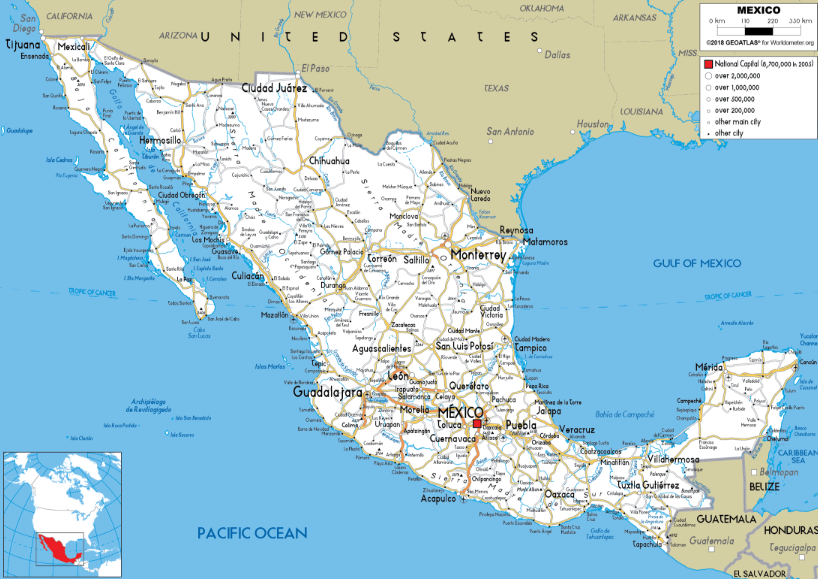
The cuota network is condition-managed and data-rich. The red libre — carrying the bulk of Mexico's population and freight — has almost none of that. Mexico highway asset management AI brings the same data discipline to the free network at a fraction of traditional survey cost.
Outputs built for Mexican road engineering practice — every condition index, distress classification, and report format configured to the relevant SICT national technical standard or NOM specification, not adapted from US or European templates.
Distress outputs and condition indices mapped directly to NIT classification codes for seamless SICT programme reporting. Carretera federal and state highway outputs formatted per SICT submission requirements.
Network-scale IRI aligned to SICT thresholds: Good <2.5 m/km | Fair 2.5–4.5 | Poor >4.5 m/km. Climate-zone adjustment applied across tropical (Gulf, Pacific), arid (Sonora, Chihuahua), highland (CDMX, Puebla), and semi-arid (Bajío) zones.
Full ASTM D6433-equivalent distress detection for Mexican pavement types — alligator cracking, rutting, potholes, raveling, bleeding — generating PCI scores aligned with SICT and state SOP PMS practice.
Independent third-party IRI and condition verification for SICT concession oversight — monthly compliance dashboards against contractual IRI thresholds, penalty trigger alerts, and dispute evidence packages.
Traffic classification calibrated to NOM-012-SCT-2 vehicle categories and axle load equivalencies. ESAL accumulation modelling for USMCA freight corridors benchmarked against original structural design assumptions.
Condition data outputs structured for SNIT schema compatibility — enabling direct integration with SICT's national road information system and PM Infraestructura GIS platforms.
Pre/post disaster condition evidence formatted for FONDEN emergency funding applications — satellite damage detection within hours of a hurricane, earthquake, or tropical storm landfall.
Climate Zone Calibration: Coastal Veracruz degrades differently from highland Toluca or desert Sonora. RoadVision AI applies zone-specific IRI deterioration curves — tropical, arid, semi-arid, highland, sub-humid — reflecting actual Mexican performance.
AI-powered road inspection Mexico — six agents covering every major workflow, from NIT-SICT compliant carretera federal reporting and state SOP PMS integration to CAPUFE concession compliance, USMCA corridor freight analytics, and FONDEN post-disaster documentation.
Network-scale IRI and PCI from dashcam or LiDAR — NIT-SICT condition classification, climate-zone calibrated per region
Network-scale IRI and PCI from dashcam or LiDAR — NIT-SICT condition classification, climate-zone calibrated per region
NIT-SICT distress codes; SICT IRI thresholds; SNIT schema-compatible export; state SOP PMS integration
Dashcam video or LiDAR — no specialist survey vehicle required; scalable across red libre, state, and rural roads
MXN $80–$200/lane-km vs. MXN $600–$1,800 for traditional carretera federal survey
Monthly updates replace biennial inspection cycles — post-hurricane and post-earthquake rapid assessment enabled
Continuous independent IRI monitoring for SICT concession corridors — CAPUFE and private operator networks
Continuous independent IRI monitoring for SICT concession corridors — CAPUFE and private operator networks
IRI thresholds aligned to SICT concession contract performance obligations and penalty trigger conditions
Monthly compliance dashboards — contractual breach alerts, penalty justification evidence, and dispute documentation packages
State and municipal roads across all 32 states and CDMX — including under-resourced agencies in Guerrero, Oaxaca, and Chiapas
State and municipal roads across all 32 states and CDMX — including under-resourced agencies in Guerrero, Oaxaca, and Chiapas
NIT-SICT compatible; state SOP PMS integration; SNIT data layer output; PM Infraestructura GIS-ready
Condition evidence structured for SICT capital programme submissions and state maintenance budget allocations
Satellite road damage detection within hours of a Pacific or Atlantic hurricane landfall, earthquake, or tropical flooding event
Satellite road damage detection within hours of a Pacific or Atlantic hurricane landfall, earthquake, or tropical flooding event
Gulf Coast (Veracruz, Tabasco), Pacific corridors (Guerrero, Oaxaca, Jalisco), seismic zones (CDMX, Puebla, Oaxaca)
FONDEN emergency funding documentation — pre/post condition evidence, road closure mapping, and damage extent quantification generated simultaneously with field response
Monterrey–Laredo, Querétaro–El Paso, Guadalajara–Nogales, CDMX–Veracruz — Mexico's primary USMCA export corridors
Monterrey–Laredo, Querétaro–El Paso, Guadalajara–Nogales, CDMX–Veracruz — Mexico's primary USMCA export corridors
Continuous ESAL accumulation modelling vs. structural design assumptions; NOM-012-SCT-2 axle load compliance monitoring
Predictive structural failure alerts before visible surface distress; freight corridor condition reports for SICT and industry
Computer vision — pavement condition, roadside geometry, signage compliance, line marking degradation, sight distance, accident blackspot correlation
Computer vision — pavement condition, roadside geometry, signage compliance, line marking degradation, sight distance, accident blackspot correlation
SICT road safety methodology; Mexico Road Safety Decade commitments; iRAP methodology for federal programme submissions
High-accident location scoring at network scale; countermeasure prioritisation evidence for SICT safety programme and state SOP budget submissions
Traditional carretera federal surveys at MXN $600–$1,800 per lane-km are unaffordable at annual frequency across 820,000 km. AI-powered road inspection Mexico changes the unit economics for every tier of the network.
Structured for Ley de Adquisiciones compliance, SICT procurement timelines, SNIT data integration, and delivery through certified Mexican integrador partners.
Benchmark AI outputs against your existing SICT or state SOP PMS data.
Full SICT, state SOP, or CAPUFE concession corridor coverage with monthly updates.
Predictive scheduling replaces biennial survey contracts as primary condition evidence.
Procurement: Available as professional services or SaaS subscription, structured for Ley de Adquisiciones compliance and SICT procurement processes. Deliverable through certified Mexican integrador partners. CompraNet-compatible documentation.
Whether you manage federal highways for SICT, a state road network across 32 SOPs, a CAPUFE concession corridor, or Mexico's USMCA export routes — book a demonstration scoped to your NIT-SICT standards, your SNIT reporting requirements, and your network tier. Includes CAPUFE concession road monitoring AI and pavement management software Mexico.

The Autonomous Road Engineer
AI-powered road condition monitoring, asset management, & infrastructure intelligence helping agencies move from reactive maintenance to predictive road management.
RoadVision AI Private Limited,
Office No. 308 & 310, B Block, Ansal
Chamber - 1, Bhikaji Cama Place,
Near Engineers India Limited (EIL)
Bhawan, New Delhi - 110066


