
Modern roadway networks demand deeper insight than what traditional visual inspections or manual surveys can provide. As traffic volumes rise and pavement structures age, road authorities require precise, real-time understanding of pavement strength to plan efficient maintenance.
This is where the integration of Falling Weight Deflectometer (FWD) data with artificial intelligence becomes a game-changing advancement. By blending structural testing with AI-powered analytics, agencies can evaluate pavement behavior with unprecedented accuracy. As the old saying goes, "You can't fix what you can't measure," and with AI, measurement becomes faster, sharper, and more meaningful.
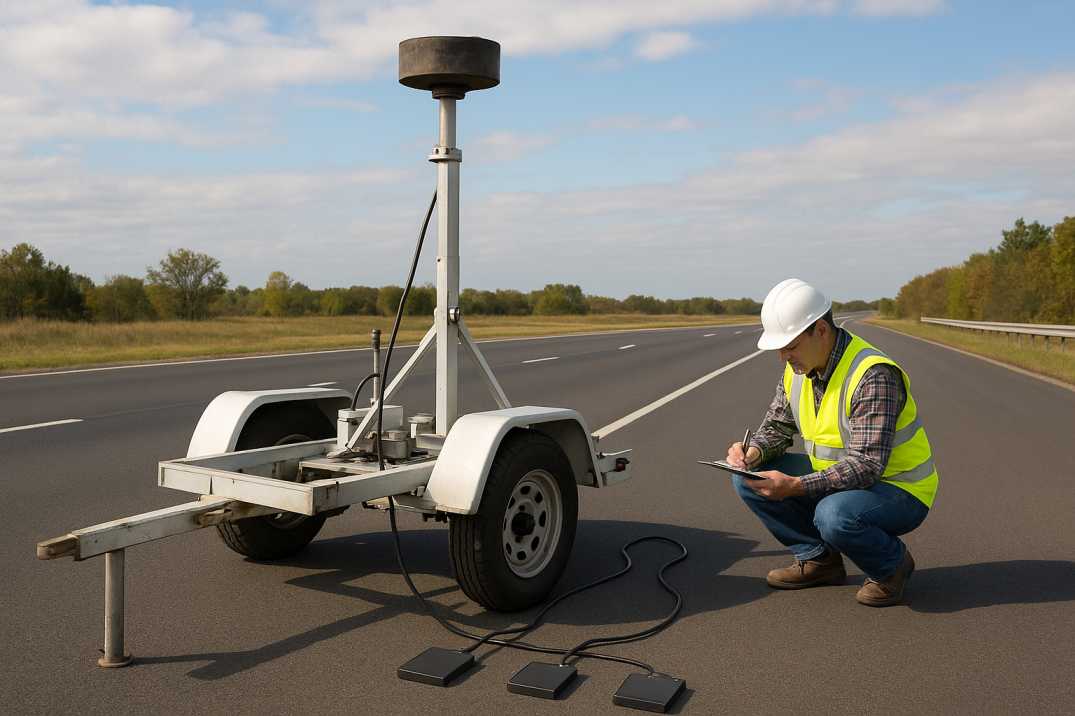
Traditional FWD surveys provide crucial information about pavement stiffness and structural capacity, but interpreting this data manually is labor-intensive, time-consuming, and dependent on expert judgment. Combining AI with FWD data unlocks several advantages:
This fusion supports long-term pavement preservation strategies aligned with guidelines issued by the Indian Roads Congress, which emphasize accurate strength evaluation and timely interventions for durable pavements.
2.1 What Is FWD Testing?
FWD testing applies an impulse load to the pavement surface and measures the resulting deflection basin using multiple sensors. This non-destructive testing method reveals:
2.2 Key FWD Parameters
2.3 FWD Testing in IRC Standards
IRC guidelines specify:
Although IRC guidelines (such as those under the Indian Roads Congress framework) focus primarily on non-destructive testing and strength-based maintenance decisions, several foundational principles directly support AI–FWD integration:
3.1 Structural Capacity Assessment
IRC emphasizes understanding pavement layer moduli, subgrade strength, and load transfer ability to guide maintenance decisions through the Pavement Condition Intelligence Agent.
3.2 Data-Driven Rehabilitation Planning
Standards require engineering judgment supported by measured deflection data rather than surface condition alone.
3.3 Consistency in Testing and Interpretation
Uniform testing procedures and calibrated equipment ensure reliable, comparable FWD results across projects and regions.
3.4 Priority-Based Maintenance
Pavement sections must be evaluated based on severity, traffic demand, and remaining life—an area where AI excels through the Traffic Analysis Agent.
3.5 Lifecycle Optimization
Structural evaluation should inform long-term preservation strategies, not just immediate rehabilitation.
These principles lay the groundwork for a future where structural testing, automated analysis, and predictive insights work hand in hand.
4.1 Manual Workflow
4.2 Limitations
RoadVision AI integrates advanced analytics, AI algorithms, and real-time pavement monitoring tools through its integrated suite of AI agents to transform how FWD data is used. Its platform automates structural evaluation while maintaining strict alignment with IRC-based methodologies.
5.1 Automated Back-Calculation of Pavement Layer Moduli
The Pavement Condition Intelligence Agent processes FWD deflection basins instantly—removing manual iterations and increasing accuracy by:
5.2 Intelligent Anomaly Detection
Machine learning through the Pavement Condition Intelligence Agent flags inconsistencies in readings caused by:
5.3 Predictive Structural Deterioration Modeling
The Pavement Condition Intelligence Agent forecasts remaining pavement life based on:
5.4 Integrated Digital Road Monitoring
FWD data is combined through the Roadside Assets Inventory Agent with:
—creating a unified digital twin of the network that links structural and functional condition.
5.5 Automated Maintenance Recommendations
The system identifies structurally weak segments and recommends optimal maintenance—overlay, rehabilitation, or strengthening—based on IRC principles, including:
5.6 Network-Level Structural Assessment
AI enables:
Together, these best practices ensure authorities make informed, timely, and cost-effective maintenance decisions.
6.1 Pattern Recognition
AI identifies patterns in deflection basins that correlate with:
6.2 Data Fusion
Integration of multiple data sources reveals:
6.3 Predictive Analytics
Machine learning forecasts:
6.4 Uncertainty Quantification
AI provides confidence intervals for predictions, supporting:
Despite its clear advantages, the path to fully automated structural evaluation poses several hurdles:
7.1 Data Standardization
FWD data from different contractors or regions varies in format and calibration. AI requires normalized, consistent datasets for accurate analysis.
AI Solution: Standardized data ingestion through RoadVision AI ensures consistency.
7.2 Environmental Influences
Temperature, moisture, and seasonal variations affect pavement deflection, requiring AI correction models for accuracy.
AI Solution: Climate-correction algorithms account for environmental factors.
7.3 High Initial Deployment Cost
Integrating AI platforms, IoT systems, and digital monitoring tools requires upfront investment—but long-term operational savings through extended pavement life and reduced emergency repairs are substantial.
AI Solution: Scalable deployment demonstrates ROI through lifecycle savings.
7.4 Model Validation and Continuous Learning
AI predictions must be routinely validated against real-world performance, ensuring reliability and trust among engineers.
AI Solution: Continuous validation loops improve model accuracy over time.
7.5 Data Volume Management
Network-level FWD testing generates large datasets requiring efficient processing.
AI Solution: Cloud-based processing through RoadVision AI scales with data volume.
7.6 Equipment Variability
Different FWD equipment types may produce variable results requiring calibration.
AI Solution: Equipment-specific calibration factors ensure consistency.
In short, while the road may have bumps, the destination—a smarter, more resilient pavement management ecosystem—is well worth the journey.
8.1 For Engineers
8.2 For Agencies
8.3 For Road Users
The fusion of AI with Falling Weight Deflectometer data marks a turning point in pavement engineering. Instead of relying solely on visual distress or manual interpretation, agencies can now leverage:
The platform's ability to:
transforms how structural pavement evaluation is approached.
As the proverb goes, "Knowledge is power." When FWD data is enhanced with AI intelligence through RoadVision AI, that power translates into safer, longer-lasting, and more cost-efficient roads.
RoadVision AI is leading the charge—bringing automated pavement strength assessment, digital monitoring, and AI-driven road asset management into a single integrated ecosystem through the Pavement Condition Intelligence Agent, Traffic Analysis Agent, and Roadside Assets Inventory Agent. By enabling early detection of subsurface weaknesses and aligning with IRC standards, RoadVision AI empowers engineers to plan smarter, reduce risk, and build resilient infrastructure.
To explore how AI–FWD data fusion can strengthen your pavement evaluation and maintenance strategies, book a demo with RoadVision AI today and step into the future of intelligent road management.
Q1. What is the role of FWD in pavement assessment?
FWD helps measure pavement deflection under simulated traffic loads, revealing structural strength and subgrade performance without damaging the surface.
Q2. How does AI improve pavement monitoring?
AI automates FWD data interpretation, identifies hidden structural issues, predicts pavement deterioration, and supports timely maintenance decisions.
Q3. Can AI-based systems replace traditional inspections?
Not entirely. Instead, AI enhances traditional inspections by merging structural data with surface-level condition data for comprehensive insights.

The Autonomous Road Engineer
AI-powered road condition monitoring, asset management, & infrastructure intelligence helping agencies move from reactive maintenance to predictive road management.


.webp)
.webp)
.webp)