
Across the UK, temporary traffic management zones are a daily reality. Roadworks, utility maintenance, resurfacing programmes, and infrastructure upgrades frequently require lane closures, pedestrian diversions, and temporary crossings.
While these works are essential, they also introduce heightened safety risks — particularly for vulnerable road users. Narrowed carriageways, reduced visibility, temporary barriers, and informal pedestrian movements can significantly increase the likelihood of pedestrian–vehicle conflicts.
Ensuring safety in these environments is a priority under guidance from National Highways, local highway authorities, and regulations governing temporary street works.
Today, AI-based traffic safety and survey solutions are transforming how these risks are identified and managed, enabling proactive interventions before incidents occur.
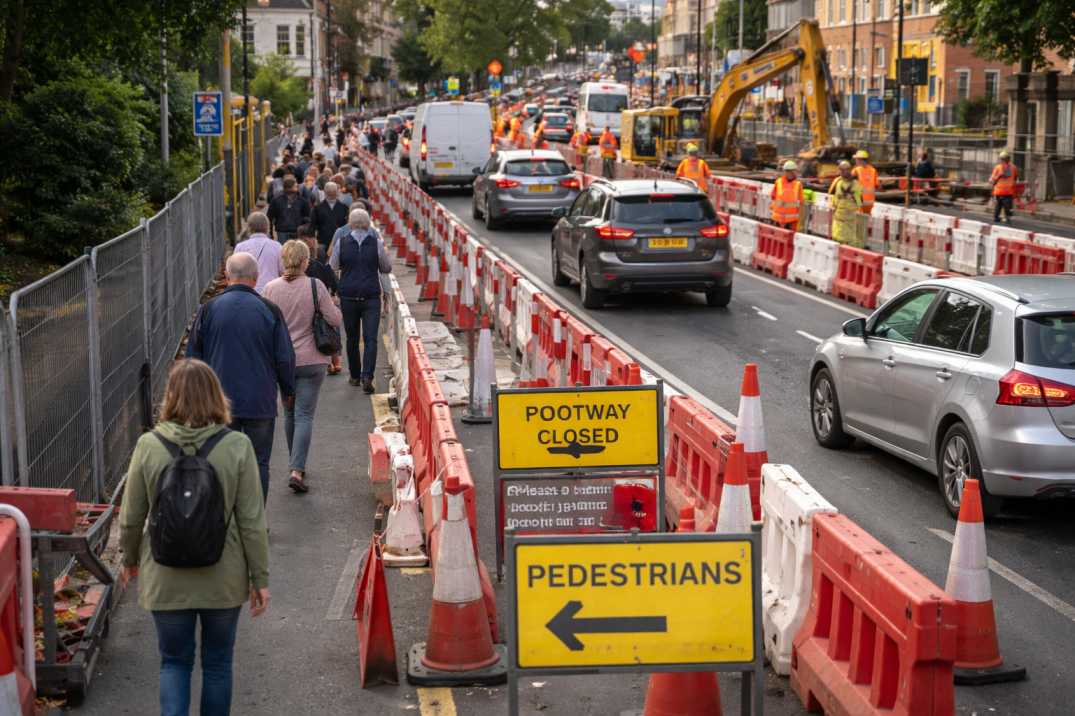
Temporary traffic management zones often disrupt the usual relationship between pedestrians and vehicles.
In busy urban areas, pedestrians may face:
At the same time, drivers must navigate altered lane widths, temporary speed restrictions, and unfamiliar road geometry.
These conditions create a high-risk environment where conflict points can emerge quickly — even when layouts are technically compliant.
2.1 Types of Work Zones
2.2 Pedestrian Considerations
2.3 Vehicle Considerations
Conventional work zone safety assessments typically rely on:
While these approaches remain important, they often struggle to capture real-world behaviour.
Human observation is limited in its ability to detect:
As a result, many risks remain hidden until a serious incident occurs.
This is where AI through the automated road safety survey ntroduces a step change in automated traffic safety analysis.
AI-powered pedestrian safety platforms through the Traffic Analysis Agent analyse continuous video data collected through temporary cameras or mobile survey vehicles.
These systems automatically detect and track:
Using trajectory modelling and speed profiling, AI identifies locations where pedestrian and vehicle movements intersect unsafely.
Indicators such as:
are flagged as potential conflict points.
This forms the foundation of AI-based road work zone safety analysis, supporting early risk identification before accidents occur.
One of AI's key advantages through the Traffic Analysis Agent is its ability to analyse behaviour rather than relying solely on planned geometry.
In many UK work zones, pedestrians do not always follow the official diversion route. If crossings feel inconvenient or unsafe, people naturally create informal "desire lines."
AI systems capture these informal movements and highlight where:
This insight enables smarter decisions within a modern traffic management system, such as adjusting signage placement, relocating crossings, or improving pedestrian segregation.
6.1 Crossing Conflicts
IndicatorDescriptionRisk LevelMid-block crossingCrossing outside designated pointsHighWait time > 60 secondsImpatient crossingModerateCrossing near heavy vehiclesLimited visibilityCriticalNight crossingReduced visibilityHigh
6.2 Footpath Conflicts
IndicatorDescriptionRisk LevelNarrow walkwaysInsufficient widthModerateShared spaceNo separation from trafficHighObstructionsBarriers, cones, equipmentModerateStepped surfacesTrip hazardsLow to moderate
6.3 Vehicle Behaviour
IndicatorDescriptionRisk LevelSpeeding through work zoneReduced reaction timeCriticalLate brakingDriver surpriseHighLane encroachmentNear pedestrian areasHighQueue jumpingAggressive behaviourModerate
UK guidance, including the Traffic Signs Manual and the Safety at Street Works and Road Works Code of Practice, places strong emphasis on protecting vulnerable road users during temporary works.
Key requirements include:
AI outputs directly support these principles by providing measurable evidence of risk exposure.
Through AI-supported road safety audit workflows via the Road Safety Audit Agent, engineers can validate whether temporary layouts achieve safety objectives under UK standards — strengthening compliance while reducing reliance on subjective judgement alone.
AI insights through the Traffic Analysis Agent are increasingly valuable across both planning and operational stages of temporary works.
Before deployment, historical behavioural data can help predict how pedestrians and vehicles are likely to interact with proposed layouts.
During active works, real-time monitoring enables rapid identification of emerging risks caused by:
Integration with road inventory inspection systems through the Roadside Assets Inventory Agent ensures that barriers, cones, and signage remain correctly positioned throughout the works.
By identifying conflict points early, AI through the Road Safety Audit Agent enables authorities to act before accidents occur.
Predictive analytics highlight which locations are most likely to experience unsafe interactions based on:
This shifts safety management from reactive incident response to proactive risk prevention.
When combined with digital traffic survey data from the Traffic Analysis Agent, AI supports continuous improvement across temporary traffic management schemes.
Insights from temporary work zones also contribute to long-term road asset management strategies.
Repeated conflict patterns may indicate underlying design issues that require permanent upgrades, such as:
When linked with pavement condition surveys through the Pavement Condition Intelligence Agent and wider network data, AI helps agencies understand how maintenance activities impact safety and user behaviour across the road lifecycle.
RoadVision AI delivers advanced AI-driven analysis for traffic safety, pedestrian monitoring, and conflict detection in temporary traffic management environments through its integrated suite of AI agents.
Through its integrated platforms, authorities can conduct detailed automated traffic safety assessments without disrupting live traffic operations.
RoadVision AI supports:
As the UK continues investing in major infrastructure renewal, the number of temporary traffic management zones will remain high.
AI will play a central role in ensuring these environments remain safe, adaptive, and compliant.
By combining behavioural intelligence, continuous monitoring, and regulatory alignment through RoadVision AI, AI enables a safer approach to managing temporary road environments for everyone.
AI is redefining how pedestrian–vehicle conflict points are identified in UK temporary traffic management zones through the Traffic Analysis Agent and Road Safety Audit Agent.
The platform's ability to:
transforms how pedestrian safety is managed during temporary works.
Through intelligent analysis of real movement patterns, AI enhances pedestrian safety, strengthens compliance, and reduces risk in complex work environments.
RoadVision AI is helping transport authorities modernise road maintenance and safety operations through intelligent traffic surveys and real-time analytics, ensuring alignment with UK road standards and best practices.
If you are looking to improve safety outcomes in temporary traffic management zones, book a demo with RoadVision AI today and discover how intelligent analytics can support safer road operations.
Q1. How does AI improve pedestrian safety in UK road work zones?
AI detects real movement patterns and near misses, allowing engineers to identify conflict points that are often missed during manual inspections.
Q2. Can AI support compliance with UK temporary traffic management standards?
Yes, AI outputs provide measurable safety insights that align with UK road safety and street works guidance.
Q3. Is AI suitable for both urban and rural work zones?
AI based systems can be deployed across urban streets and high speed rural highways, adapting to different traffic and pedestrian conditions.
The Autonomous Road Engineer
AI-powered road condition monitoring, asset management, & infrastructure intelligence helping agencies move from reactive maintenance to predictive road management.


.webp)
.webp)
.webp)