
India's highways and urban road networks are under continuous pressure due to rapid urbanisation, economic expansion, and rising vehicle ownership. As traffic volumes grow and travel patterns become more complex, accurate forecasting has become essential for sustainable highway planning.
Effective road asset management in India depends heavily on traffic engineering parameters such as:
Traditionally, these values have been estimated using manual surveys and static assumptions. However, such approaches often fail to capture real-world variability, leading to infrastructure that is either under-designed or over-designed.
With the evolution of automated traffic survey systems and artificial intelligence through the Traffic Analysis Agent, traffic forecasting is moving towards a more data-driven, regulation-aligned approach. AI enables engineers to strengthen compliance with IRC standards while significantly improving speed, accuracy, and reliability.
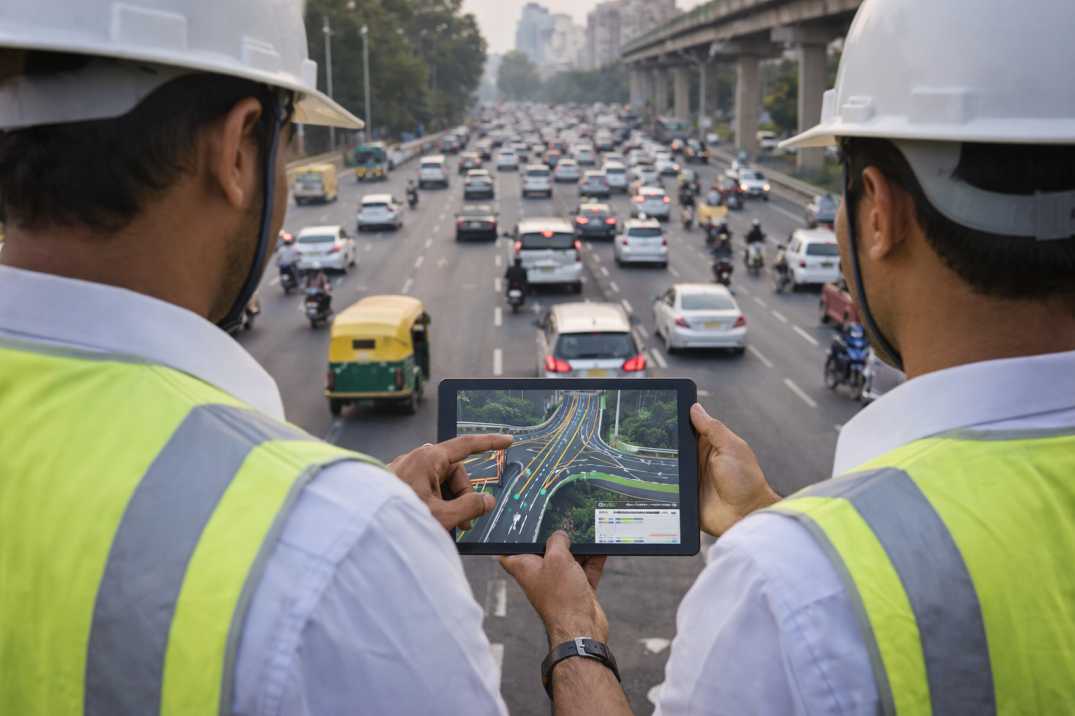
IRC-SP:16 provides India's primary guidelines for:
It forms the backbone of key planning activities such as:
Two of the most critical outputs under IRC-SP:16 are:
Peak Hour Factor (PHF)
PHF represents the variation of traffic flow within the peak hour and helps define actual design demand. It is calculated as:
*PHF = Peak Hour Volume / (Peak 15-minute Volume × 4)*
Traffic Growth Prediction
Growth rates influence design life assumptions, future widening needs, and long-term capacity augmentation.
When these parameters are inaccurate, projects face congestion, premature pavement distress, and increased safety risks. This is where AI-based traffic analysis through the Traffic Analysis Agent becomes a game changer.
2.1 What PHF Represents
2.2 Typical PHF Values
Road TypeTypical PHFCharacteristicsUrban arterials0.90-0.95Steady flow, multiple peaksSuburban roads0.85-0.90Commuter peaksRural highways0.70-0.85Variable, lower peaksRecreational routes0.65-0.80Seasonal peaks
2.3 Factors Affecting PHF
Manual and semi-automated surveys still widely used across Indian road projects face several challenges:
These limitations directly impact the quality of IRC-SP:16 traffic analysis, making long-term planning less resilient.
AI through the Traffic Analysis Agent eliminates many of these gaps by analysing real traffic behaviour continuously rather than relying on isolated observations.
AI-powered systems through the Traffic Analysis Agent process continuous traffic data collected through:
Instead of relying on fixed peak hour windows, AI dynamically identifies true peak periods based on actual flow patterns.
This allows engineers to compute PHF values that reflect:
Through automated traffic survey platforms, AI ensures Peak Hour Factor calculations remain aligned with IRC-SP:16 definitions while improving confidence in design inputs.
RoadVision AI platforms automatically:
5.1 Vehicle Categories
ClassVehicle TypePHF Influence1Cars, jeeps, taxisHigh during commuter peaks2BusesSchool and office peaks3Two-wheelersSchool, office, and evening peaks4Auto-rickshawsVariable, often high during peak5Light commercial vehiclesMid-day peaks6Trucks (multi-axle)Night and off-peak movement
5.2 PCU (Passenger Car Unit) Factors
AI continuously updates PCU factors based on observed behaviour rather than static tables, improving capacity analysis accuracy.
Traditional traffic growth prediction methods often rely on:
However, India's mobility patterns are influenced by multiple evolving factors such as:
AI-based traffic demand forecasting models through the Traffic Analysis Agent learn from multiple datasets, enabling scenario-based growth simulations rather than fixed assumptions.
This approach supports IRC-SP:16 requirements while improving long-term investment decisions.
With AI, engineers can test:
This reduces the risk of under-designing or over-designing highway infrastructure.
7.1 Economic Growth Factors
7.2 Demographic Factors
7.3 Infrastructure Factors
7.4 Policy Factors
Accurate traffic forecasting strengthens road asset management India by aligning infrastructure investments with realistic demand.
AI-derived traffic projections through the Traffic Analysis Agent help optimise:
When traffic forecasts integrate with:
authorities gain a unified digital framework for proactive network management.
A major advantage of AI adoption is that it can operate fully within regulatory frameworks.
AI models can be trained to follow IRC definitions for:
Outputs generated through AI-based traffic volume analysis can be structured to match IRC-SP:16 reporting formats, ensuring acceptance by:
AI-driven traffic forecasting through the Traffic Analysis Agent does not operate in isolation. It strengthens broader infrastructure workflows such as:
When traffic growth insights feed into AI-based road safety audit systems, planners can proactively address accident risks that emerge due to demand mismatches.
This marks India's transition from reactive planning to predictive infrastructure development.
While AI offers strong benefits, implementation requires careful planning:
The best outcomes come from combining AI automation through RoadVision AI with engineering expertise.
AI-based Peak Hour Factor estimation and Traffic Growth Prediction aligned with IRC-SP:16 through the Traffic Analysis Agent represents a critical shift in Indian highway planning.
The platform's ability to:
transforms how traffic forecasting is approached across India.
By combining regulatory compliance with intelligent automation, AI enables:
RoadVision AI is transforming road infrastructure development and maintenance through advanced computer vision, digital twin models, and AI-driven traffic survey solutions. Focused on full compliance with IRC Codes, the platform empowers engineers and decision-makers with data-backed insights that improve road safety, reduce costs, and enhance long-term transportation efficiency.
Book a demo with RoadVision AI today to explore how intelligent traffic forecasting can modernise your highway projects through data-driven IRC compliance.

The Autonomous Road Engineer
AI-powered road condition monitoring, asset management, & infrastructure intelligence helping agencies move from reactive maintenance to predictive road management.


.webp)
.webp)
.webp)