
Urban mobility in Doha has transformed rapidly over the last decade. High-capacity corridors, multilane junctions, signalised intersections, and modern roundabouts now accommodate complex traffic movements throughout the day.
While Qatar has invested heavily in advanced road infrastructure, junction safety remains one of the most critical challenges in urban traffic management. Traditional crash-based safety audits often fail to capture the full spectrum of risk, particularly in fast-growing cities where traffic behaviour evolves quickly.
This is where road asset management in Doha is being strengthened through AI-driven road safety surveys and conflict point analysis, enabling proactive, data-led junction safety improvements across the city.
Rather than waiting for accidents to occur, AI allows authorities to identify unsafe interactions in real time and enhance intersection safety through modern automated assessment.
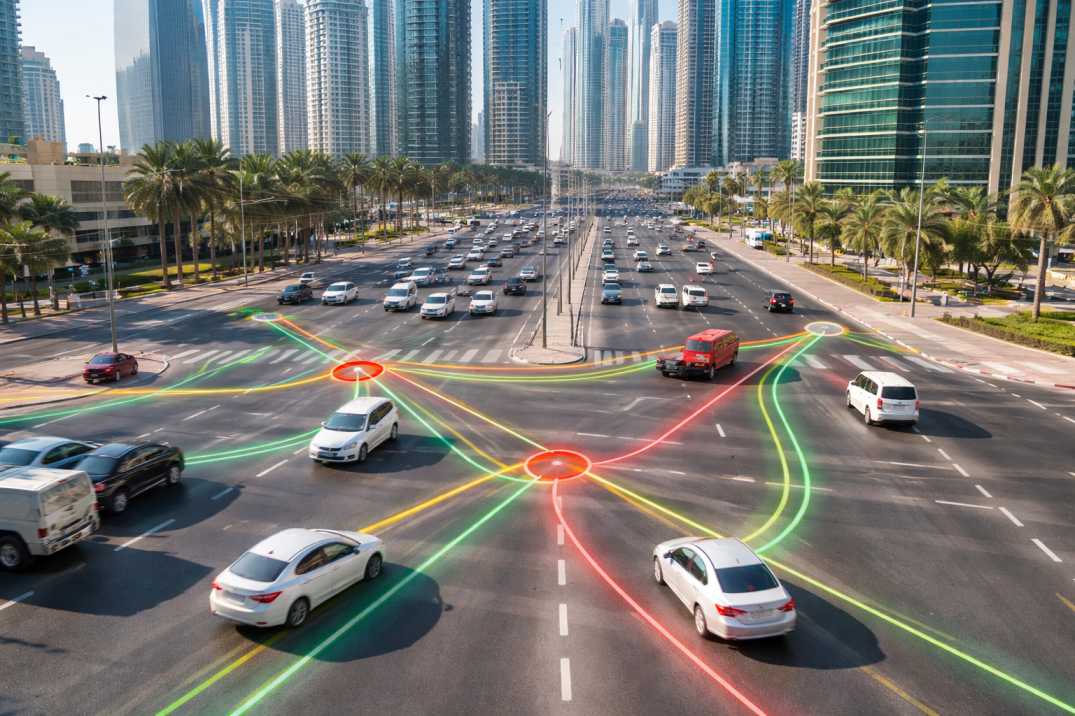
Junctions are the most complex and risk-prone components of any road network. In Doha, rapid traffic growth, diverse driver behaviour, and high operating speeds increase the likelihood of unsafe interactions — even when junction designs meet regulatory standards.
Many serious crashes are preceded by repeated near-miss events that never appear in official collision records.
Relying solely on historical crash data presents major limitations:
A proactive approach based on real-world behavioural evidence through the Road Safety Audit Agent is therefore essential for effective traffic risk assessment in Qatar's urban environment.
2.1 What Are Conflict Points?
Conflict points are locations where the paths of vehicles, pedestrians, or cyclists intersect, merge, or diverge. Each represents a potential crash scenario depending on speed, timing, and driver response.
2.2 Types of Conflicts
2.3 Common Conflict Locations in Doha
Conflict points are locations where the paths of vehicles, pedestrians, or cyclists intersect, merge, or diverge. Each represents a potential crash scenario depending on speed, timing, and driver response.
Across Doha's intersections, conflict points commonly arise from:
Traditional audits identify these conflicts through short-term manual observation, which is constrained by time, traffic variability, and human judgement.
AI-based conflict point analysis through the Road Safety Audit Agent automates this process, continuously detecting unsafe interactions with far greater accuracy and consistency.
AI-powered systems through the Traffic Analysis Agent and Road Safety Audit Agent use video feeds from junction-mounted cameras or mobile survey units. Advanced computer vision models detect and track every road user, including:
Each movement is mapped as a digital trajectory.
When trajectories come dangerously close in space and time, the system flags a conflict event and evaluates severity using parameters such as:
This enables authorities to identify near-miss behaviour long before crashes occur, forming the foundation of evidence-based junction safety planning.
5.1 Time-to-Collision (TTC)
5.2 Post-Encroachment Time (PET)
5.3 Conflict Severity
5.4 Conflict Frequency
An AI-driven road safety survey through the Road Safety Audit Agent goes far beyond short-term site visits. It enables continuous monitoring across different operational conditions, including:
For junction audits in Doha, this means safety patterns can be assessed over days or weeks instead of a few observation hours.
Engineers gain deeper insight into how behaviour shifts with traffic demand, signal timing, and congestion — resulting in more reliable safety recommendations.
Conflict-based intersection audits support engineering decisions by revealing how road users actually behave, rather than how designs assume they should behave.
AI analysis through the Road Safety Audit Agent helps identify issues such as:
These findings support targeted interventions, including:
Integrated with professional road safety audit practices, AI significantly improves audit confidence and effectiveness.
8.1 Signalised Intersections
8.2 Roundabouts
8.3 Multilane Junctions
8.4 Pedestrian Crossings
AI through the Road Safety Audit Agent transforms raw behavioural data into actionable safety intelligence. Conflict severity and frequency can be quantified, allowing agencies to prioritise junctions with the highest latent risk.
This ensures resources are allocated efficiently, focusing on:
Over time, this proactive approach leads to measurable reductions in serious collisions and strengthens public confidence in Doha's road safety strategy.
For long-term impact, conflict analytics must connect with broader infrastructure planning.
When integrated into road asset management systems in Doha through the Roadside Assets Inventory Agent, conflict point analysis becomes even more powerful by linking safety risk with:
This supports lifecycle-based investment decisions and evidence-driven safety upgrades across Qatar's urban network.
RoadVision AI enables scalable deployment of AI-based conflict point analysis through its integrated suite of AI agents across Doha's junction network.
The platform integrates:
AI-based conflict point analysis through the Road Safety Audit Agent is transforming how junction safety audits are conducted in Doha. By focusing on near-miss behaviour and operational risk, authorities can intervene before crashes occur — shifting from reactive response to proactive prevention.
The platform's ability to:
transforms how junction safety is managed across Doha's urban network.
RoadVision AI leads this transformation by delivering automated traffic safety intelligence, accurate road data, and integrated infrastructure insights aligned with Qatar's regulations and modern safety objectives.
Book a demo with RoadVision AI today to enhance junction safety planning across Doha.
Because it identifies unsafe interactions before accidents occur.
Yes AI systems analyse video data without requiring physical changes.
No it enhances audits by providing objective behavioural evidence.

The Autonomous Road Engineer
AI-powered road condition monitoring, asset management, & infrastructure intelligence helping agencies move from reactive maintenance to predictive road management.


.webp)
.webp)
.webp)