
Qatar's rapid infrastructure expansion—driven by national mobility ambitions, new economic districts and world-class roadway performance goals—has transformed its transport landscape. As highways grow wider and corridors become more complex, authorities face a mounting challenge: how to capture, validate and maintain accurate asset information at the scale modern networks demand.
Traditional, manual inventory surveys are no longer enough. With thousands of signs, lighting assets, safety devices, lane markings, drainage structures and pavement elements distributed across the country, asset monitoring must be faster, smarter and fully aligned with regulatory frameworks.
That is why modern road authorities are increasingly turning to AI-driven road asset management Qatar platforms. Tools rooted in automated detection, digital mapping, computer vision and continuous monitoring now provide far greater reliability, coverage and compliance assurance than human-led surveys ever could.
This article explains why accurate inventories matter in Qatar, how AI transforms compliance and asset mapping, the best practices used by leading platforms such as RoadVision AI, and how these innovations align with global benchmark methodologies including guidance from the Indian Roads Congress.
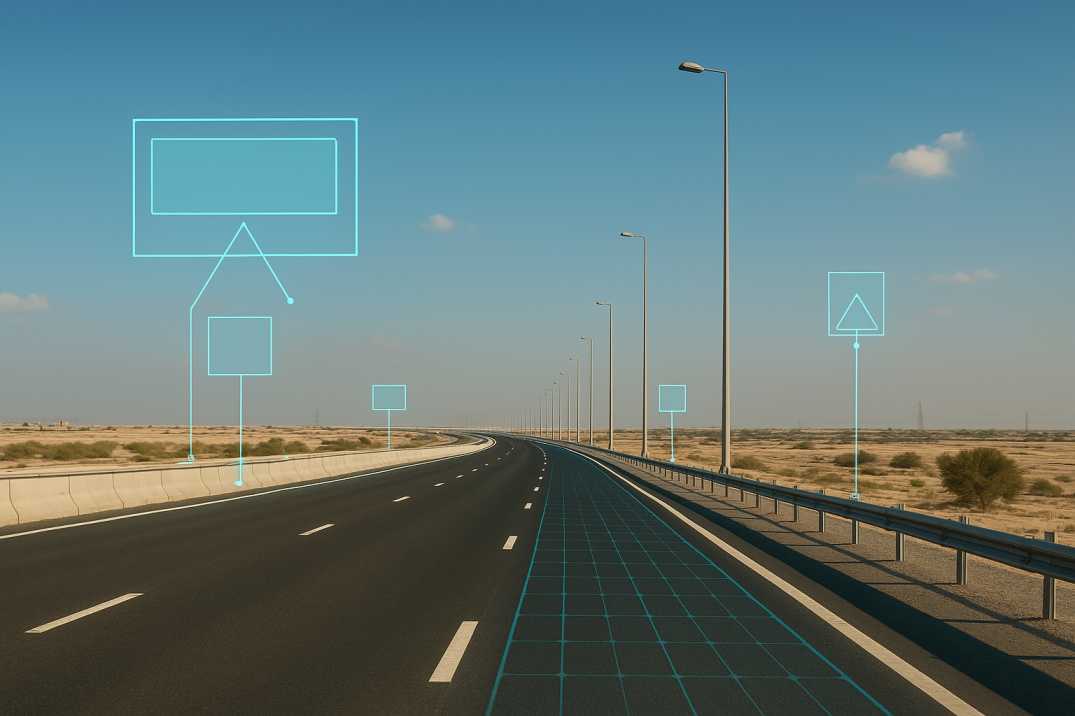
Qatar operates a transport ecosystem shaped by:
Accurate asset data is essential for:
As the network grows, manual inventory teams simply cannot keep pace. Coverage gaps widen, data ages quickly, and inconsistencies creep into classification and documentation.
AI through the Roadside Assets Inventory Agent closes this gap with continuous, high-precision, and fully auditable asset visibility.
2.1 Pavement Assets
2.2 Traffic Control Assets
2.3 Safety Assets
2.4 Structural Assets
2.5 Roadside Assets
Traditional surveys suffer from several predictable limitations:
As the old saying goes, "you can't pour new wine into old bottles." Modern networks demand modern tools.
While Qatar has strong internal road regulations, authorities frequently align with globally recognised engineering frameworks for asset documentation, safety inspections and lifecycle planning. The IRC (Indian Roads Congress) guidelines are often referenced internationally for structured road inventory, asset categorisation, maintenance planning and standardised surveying formats.
Key principles relevant to Qatar include:
4.1 Standardised Asset Documentation
Clear definitions and uniform classification systems ensure assets are recorded consistently across regions and contractors, enabling network-wide analysis.
4.2 Objective Condition Assessment
Inventory quality improves when subjective human judgement is reduced and replaced with measurable indicators through the Pavement Condition Intelligence Agent.
4.3 Continuous Network Visibility
Regular updates strengthen compliance, safety audits and lifecycle costing, ensuring decisions are based on current conditions.
4.4 Integration with Maintenance Planning
Inventory data should inform decision-making, risk ranking and rehabilitation scheduling—not just sit in a database.
4.5 Use of Technology for Efficiency
IRC frameworks emphasise leveraging modern tools—digital maps, cameras, automated detection—to improve survey quality and repeatability.
4.6 Geospatial Accuracy
Precise location data for every asset enables field maintenance, emergency response, and integration with GIS systems.
These principles align naturally with Qatar's smart-infrastructure ambitions and form the foundation on which AI-led platforms operate.
RoadVision AI uses a multi-layered, automated approach through its integrated suite of AI agents to provide a complete, real-time picture of roadway assets. Its practices mirror global engineering principles and align with Qatar's regulatory expectations.
5.1 Automated, High-Precision Asset Detection
The Roadside Assets Inventory Agent identifies signs, lighting poles, barriers, markings, guardrails, signals, drainage structures, footpaths and more with machine-learning accuracy that eliminates human error.
5.2 Creation of Digital Road Inventories
Using geotagged imagery, LiDAR, GPS and mapping algorithms, RoadVision AI builds a complete digital twin of Qatar's road assets—perfect for documentation, audits and long-term planning.
5.3 Integrated AI Road Inspection
Vehicles equipped with high-speed cameras through the Roadside Assets Inventory Agent capture thousands of images per kilometre. AI classifies conditions, detects missing assets, flags damage and identifies compliance gaps.
5.4 Spatial Intelligence for Engineering Decisions
Digital maps allow engineers to:
5.5 Strong Compliance Alignment
The system validates assets against Qatar's national regulations, municipal standards and international best practices including IRC's structured asset management principles.
5.6 Predictive Maintenance & Early Problem Detection
AI learns from historic patterns through the Pavement Condition Intelligence Agent and automatically highlights:
It shifts Qatar from reactive maintenance to proactive planning.
5.7 Integration with Asset Management Systems
All inventory data is formatted for seamless integration with existing Qatari asset management platforms, ensuring continuity with established workflows.
6.1 Expressways
6.2 Major Bridges and Tunnels
6.3 Smart Mobility Corridors
6.4 Drainage Infrastructure
While AI dramatically improves capability, organisations may still encounter obstacles:
7.1 Transitioning Legacy Records
Converting existing paper or spreadsheet records into digital formats requires careful planning and data validation.
AI Solution: Flexible import tools enable gradual migration of legacy data.
7.2 Integrating Inventory Outputs
Ensuring AI-generated data works with existing asset management systems requires standardised formats.
AI Solution: Standardised outputs through RoadVision AI ensure compatibility.
7.3 Staff Training
Teams need training to interpret AI-generated insights and incorporate them into workflows.
AI Solution: Comprehensive training programs ensure successful adoption.
7.4 Multiple Contractor Coordination
Harmonising inventory data from different contractors requires unified standards.
AI Solution: Centralized platforms ensure all stakeholders work from the same data.
7.5 Rapid Urban Expansion
New developments in Lusail and other areas require constant inventory updates.
AI Solution: Continuous monitoring captures new assets as they are installed.
7.6 Data Governance
Large-scale asset data requires appropriate security and access controls.
AI Solution: Role-based access controls and secure storage protocols.
But with structured onboarding and unified digital processes through RoadVision AI, these challenges quickly become manageable.
8.1 For Road Authorities
8.2 For Maintenance Teams
8.3 For Asset Planners
As Qatar accelerates toward a smarter, safer and more resilient transport network, AI-based asset inventory systems through the Roadside Assets Inventory Agent and Pavement Condition Intelligence Agent are no longer optional—they are essential.
The platform's ability to:
transforms how asset inventories are managed across the country.
Continuous monitoring, automated detection and predictive analytics give authorities exactly what they need:
RoadVision AI delivers all of this through intelligent detection, digital mapping and integrated dashboards designed specifically for complex, fast-growing networks like Qatar's. With its blend of global best practices, structured methodologies influenced by IRC guidance and region-specific compliance intelligence, it ensures every asset is accounted for and every decision is data-driven through the Traffic Analysis Agent and Road Safety Audit Agent.
As the saying goes, "the best time to repair the roof is before it starts raining." With AI, Qatar's authorities can spot issues early, plan confidently and build a future-ready transport ecosystem.
To experience how AI-powered asset inventories can streamline your operations, book a demo with RoadVision AI today.
AI detects signs, signals, barriers, lighting, lane markings, drainage elements, curbs, medians and other roadway features with high accuracy.
AI captures every asset systematically, compares conditions with regulatory requirements and highlights non-compliant or missing elements.
Yes. By automating inspections and predicting failures early, AI reduces unnecessary fieldwork and helps prioritise maintenance spending effectively.

The Autonomous Road Engineer
AI-powered road condition monitoring, asset management, & infrastructure intelligence helping agencies move from reactive maintenance to predictive road management.


.webp)
.webp)
.webp)