
Intersection safety is one of the most critical challenges in India's rapidly expanding road network. As urbanisation accelerates and traffic volumes grow, junctions are increasingly exposed to complex interactions between vehicles, pedestrians, cyclists, and two-wheelers.
For agencies and consultants working under road asset management in India, improving intersection safety now requires more than geometry checks and compliance reports. It demands tools that can interpret how intersections actually operate on the ground.
In this context, AI-based conflict point detection is emerging as a powerful approach to support safer IRC:65 intersection planning, enabling data-driven design decisions and measurable safety improvements.
IRC:65 provides detailed geometric and operational guidance for at-grade intersections. However, design compliance alone does not always guarantee safe outcomes. The gap between design intent and real-world behaviour is where AI intersection safety analysis delivers significant value.
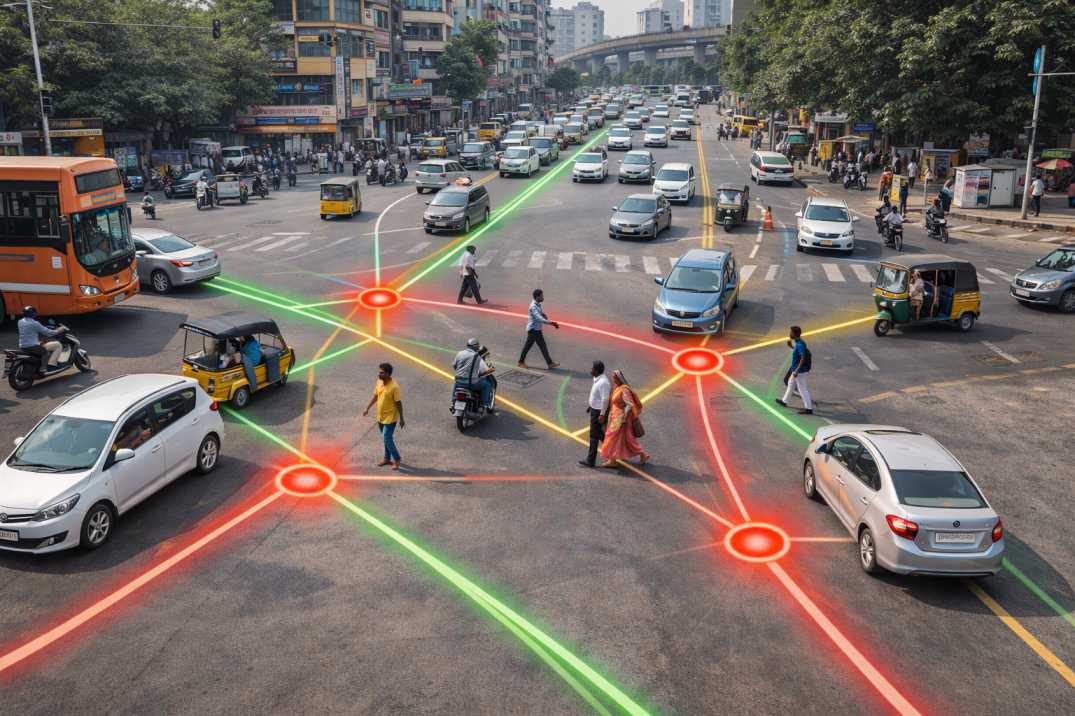
IRC:65 aims to reduce crash risk through:
Yet Indian intersections operate under mixed traffic conditions where behaviour is often unpredictable.
Even when an intersection meets geometric standards, unsafe manoeuvres such as:
continue to occur.
Addressing these risks requires moving beyond drawings and into operational performance assessment using AI-based junction safety assessment through the Road Safety Audit Agent.
Conflict points are locations where road user paths:
IRC:65 focuses on minimising both the number and severity of these interactions through layout optimisation.
However, not all conflict points carry the same level of danger. Some occur routinely without incidents, while others generate repeated near-misses that signal high crash potential.
AI-based conflict point detection through the Traffic Analysis Agent helps engineers objectively identify which interactions represent genuine safety threats, allowing interventions to be prioritised based on real risk rather than assumptions.
3.1 Crossing Conflicts
3.2 Merging Conflicts
3.3 Diverging Conflicts
3.4 Pedestrian Conflicts
3.5 Cyclist Conflicts
Conventional intersection safety reviews depend on short-duration field observations and historical crash records. In Indian conditions, this approach has major limitations:
As a result, many safety risks remain hidden until serious crashes occur.
Integrating AI into road safety audit workflows through the Road Safety Audit Agent enables continuous and unbiased evaluation of intersection performance.
AI systems through the Traffic Analysis Agent use video data captured from:
The platform detects and tracks every road user, converting movement into digital trajectories.
When two trajectories come dangerously close in time and space, the system identifies a conflict event. Key parameters such as:
are analysed to assess severity.
This forms the foundation of AI intersection safety analysis, providing measurable evidence for safer planning aligned with IRC:65 principles.
6.1 Time-to-Collision (TTC)
6.2 Post-Encroachment Time (PET)
6.3 Conflict Severity Classification
SeverityDescriptionTTCPETCriticalEvasive action required, imminent collision< 1.5s< 2sModeratePotential conflict with awareness1.5-3s2-4sMinorObservable but comfortable margin> 3s> 4s
AI does not replace IRC:65 design guidance — it strengthens its implementation.
Conflict analysis helps engineers verify whether:
These operational insights reveal design deficiencies that may not be visible in drawings, improving both new intersection design and retrofit planning.
Indian intersections carry a wide range of users with different movement patterns and speed profiles.
AI-based junction safety assessment through the Traffic Analysis Agent performs especially well in such environments by analysing all users simultaneously, including:
These insights directly support proactive safety upgrades under modern intelligent traffic safety systems.
9.1 Right-Turn Conflicts
9.2 Left-Turn Conflicts
9.3 Through Movement Conflicts
9.4 Pedestrian Conflicts
Intersection safety is closely linked to the condition and visibility of assets.
Conflict detection becomes even more effective when integrated with broader asset intelligence such as:
For example, repeated braking-related conflicts may indicate poor skid resistance, while pedestrian conflicts may reflect missing signs or ineffective barriers.
This integrated approach strengthens road asset management India by connecting safety risk directly to asset investment priorities.
Conflict frequency alone does not define intersection risk. Exposure plays a critical role.
By combining AI conflict outputs with traffic survey data from the Traffic Analysis Agent, engineers can normalise safety risk based on:
This ensures that high-risk intersections are prioritised accurately, supporting smarter funding allocation and targeted improvements.
RoadVision AI enables scalable deployment of AI-driven intersection safety solutions aligned with Indian road standards through its integrated suite of AI agents.
The platform combines:
into a unified workflow.
IRC:65 provides strong geometric and operational guidance for intersection design, but true safety depends on how junctions perform under real-world traffic behaviour.
AI-based conflict point detection through the Traffic Analysis Agent bridges this gap by revealing behavioural risks and near-miss patterns that traditional methods often miss.
The platform's ability to:
transforms how intersection safety is assessed across India.
By integrating automated intersection safety analysis into planning and audit workflows, road authorities can:
RoadVision AI is transforming infrastructure development and maintenance through advanced AI and computer vision. The platform enables proactive road safety audits, early detection of pavement defects, and intelligent traffic insights — all while ensuring compliance with IRC Codes.
Book a demo with RoadVision AI today to modernise intersection safety planning with real-world behavioural intelligence.
AI evaluates real traffic behaviour to validate design effectiveness beyond drawings.
Yes AI analyses video data without requiring physical modifications.
No AI enhances audits by providing objective and continuous safety data.
The Autonomous Road Engineer
AI-powered road condition monitoring, asset management, & infrastructure intelligence helping agencies move from reactive maintenance to predictive road management.


.webp)
.webp)
.webp)