
Across countries like India, where roads form the backbone of economic movement, pavement networks are aging faster than authorities can maintain them. For decades, the standard approach has been reactive maintenance—waiting for cracks, potholes, rutting, and structural failures to appear before repairs begin.
But today's road networks face heavier traffic, extreme climate variations, and limited maintenance budgets. As the old saying goes, "A stitch in time saves nine," and nowhere is this truer than in pavement management.
With AI-driven pavement inspection and predictive modelling, the future shifts from damage control to damage prevention.
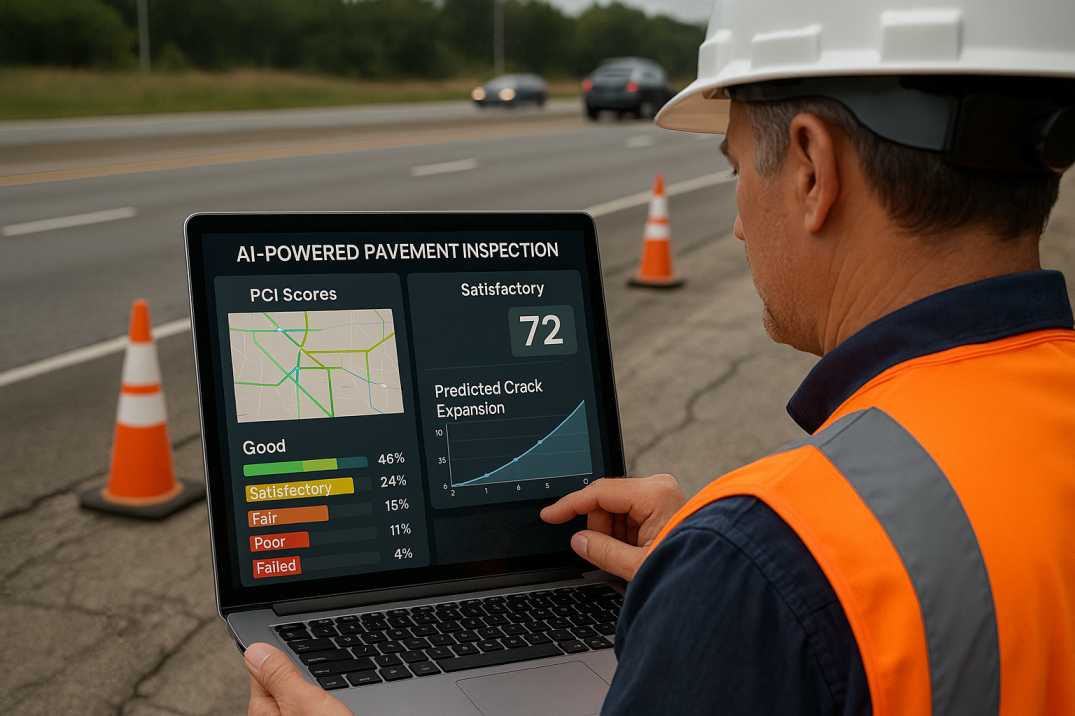
Historically, pavement inspection involved:
This approach misses early-stage issues such as microcracks, moisture intrusion, and deformation trends. The consequences include:
Reactive maintenance is no longer sustainable for growing economies—or safe for road users.
Artificial Intelligence revolutionizes road asset monitoring by shifting from subjective, intermittent checks to continuous, objective assessments.
Platforms like RoadVision AI use:
AI can detect:
And most importantly—AI predicts where failures will occur next, enabling proactive intervention.
Even though pavement management is evolving globally, India's national standards remain benchmark references for systematic inspection. The Indian Roads Congress (IRC) outlines core principles that guide effective pavement evaluation:
3.1 IRC:82 — Measuring Surface Distress
Focus on severity, density, and progression of cracks, potholes, and deformation across all road categories.
3.2 IRC:SP:16 — Pavement Strength Evaluations
Assessment of structural adequacy and overlay requirements for strengthening deteriorated sections.
3.3 IRC:SP:76 — Guidelines for Surface Characteristics
Evaluation of skid resistance, roughness, and riding quality affecting user safety and comfort.
3.4 IRC:SP:99 — Road Safety Audits
Identify hazards linked to poor pavement condition, especially at blackspots and high-risk locations.
AI helps automate and standardize compliance with these IRC principles, dramatically reducing errors and time delays while ensuring consistency across networks.
The Pavement Condition Intelligence Agent transforms reactive maintenance into predictive asset management.
4.1 Automated Pavement Surveys
RoadVision AI captures high-resolution roadway imagery using smartphones, dashcams, or drones deployed on existing fleet vehicles. AI algorithms detect, classify, and quantify each defect according to IRC-aligned severity levels without human intervention.
4.2 PCI-Based Condition Scoring
The system automatically generates Pavement Condition Index (PCI) scores segment by segment, enabling agencies to prioritize sections that require treatment based on objective data rather than subjective judgement.
4.3 Predictive Failure Modelling
Using historical deterioration patterns and machine-learning analytics, RoadVision AI forecasts:
This enables timely preventive interventions rather than crisis repairs.
4.4 Digital Twin of Road Networks
A complete digital replica of the road network created through the Roadside Assets Inventory Agent allows planners to simulate maintenance scenarios and budget impacts before committing resources.
4.5 Dashboards for Real-Time Decision Making
Engineers receive actionable dashboards showing:
As the proverb goes, "Knowledge is power," and these analytics empower authorities with unprecedented clarity.
5.1 Hidden Defects Not Visible During Field Walkovers
Challenge: Subsurface damage often goes unnoticed until structural failure occurs, leading to expensive emergency repairs.
AI Solution: Deep-learning models detect surface patterns indicative of underlying structural distress, flagging sections for detailed investigation.
5.2 Inconsistent Human Judgement
Challenge: Manual inspections vary from person to person, shift to shift, and region to region, creating unreliable network comparisons.
AI Solution: Objective, repeatable, standardized scoring ensures a pothole in Kerala is rated the same as one in Punjab.
5.3 Slow Inspection Cycles
Challenge: A city might take months to survey manually, leaving critical defects undetected during that period.
AI Solution: Network-scale scans completed in days using existing fleet vehicles, with results available immediately.
5.4 Budget Constraints
Challenge: Reactive repairs drain budgets with 4-6x higher costs compared to preventive treatment.
AI Solution: Predictive planning reduces emergency expenditures by catching problems early when interventions are cheapest.
5.5 Safety Risks
Challenge: Damaged pavement increases crash probability, especially for two-wheelers during monsoon.
AI Solution: The Road Safety Audit Agent flags hazardous zones early for safety audits per IRC:SP:99 requirements.
The global shift from reactive to predictive road maintenance is underway—and Indian authorities must embrace it if they want safer, longer-lasting pavements. With AI-powered tools, road agencies can finally transition from "fix it when it breaks" to "fix it before it breaks."
Platforms like RoadVision AI are leading this evolution by:
In simple terms, "An ounce of prevention is worth a pound of cure." AI gives engineers the foresight they never had before through the integrated capabilities of the Pavement Condition Intelligence Agent, Road Safety Audit Agent, and Roadside Assets Inventory Agent.
Ready to take your pavement network into the future? Book a demo with RoadVision AI today and experience predictive pavement management firsthand.
Q1. How does predictive analysis help in road maintenance?
Predictive analysis uses AI and historical data to forecast pavement failures, enabling proactive interventions before damage becomes visible.
Q2. Can AI detect hidden road defects?
Yes, AI road inspection systems can detect early-stage defects like micro-cracks, surface rutting, and edge wear that are invisible to the human eye.
Q3. Is AI road asset management scalable for large cities?
Absolutely. AI systems like RoadVision can process thousands of kilometers quickly, making them ideal for metropolitan and rural infrastructure alike.

The Autonomous Road Engineer
AI-powered road condition monitoring, asset management, & infrastructure intelligence helping agencies move from reactive maintenance to predictive road management.


.webp)
.webp)
.webp)