
India is reinventing its mobility landscape at a pace never seen before. Rapid urbanisation, exponential vehicle growth, and multimodal travel have stretched traditional traffic engineering methods to their limit. While IRC:65 still forms the cornerstone for capacity analysis and traffic flow evaluation, today's traffic complexity demands far richer, faster, and more reliable insights.
Modern cities can no longer depend solely on manual surveys or short-duration counts—methods that often capture traffic "like a photograph" when what engineers truly need is a video-like, continuous understanding of road behaviour. This is where AI-based traffic surveys step in, acting as a bridge between legacy standards and future-ready digital mobility systems.
As the saying goes, "What gets measured, gets managed." AI ensures that what we measure today is accurate, consistent, and actionable for tomorrow's road networks.
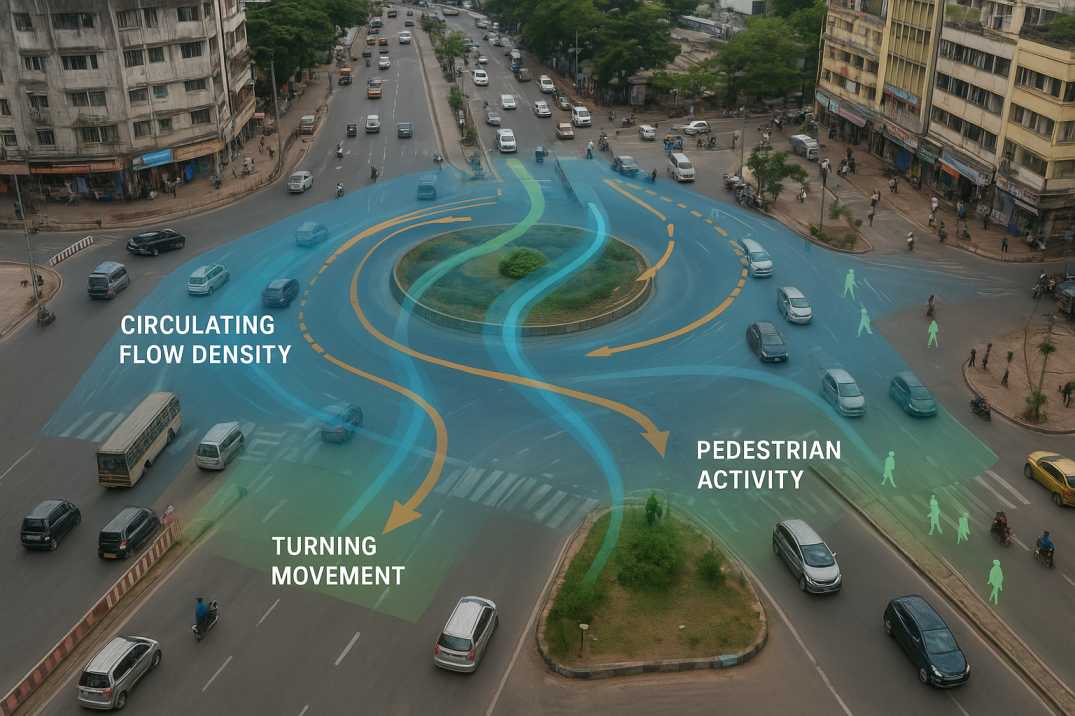
IRC:65 is indispensable, but its practical application heavily depends on data quality. The traditional approach faces limitations:
Modern AI systems through the Traffic Analysis Agent change the game entirely by providing continuous, automated, and standardised traffic insights that strengthen the very foundation of IRC:65 analyses.
IRC:65 outlines the scientific backbone for traffic engineering in India, including:
2.1 Definitions of Traffic Flow & Speed–Flow Relationships
It describes how traffic behaves under different flow conditions and how speed varies with congestion, providing the theoretical basis for capacity analysis.
2.2 PCU (Passenger Car Unit) Framework
Since Indian traffic is heterogeneous, PCU is critical for converting varied vehicle types into a comparable metric for capacity calculations.
2.3 Capacity Standards for Different Road Types
Including single-lane, two-lane, urban arterials, rural highways, and divided roadways—each with distinct capacity characteristics.
2.4 Level of Service (LOS) & Operating Conditions
Defining acceptable performance thresholds under ideal and real-world conditions for different road classifications.
2.5 Guidelines for Traffic Surveys
Covering classified counts, volume studies, speed–delay analysis, and peak-hour factor computation with prescribed methodologies.
2.6 Analysis Procedures
Methodologies for determining directional distribution, hourly variations, and design hourly volumes.
Yet, the effectiveness of these principles relies entirely on how accurately and consistently engineers collect field data—an area where AI elevates the game enormously.
AspectTraditional Manual SurveysAI-Based SurveysDurationShort periods (4-24 hours)Continuous 24/7CoverageSample locationsFull networkClassificationObserver-dependentAutomated, consistentNight-time dataLimited accuracyFull accuracyObserver fatigueAffects accuracyEliminatedPeak captureLimitedAll peaks capturedData processingWeeksReal-timeSeasonal variationLimited captureFull annual patternsCostLabour-intensiveScalable, cost-effective
Modern platforms like RoadVision AI apply AI and computer vision through its integrated suite of AI agents to transform how traffic data is captured, processed, and applied to IRC:65 standards.
4.1 Automated Classified Traffic Counts with High Precision
The Traffic Analysis Agent achieves what manual surveys rarely can:
This makes traffic demand estimation more representative and more compliant with IRC:65 methodologies.
4.2 Dynamic & Real-Time PCU Computation
Instead of static PCU multipliers, AI enables:
This ensures PCU reflects true operating conditions instead of outdated assumptions.
4.3 Continuously Updated Speed–Flow Curves
AI extracts:
Engineers can finally calibrate IRC speed–flow curves with actual urban behaviour instead of theoretical estimates.
4.4 Predictive Congestion & Demand Modelling
AI models through the Traffic Analysis Agent forecast congestion using:
This shifts mobility planning from reactive to proactive—bringing future-ready relevance to IRC:65.
4.5 Integrated Road Inventory & Pavement Condition Analytics
Since road capacity depends on geometry and pavement condition, AI integrates through the Roadside Assets Inventory Agent and Pavement Condition Intelligence Agent:
This produces a holistic operational picture instead of isolated traffic counts.
4.6 Visual Dashboards for Better Engineering Decisions
With heat maps, movement patterns, queue lengths, and TMCs, engineers can instantly translate AI insights into IRC-compliant design improvements.
4.7 Safety Integration
The Road Safety Audit Agent correlates traffic patterns with crash risk, identifying locations where capacity-related issues may create safety hazards.
5.1 Design Hourly Volume (DHV)
5.2 Directional Distribution
5.3 Peak Hour Factor (PHF)
5.4 Capacity Analysis
5.5 Level of Service (LOS)
While the benefits are compelling, seamless adoption requires overcoming a few roadblocks:
6.1 Lack of Technology Awareness
Some engineering teams may be unfamiliar with AI capabilities and benefits.
AI Solution: Training programs and pilot demonstrations through RoadVision AI build awareness.
6.2 Standardised Digital Data Formats
Different regions may use varying formats for traffic data.
AI Solution: Standardised outputs ensure compatibility across jurisdictions.
6.3 Initial Deployment Cost
AI-based systems require upfront investment, though long-term savings through optimised designs are substantial.
AI Solution: Scalable deployment demonstrates ROI through improved designs.
6.4 Integration with Existing Workflows
Public-sector workflows may need adaptation for digital inputs.
AI Solution: Flexible integration tools enable gradual adoption.
6.5 Data Privacy and Storage
Long-term storage of traffic video requires appropriate data governance.
AI Solution: Anonymized data processing and secure storage protocols.
6.6 Technical Capacity
Agencies may need support to interpret AI outputs effectively.
AI Solution: Comprehensive training programs ensure successful adoption.
The good news? As deployment costs drop and success stories grow, adoption is accelerating rapidly.
7.1 For Traffic Engineers
7.2 For Planning Agencies
7.3 For Road Users
As Indian mobility evolves, relying on old methods to solve new problems is like "trying to fill a bucket with a hole in the bottom." The solution is not to work harder—but to work smarter.
AI-based traffic surveys through the Traffic Analysis Agent modernise IRC:65 by:
The platform's ability to:
transforms how traffic engineering is approached across India.
RoadVision AI is leading this transformation by combining road intelligence, AI-driven inspections, digital traffic analytics, and automated reporting into a single ecosystem through the Pavement Condition Intelligence Agent, Road Safety Audit Agent, and Roadside Assets Inventory Agent. By aligning perfectly with IRC Codes, they empower engineers to design safer, smoother, and more sustainable road networks—built for the realities of modern India.
If you're ready to enhance your traffic engineering workflows or bring IRC:65 compliance into the AI era, book a demo with RoadVision AI today and take the first step toward a smarter mobility future.
AI uses automated camera-based vehicle detection to count and classify vehicles with high precision, eliminating human error and improving compliance with IRC guidelines.
AI can replace most manual surveys while increasing frequency and accuracy. However, hybrid validation checks may still be used in certain locations.
Yes. AI detects pedestrians, cyclists, commercial vehicles, public transport, and mixed-flow conditions, giving richer insights for capacity and design.

The Autonomous Road Engineer
AI-powered road condition monitoring, asset management, & infrastructure intelligence helping agencies move from reactive maintenance to predictive road management.


.webp)
.webp)
.webp)