
Urban congestion remains one of the most stubborn challenges confronting cities across the United Kingdom. As mobility demands rise and multimodal networks become increasingly complex, the limitations of traditional traffic systems have become abundantly clear. Today, modern road asset management UK platforms, combined with AI-based traffic flow management, are enabling authorities to understand, predict and mitigate congestion with a level of precision that legacy technologies simply cannot match.
Cities such as London, Manchester, Birmingham, Glasgow and Leeds experience daily challenges ranging from peak-hour gridlock and unpredictable journey times to freight delays and complex intersection bottlenecks. As the saying goes, "time is money," and congestion drains both—impacting productivity, safety and environmental outcomes.
Aligned with frameworks from the Department for Transport (DfT), Transport for London (TfL) and National Highways, AI-driven systems through the Traffic Analysis Agent are rapidly reshaping congestion management across the UK, supporting safer, cleaner and more efficient urban mobility.
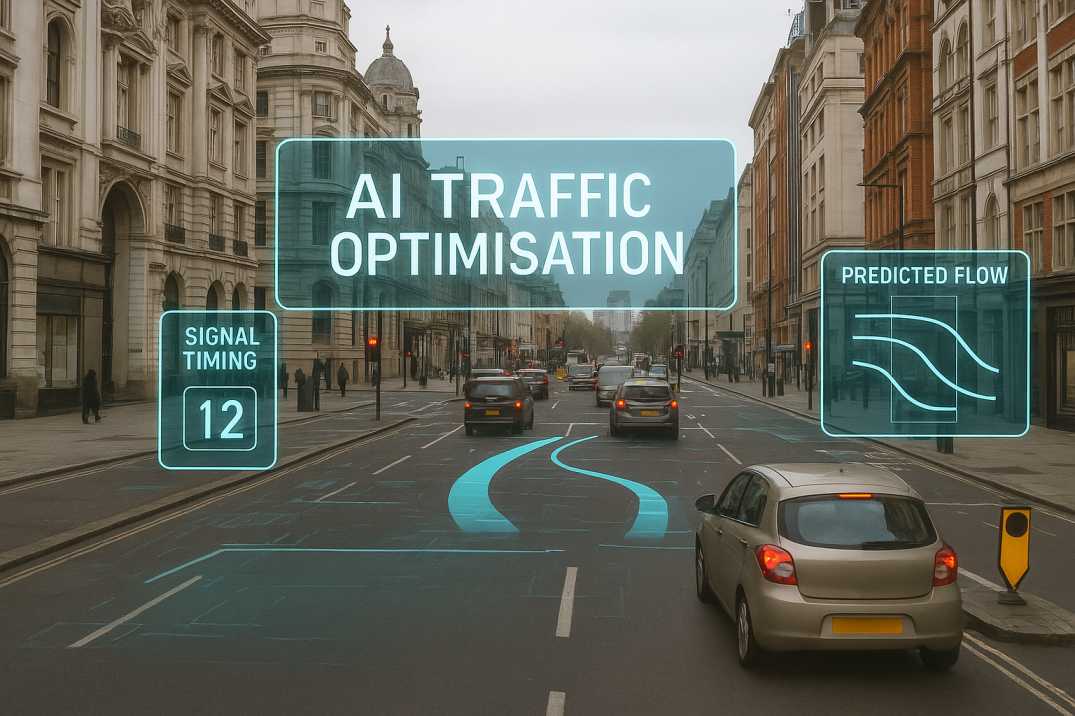
1.1 High Traffic Volumes and Limited Space
Urban roads have limited room for physical expansion. With rising demand from private vehicles, buses, freight and active travellers, many corridors experience chronic slowdowns—especially during peak hours.
1.2 Outdated Signal Timing and Manual Adjustments
A significant number of intersections still depend on static timing plans. These do not adapt to real-time fluctuations, leading to queue spillback, inefficient pedestrian phases and prolonged delays.
1.3 Growth in Freight and Delivery Movements
E-commerce has increased the number of vans and logistics vehicles on UK streets, contributing to lane blockages, stop-and-go movements and inconsistent traffic flow.
1.4 Incidents, Events and Weather Impacts
Breakdowns, minor collisions, football matches, construction works and rainfall can cause substantial congestion. Without real-time detection, authorities struggle to respond effectively.
1.5 Limited Real-Time Network Insights
Traditional sensors like loop detectors offer isolated snapshots, not holistic, corridor-wide intelligence. Without continuous data, congestion patterns remain reactive rather than predictive.
1.6 Public Transport Interference
Bus bunching, tram delays and rail replacement services can create unpredictable congestion patterns that static systems cannot address.
2.1 London
2.2 Manchester
2.3 Birmingham
2.4 Glasgow
2.5 Leeds
While the UK primarily follows DfT, TfL, UTMC and National Highways guidelines, many global cities—including those adopting multi-national standards—incorporate IRC principles to strengthen geometric design, traffic engineering and corridor planning. These principles emphasise:
AI through the Road Safety Audit Agent and Pavement Condition Intelligence Agent enhances these principles by converting them into continuous, data-driven operational metrics rather than periodic assessments.
4.1 Economic Impact
4.2 Environmental Impact
4.3 Social Impact
RoadVision AI strengthens congestion management through its integrated suite of AI agents, delivering comprehensive solutions for UK urban centres.
5.1 Real-Time Traffic Prediction and Early Warning
The Traffic Analysis Agent processes live feeds, road condition data, weather forecasts, incident reports and historic trends to predict congestion before it forms. Authorities can pre-emptively adjust signal timing, reroute traffic or issue traveller alerts.
5.2 Adaptive Signal Control
Using AI-driven algorithms aligned with UTMC frameworks, RoadVision AI dynamically adjusts signal timings based on real-time:
This reduces idling, improves throughput and enhances bus reliability.
5.3 Automated Incident Detection and Rapid Response
The Traffic Analysis Agent identifies:
Automated alerts enable faster clearance, significantly reducing disruption duration.
5.4 Enhancing Public Transport Priority
The Traffic Analysis Agent identifies bus bunching, delays and saturation at key stops. Signals automatically prioritise buses to maintain reliability—critical for UK cities aiming to boost modal shift.
5.5 Integrated Pavement and Asset Intelligence
Congestion often worsens where surface distress or uneven pavements exist. The Pavement Condition Intelligence Agent and Roadside Assets Inventory Agent integrate:
This holistic integration helps authorities identify where road infrastructure itself contributes to congestion.
5.6 Multi-Modal Coordination
The platform maps interactions between buses, cyclists, pedestrians and private vehicles to help redesign junctions, reduce conflicts and support safe, efficient network flow.
5.7 Corridor Performance Monitoring
The Traffic Analysis Agent tracks:
6.1 Department for Transport (DfT)
6.2 Transport for London (TfL)
6.3 National Highways
6.4 UTMC (Urban Traffic Management and Control)
7.1 Legacy Infrastructure Limitations
Many cities rely on outdated roadside equipment with limited connectivity or low-resolution data.
AI Solution: Flexible integration through RoadVision AI enables gradual modernization.
7.2 Data Silos Across Agencies
Local councils, bus operators, road authorities and emergency responders often operate independently, slowing cross-network optimisation.
AI Solution: Centralized platforms ensure all stakeholders work from the same data.
7.3 Weather and Seasonal Variability
Conditions such as rain, fog and darkness influence AI model performance and must be continually accounted for in training datasets.
AI Solution: Models trained on UK conditions maintain accuracy across weather variations.
7.4 Behavioural Unpredictability
Human decision-making—driver aggression, sudden braking, non-compliance—adds layers of complexity requiring robust behavioural modelling.
AI Solution: Advanced behaviour analytics capture nuanced patterns.
7.5 Funding and Deployment Pace
Large-scale AI adoption requires strategic investment and phased deployment to maximise return and ensure interoperability.
AI Solution: Scalable deployment demonstrates ROI before full-scale rollout.
7.6 Public Acceptance
New traffic management approaches require public understanding and acceptance.
AI Solution: Transparent communication about benefits builds support.
As the phrase goes, "Rome wasn't built in a day," and transforming urban mobility requires gradual, data-driven evolution.
8.1 For Road Users
8.2 For Transport Authorities
8.3 For Environment
Congestion across the UK's major cities demands more than incremental improvements—it requires a fundamental shift towards intelligent, predictive and automated mobility systems. AI through the Traffic Analysis Agent brings real-time monitoring, proactive interventions and evidence-backed optimisation that traditional tools cannot deliver.
The platform's ability to:
transforms how congestion is managed across UK urban centres.
RoadVision AI is at the forefront of this transformation. Combining AI-based congestion control, digital twin technology, pavement condition analytics through the Pavement Condition Intelligence Agent, and automated traffic monitoring, the platform empowers engineers and road authorities to:
In short, RoadVision AI helps cities "work smarter, not harder," enabling safer, cleaner and more predictable journeys for millions through the Road Safety Audit Agent and Roadside Assets Inventory Agent.
If you're ready to elevate your city's traffic management strategy, book a demo with RoadVision AI today to explore how our platform can transform your network.
AI predicts traffic buildup, optimises signals, detects incidents quickly and recommends real-time adjustments that reduce delays.
Yes. AI integrates with UTMC systems, DfT-compliant sensors and existing signal controllers without major infrastructure changes.
AI prioritises buses at intersections, reduces delay and enhances schedule accuracy.
The Autonomous Road Engineer
AI-powered road condition monitoring, asset management, & infrastructure intelligence helping agencies move from reactive maintenance to predictive road management.


.webp)
.webp)
.webp)