
India now operates one of the world's largest and fastest-growing road networks. With rising traffic volumes, heavier axle loads, diverse climatic zones and rapid urbanisation, pavements across national, state and rural corridors deteriorate faster than ever before. Ensuring good riding quality is not just a comfort issue—it is a critical benchmark of structural soundness, safety and long-term serviceability.
This makes accurate pavement roughness assessment indispensable for road asset management in India. The Indian Roads Congress (IRC), through its standard IRC:82, defines how roughness should be measured, monitored and reported. Yet traditional methods struggle to keep pace with the scale of today's network.
As the saying goes, "a stitch in time saves nine." AI-powered pavement condition monitoring through the Pavement Condition Intelligence Agent ensures that defects are detected early, roughness trends are captured accurately and maintenance decisions are made proactively rather than reactively.
This article explains India's pavement challenges, the importance of IRC:82, how AI enhances roughness measurement and how RoadVision AI delivers best-practice digital compliance for modern highway agencies.
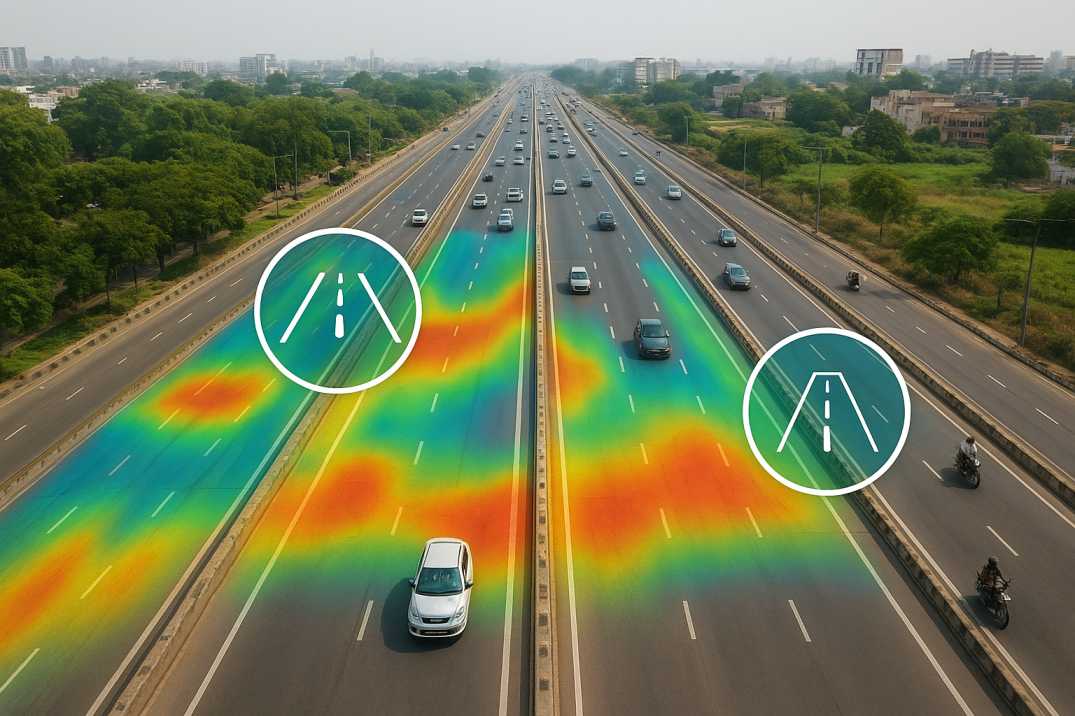
India's roads face unique and intense stressors:
Accurate roughness data helps authorities:
Traditional survey methods—bump integrators, static profilometers, manual data entry—require slow travel speeds, significant manpower and repeated calibration. This limits coverage and frequency, causing agencies to "fight fires" rather than manage pavements strategically.
2.1 What Is Pavement Roughness?
Pavement roughness refers to deviations in the pavement surface that affect ride quality. It is the primary indicator of functional pavement condition and correlates strongly with user satisfaction, vehicle operating costs, and safety.
2.2 How Roughness Is Measured
2.3 IRI Categories Under IRC:82
IRI Range (mm/km)ConditionRecommended Action< 1,800GoodRoutine maintenance1,800 - 2,400FairMonitor, preventive maintenance2,400 - 3,200PoorPlanned rehabilitation> 3,200Very PoorUrgent reconstruction
IRC:82 provides the technical backbone for measuring pavement roughness in India. Its key principles include:
3.1 Use of Standardised Measuring Equipment
IRC:82 outlines approved tools, calibration rules and standard operating procedures. It emphasises repeatability and uniformity, ensuring roughness values are comparable across regions and years.
3.2 International Roughness Index (IRI) as the Benchmark
Roughness is expressed in IRI (m/km), representing longitudinal unevenness. This index links riding quality to underlying structural behaviour.
3.3 Defined Survey Frequencies and Coverage Requirements
The code mandates regular, systematic measurement for all major highway categories, enabling long-term performance tracking.
3.4 Strict Calibration and Quality-Control Protocols
IRC:82 specifies calibration for sensors, wheels, speeds and measurement intervals. Digital systems through the Pavement Condition Intelligence Agent must comply with these standards to ensure data consistency.
3.5 Acceptance Criteria for Maintenance Decisions
Thresholds (Good, Fair, Poor, Very Poor) guide resurfacing, overlays and reconstruction planning.
3.6 Distress Correlation
Roughness must be evaluated alongside other distress types (cracking, rutting, potholes) for comprehensive condition assessment.
These principles set the rules of the game—AI through the Pavement Condition Intelligence Agent ensures these rules are met accurately, repeatedly and at network scale.
4.1 Traffic Factors
4.2 Climate Factors
4.3 Construction Factors
4.4 Maintenance History
RoadVision AI enhances IRC:82-aligned roughness measurement through its integrated suite of AI agents, delivering comprehensive solutions for Indian highway authorities.
5.1 Automated Pavement Roughness Measurement Using AI
The Pavement Condition Intelligence Agent combines high-speed cameras, sensors and AI-based vibration analysis to capture continuous pavement profiles. Machine learning algorithms calculate roughness values comparable to IRI with near-zero human interpretation error. This eliminates inconsistencies common in manual surveys.
5.2 High-Speed Digital Pavement Inspection for Full-Network Coverage
Survey vehicles or mobile-mounted systems record thousands of frames per kilometre at traffic speed. This supports IRC:82's requirement for consistent, corridor-wide coverage—even for long and heavily trafficked highways.
5.3 AI-Based Roughness Analysis with Distress Correlation
RoadVision AI not only computes IRI estimates but also correlates roughness with:
This delivers a holistic understanding of riding quality and structural behaviour.
5.4 Integration into Road Asset Management Dashboards
Roughness data automatically feeds into centralised digital dashboards through the Roadside Assets Inventory Agent, enabling engineers to:
5.5 Real-Time Quality Control for IRC Compliance
RoadVision AI validates survey speed, calibration integrity, GPS accuracy and data completeness—ensuring roughness results meet IRC:82 protocols without guesswork.
5.6 Instant Processing, Maps and Automated Reporting
Instead of weeks of manual compilation, RoadVision AI generates:
This accelerates decision-making for highway authorities.
5.7 Traffic Loading Correlation
The Traffic Analysis Agent correlates roughness progression with traffic loading to identify corridors where heavy vehicles are accelerating deterioration.
5.8 Safety Integration
The Road Safety Audit Agent identifies locations where roughness may be contributing to crash risk.
6.1 Poor Construction Quality
6.2 Traffic-Induced Roughness
6.3 Climate-Induced Roughness
7.1 Vast and Diverse Road Network
From expressways to rural connectors, India's network demands scalable, automated systems capable of uniform assessment.
AI Solution: Continuous monitoring through the Pavement Condition Intelligence Agent covers all road classes.
7.2 Climate and Seasonal Variability
Monsoon-driven distress, heat-related rutting and water infiltration complicate manual assessment and require frequent updates.
AI Solution: Year-round monitoring captures seasonal variations.
7.3 Resource and Manpower Limitations
Many state highway agencies lack dedicated technical teams to perform regular IRC:82-compliant measurements.
AI Solution: Automated surveys reduce personnel requirements.
7.4 Data Fragmentation and Legacy Formats
Paper-based logs and standalone datasets hinder long-term trend analysis.
AI Solution: Centralized platforms through RoadVision AI unify all data.
7.5 Inconsistent Calibration and Methodologies
Manual surveys often deviate from IRC requirements due to equipment constraints and operational challenges.
AI Solution: Automated quality control ensures consistent calibration.
7.6 Rural Road Coverage
Many rural roads under PMGSY lack regular roughness monitoring.
AI Solution: Smartphone-based surveys provide cost-effective coverage.
In short, "you can't fix what you can't measure." Without scalable digital tools through RoadVision AI, maintaining IRC compliance becomes difficult.
8.1 Vehicle Operating Costs
8.2 Safety Benefits
8.3 Asset Life Extension
8.4 User Satisfaction
AI-driven systems are transforming how India evaluates pavement roughness, enabling highway authorities to make informed, timely and cost-efficient decisions. By automating data capture, improving accuracy, and aligning measurements with IRC:82 through the Pavement Condition Intelligence Agent, Traffic Analysis Agent, and Road Safety Audit Agent, AI ensures that agencies maintain stronger compliance while enhancing the nation's riding quality.
The platform's ability to:
transforms how pavement roughness is measured across India.
RoadVision AI combines computer vision, digital twins, predictive modelling and real-time analytics to elevate roughness measurement, distress classification, pothole detection, condition mapping and maintenance forecasting.
In a country where millions rely on smooth, safe pavements daily, intelligent monitoring through the Roadside Assets Inventory Agent is not a luxury—it is a necessity.
As the proverb goes, "the road to success is always under construction"—but with AI, it becomes smarter, safer and better managed.
If you'd like to see how RoadVision AI can modernise your pavement evaluation workflows, book a demo with RoadVision AI today and explore the possibilities firsthand.
It helps determine pavement ride quality, identifies deterioration and guides timely maintenance planning as per IRC:82.
AI automates data collection, increases accuracy, speeds up analysis and ensures compliance with IRC performance standards.
Yes. AI-based digital inspection systems enable full-network evaluation at high speed, replacing slow and labour-intensive methods.
The Autonomous Road Engineer
AI-powered road condition monitoring, asset management, & infrastructure intelligence helping agencies move from reactive maintenance to predictive road management.


.webp)
.webp)
.webp)