
Australia's cities are growing at a rapid pace, creating bustling urban corridors where pedestrians and vehicles constantly intersect. As mobility patterns evolve, safeguarding people walking through busy precincts has become a national priority. With strong alignment to Vision Zero and the Safe System Approach, authorities are now shifting from traditional observational audits toward AI-enabled safety intelligence. Modern AI pedestrian safety systems, smart vision platforms and automated traffic monitoring tools are empowering cities to spot risks early, analyse behaviour objectively and prevent crashes before they occur.
This article explores why modern pedestrian safety interventions are essential, how Austroads and IRC-aligned principles guide safer street design, how RoadVision AI applies industry best practices, the core challenges, and what the path forward looks like for Australian cities.
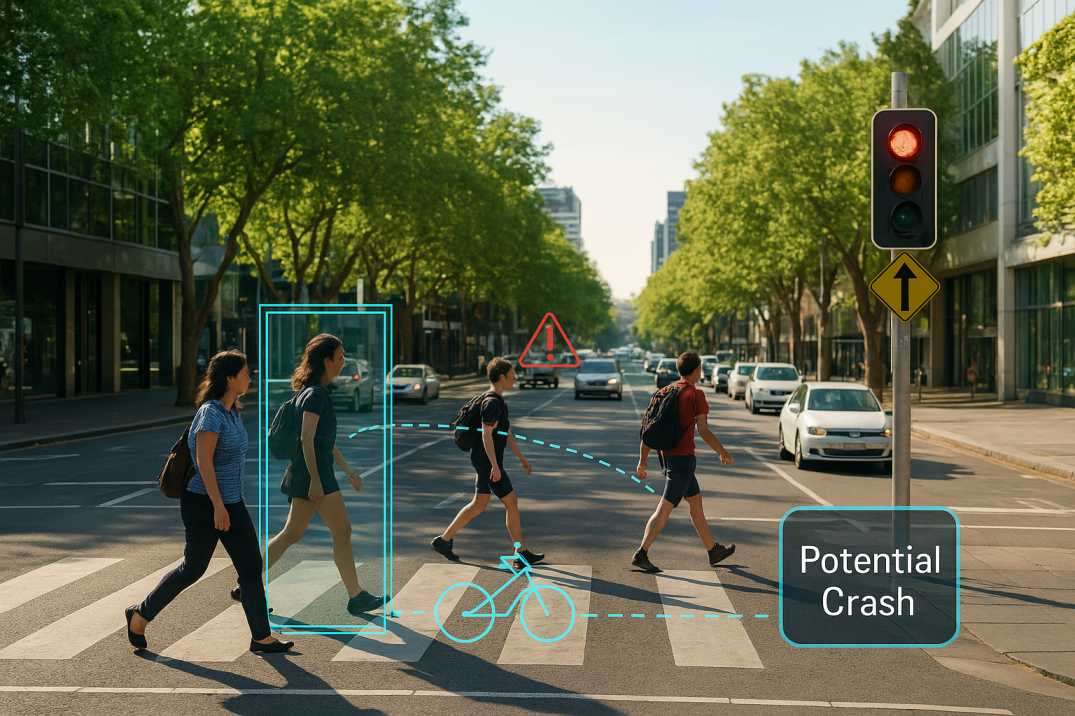
1.1 Urban Growth and Higher Walking Volumes
Cities like Sydney, Melbourne, Brisbane, Perth, and Adelaide are witnessing significant rises in pedestrian movement. More people walking to public transport, schools, offices and retail areas increases exposure to risk, particularly at multi-lane roads, mid-block crossings and complex intersections.
1.2 Complex Urban Transport Ecosystems
Modern Australian CBDs blend private vehicles, buses, trams, cyclists, e-scooters and delivery fleets—creating highly dynamic environments where a momentary lapse in visibility can spark a conflict or near-miss.
1.3 Speed and Behavioural Risks
Excessive vehicle speeds, distracted driving, aggressive turns and sudden braking pose major hazards. Pedestrian distractions (phones, headphones, poor gap judgement) add another layer of unpredictability.
1.4 Environmental & Visibility Constraints
Night-time conditions, harsh sun glare, peak-hour congestion or wet weather can reduce visibility and reaction times—conditions where "a split second can make or break it."
1.5 Limitations of Manual, Periodic Assessments
Traditional safety audits depend on manual observation that is infrequent, subjective and incapable of capturing spontaneous near-miss events. In the words of the old saying: "You can't fix what you don't see."
2.1 High-Risk Locations
2.2 Contributing Factors
2.3 High-Risk Times
Australia's pedestrian safety strategies draw heavily from:
Key aligned principles include:
Smart vision systems through the Traffic Analysis Agent and Road Safety Audit Agent amplify these frameworks by providing objective, high-frequency evidence to guide effective interventions.
4.1 Infrastructure Improvements
4.2 Speed Management
4.3 Technology Solutions
RoadVision AI applies these principles through its integrated suite of AI agents, delivering comprehensive pedestrian safety solutions.
5.1 Continuous Automated Monitoring Across High-Risk Zones
The Traffic Analysis Agent and Road Safety Audit Agent deploy smart vision systems capable of 24×7 monitoring of intersections, school zones, CBD corridors and high-volume crossings. This captures real-time behaviour that traditional audits miss.
5.2 AI-Driven Detection of Conflicts and Near-Miss Events
Using advanced computer vision, RoadVision AI accurately identifies:
These insights help prioritise engineering upgrades and enforcement where they matter most.
5.3 Predictive Safety Modelling
Machine-learning models through the Traffic Analysis Agent analyse movement patterns, historic crash data, approach speeds, signal timing, lighting levels and geometry to forecast high-risk scenarios. This supports proactive interventions instead of reactive fixes.
5.4 Integration With Road Inventory & Pavement Condition Records
The Pavement Condition Intelligence Agent and Roadside Assets Inventory Agent unify pedestrian risk data with:
This holistic view ensures Safe System interventions address both behavioural and infrastructure-related risks.
5.5 Enhanced Urban Mobility Planning
The platform's analytics highlight:
This helps authorities redesign signals, widen crossings, add refuge islands or recalibrate lane priorities.
5.6 School Zone Safety
AI monitors:
6.1 Sydney
6.2 Melbourne
6.3 Brisbane
6.4 Perth
Even with advanced systems, several hurdles persist:
7.1 Highly Complex Traffic Environments
CBDs and multimodal corridors generate unpredictable interactions that require high-precision AI models and continuous training.
AI Solution: Continuous model refinement through RoadVision AI adapts to complex environments.
7.2 Varying Visibility and Weather Conditions
Night-time glare, uneven lighting and rain challenge standard detection models—requiring adaptive AI algorithms.
AI Solution: Multi-sensor fusion maintains accuracy across conditions.
7.3 Fragmented Data Across Agencies
Transport, road safety, city councils and enforcement bodies often operate separate systems, making data integration key to a unified safety strategy.
AI Solution: Centralized platforms ensure all stakeholders work from the same data.
7.4 Behavioural Variability
Pedestrian actions are less predictable than vehicle behaviour—demanding more nuanced risk-detection models.
AI Solution: Advanced behaviour analytics capture nuanced patterns.
7.5 Infrastructure Age and Condition
Older assets (signage, kerbs, crosswalk markings) often fail basic visibility or accessibility standards, influencing pedestrian crash risk.
AI Solution: The Roadside Assets Inventory Agent identifies infrastructure deficiencies.
7.6 Public Transport Integration
High pedestrian volumes at stops and stations require specialised safety analysis.
AI Solution: Integrated analysis of transport nodes.
8.1 For Pedestrians
8.2 For Transport Authorities
8.3 For Drivers
Pedestrian safety in Australia is at a critical juncture. With increasing urban density and evolving mobility, relying solely on manual audits is "like trying to catch lightning in a bottle"—too inconsistent to protect vulnerable road users effectively.
Smart vision systems powered by AI through the Traffic Analysis Agent and Road Safety Audit Agent offer a game-changing leap:
The platform's ability to:
transforms how pedestrian safety is approached across Australian cities.
RoadVision AI is leading this transformation by integrating digital twins, AI-based safety audits, conflict detection, pavement condition intelligence and traffic analysis into one unified platform through the Roadside Assets Inventory Agent. Its compliance with Austroads geometric design guidelines and IRC Codes ensures engineering precision while enabling cities to reduce crashes, optimise infrastructure investment and enhance mobility sustainability.
If you're aiming to modernise your city's pedestrian and road-safety ecosystem, book a demo with RoadVision AI today and discover how our platform can help you see risks before they turn into tragedies.
AI identifies high-risk locations, monitors conflicts in real time and provides evidence-backed insights for improving crossing design and safety interventions.
Yes. AI detects near misses, unsafe pedestrian entries, distracted walking and risky vehicle movements that traditional inspections cannot capture.
AI complements manual audits by offering continuous monitoring and objective measurements, improving the accuracy and speed of safety assessment.
The Autonomous Road Engineer
AI-powered road condition monitoring, asset management, & infrastructure intelligence helping agencies move from reactive maintenance to predictive road management.


.webp)
.webp)
.webp)