
Pavement performance is central to the safety, durability, and economic efficiency of India's highway network. Under the framework of road asset management in India, predicting pavement distress before structural failure occurs has become a priority for highway authorities, consultants, and concessionaires.
IRC:37 provides the foundational design methodology for flexible pavements in India, focusing on traffic loading, subgrade strength, and layer composition. However, real-world pavement behaviour is shaped by dynamic influences that extend beyond static design assumptions.
This is where AI-based pavement failure prediction is reshaping how IRC:37 principles are applied in practice.
By combining automated road condition monitoring, field performance data, and machine learning models through the Pavement Condition Intelligence Agent, engineers can now anticipate pavement layer distress well before visible failures emerge.
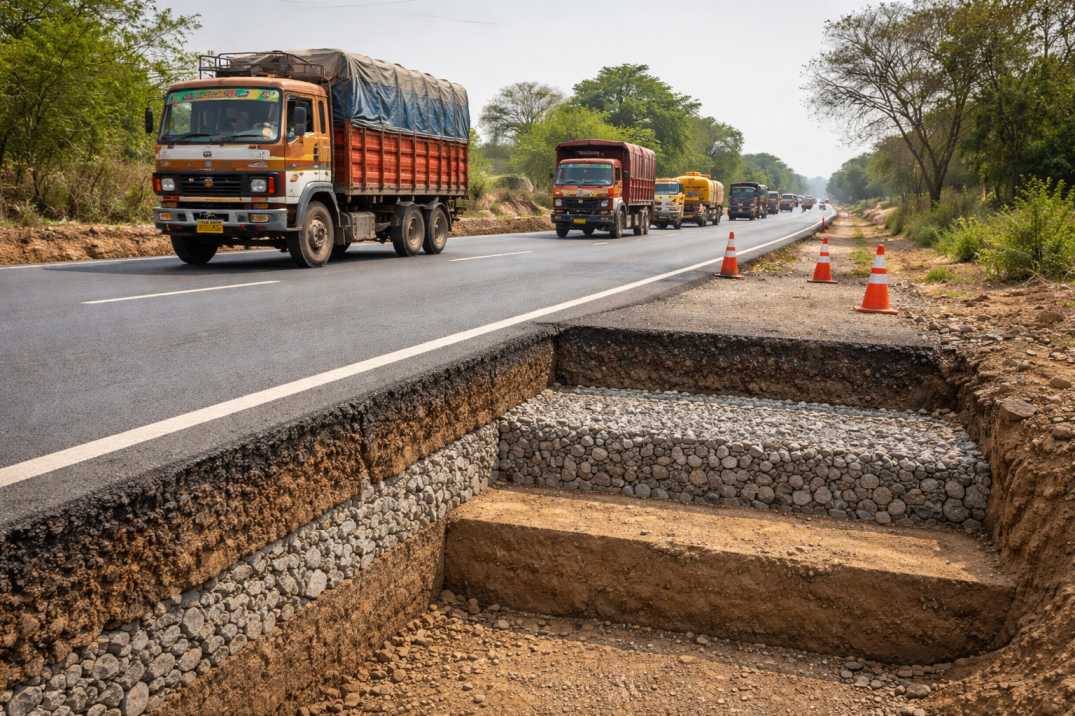
IRC:37 establishes a mechanistic–empirical approach for flexible pavement design. It links:
The guideline aims to ensure that pavement layers perform satisfactorily throughout their intended design life.
However, pavements rarely deteriorate exactly as predicted on paper. Variations in construction quality, climate exposure, drainage performance, and axle loading patterns introduce uncertainty.
Integrating AI in pavement design through the Pavement Condition Intelligence Agent allows these real-world influences to be continuously analysed alongside IRC:37 design intent.
2.1 Types of Layer Failures
2.2 Failure Progression
2.3 Factors Influencing Layer Failure
Traditional pavement evaluation relies on periodic visual surveys, deflection testing, and laboratory analysis. While effective, these methods capture only snapshots in time.
Layer failures often initiate below the surface through:
By the time surface distress becomes visible, structural capacity may already be compromised.
Pavement layer failure analysis therefore requires early indicators that conventional methods struggle to capture consistently at network scale.
Automated road condition monitoring through the Pavement Condition Intelligence Agent enables continuous observation of pavement performance using image and video data collected at traffic speed.
AI algorithms detect subtle surface changes that correlate with underlying structural distress, including:
When analysed longitudinally, trends in cracking and deformation become measurable over time.
These trends form the basis for pavement layer distress prediction, enabling interventions before irreversible damage occurs.
AI-based pavement failure prediction systems through the Pavement Condition Intelligence Agent use historical pavement datasets, traffic patterns from the Traffic Analysis Agent, and environmental exposure factors to train predictive models.
These models learn how pavements designed under IRC:37 flexible pavement guidelines behave under real operational conditions.
By correlating distress progression with subsurface response, AI predicts when individual layers may exceed:
This shifts pavement management from reactive maintenance to predictive planning.
6.1 Cracking Indicators
IndicatorWhat It PredictsThresholdCrack densityFatigue progression> 10% area affectedCrack widthSeverity escalation> 3 mm criticalCrack patternFailure mechanismAlligator pattern signals structural failure
6.2 Rutting Indicators
IndicatorWhat It PredictsThresholdRut depthLayer deformation> 10 mm criticalRut progression rateAccelerated failure> 2 mm/year high riskWheel path locationChannelisationConsistent tracking indicates design issues
6.3 Surface Texture Indicators
IndicatorWhat It PredictsThresholdTexture lossBinder aging< 0.5 mm texture depthRavellingAggregate loss> 10% area affectedBleedingBinder migrationPresence indicates temperature issues
Rather than replacing IRC:37, AI enhances its application.
Design assumptions can be validated against observed field performance, allowing engineers to refine:
This strengthens AI-based road design by ensuring pavement decisions are continuously informed by real-world behaviour rather than initial assumptions alone.
8.1 Fatigue Failure
8.2 Rutting Failure
8.3 Moisture Failure
8.4 Subgrade Failure
Pavement condition does not exist in isolation. Deteriorated surfaces directly affect:
When pavement predictions are integrated with road safety audit data from the Road Safety Audit Agent, agencies gain clearer insight into safety implications linked to structural distress.
Similarly, combining predictions with road inventory inspection from the Roadside Assets Inventory Agent highlights whether drainage assets, shoulders, or edge conditions contribute to accelerated failure.
Traffic loading inputs from automated traffic surveys through the Traffic Analysis Agent further refine prediction accuracy by reflecting actual axle load exposure rather than assumed design traffic.
Predictive insights support smarter budgeting and prioritisation under road asset management India frameworks.
Instead of resurfacing based solely on pavement age or visible distress, agencies can intervene precisely when structural layers approach critical thresholds.
This approach delivers measurable benefits:
RoadVision AI enables scalable implementation of AI-driven pavement analysis aligned with Indian standards through its integrated suite of AI agents.
The platform integrates:
into a unified decision-support workflow.
IRC:37 remains the cornerstone of flexible pavement design in India, but modern highway networks demand continuous performance intelligence.
AI-based pavement failure prediction through the Pavement Condition Intelligence Agent, supported by automated road condition monitoring and pavement layer distress prediction, transforms how IRC:37 principles are applied over the pavement lifecycle.
The platform's ability to:
transforms how pavement performance is managed across India.
By integrating AI into design evaluation and maintenance planning, authorities can improve durability, safety, and cost efficiency across India's road network.
RoadVision AI is transforming infrastructure development and maintenance by harnessing AI in roads to enhance safety and streamline road management. Using advanced computer vision technology, the platform enables early detection of potholes, cracks, and surface defects through precise pavement surveys.
Committed to building smarter, safer, and more sustainable roads, RoadVision AI aligns with IRC Codes, empowering engineers and stakeholders with data-driven insights that cut costs, reduce risks, and enhance transportation outcomes.
Book a demo with RoadVision AI today to modernise your pavement performance strategy.
AI validates design assumptions using real performance data and predicts layer distress early.
AI infers subsurface issues by analysing surface distress patterns over time.
Yes AI scales effectively across both high-volume highways and regional roads.

The Autonomous Road Engineer
AI-powered road condition monitoring, asset management, & infrastructure intelligence helping agencies move from reactive maintenance to predictive road management.


.webp)
.webp)
.webp)