
Across the Kingdom of Saudi Arabia, at-grade intersections are critical nodes within the national highway and urban road networks. As traffic volumes increase and urban development accelerates, intersections must be designed not only to manage current demand but also to anticipate future mobility patterns.
With the rise of AI-based road asset management and digital road monitoring systems, intersection planning is no longer limited to geometric drawings. Today, engineers can integrate real-time traffic insights, predictive analytics, and automated compliance tools into the design process.
As the saying goes, "A stitch in time saves nine," and nowhere is this more relevant than in designing intersections that prevent congestion, crashes, and premature deterioration.
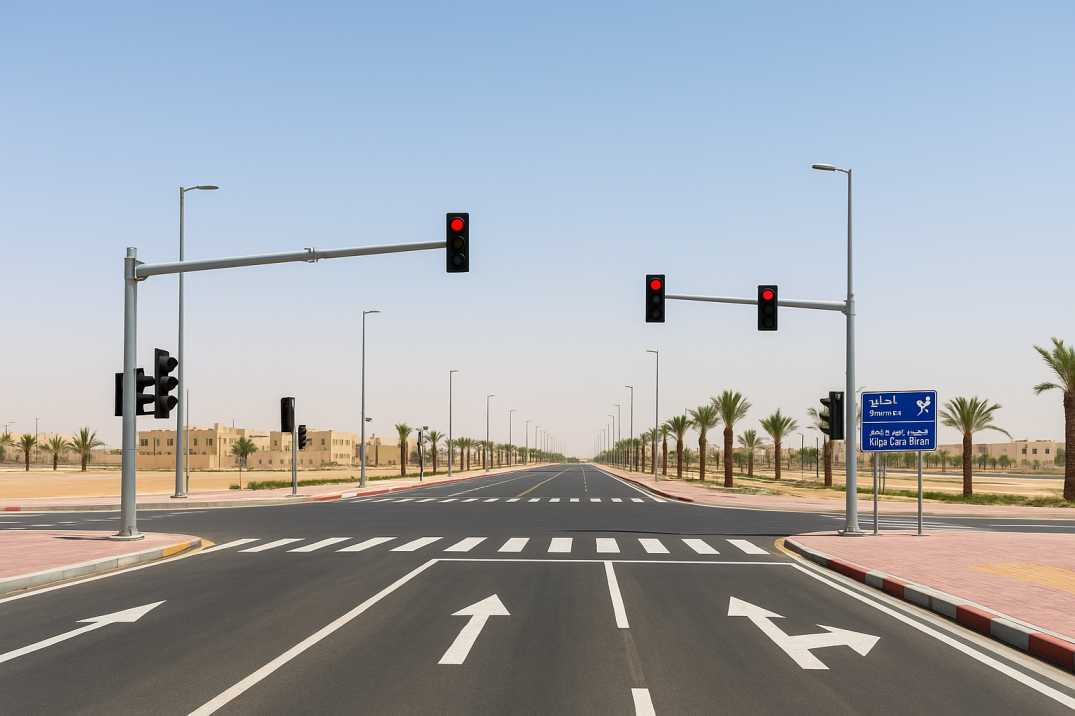
Intersections represent the highest concentration of conflict points. Poor design can lead to:
Saudi Arabia's road network—spanning highways, arterials, collectors, and urban streets—requires intersections tailored to design speed, traffic composition, and land-use context. Adding AI-driven monitoring through the Traffic Analysis Agent enhances this further by identifying performance issues long before they become problematic.
2.1 Types of At-Grade Intersections
2.2 Conflict Points
At-grade intersections have inherent conflict points where vehicle paths cross:
The number of conflict points increases exponentially with more lanes and approaches, making geometric design critical for safety.
Saudi design guidance such as SHC 301 – Highway Geometric Design outlines the key parameters shaping at-grade intersection design. While the Saudi framework is context-specific, many principles align with global best practice and IRC-style methodology. Below are the foundational principles:
3.1 Road Hierarchy and Intersection Type
Intersections must reflect functional classification:
3.2 Adequate Sight Distance
Drivers must have clear visibility of:
This includes stopping sight distance, decision sight distance, and view triangles. The Road Safety Audit Agent verifies these requirements.
3.3 Turning Radii and Vehicle Accommodation
Design must account for:
3.4 Vertical and Horizontal Alignment
Near intersections:
3.5 Pedestrian and Non-Motorised Provisions
Urban intersections require:
3.6 Traffic Control Strategy
Depending on demand and conflicts:
3.7 Channelisation
Use of islands and raised medians to:
These core principles create the foundation for a modern, safe, and efficient at-grade intersection design.
4.1 Approach Geometry
4.2 Turning Radii
4.3 Sight Distance Requirements
4.4 Cross-Section Elements
Modern Saudi road authorities are adopting digital transformation, and RoadVision AI is at the forefront of enabling these capabilities through its integrated suite of AI agents.
5.1 AI-Driven Geometric Validation
The Road Safety Audit Agent automatically checks:
This ensures designs align with Saudi standards.
5.2 Predictive Traffic Modelling
Through AI analytics via the Traffic Analysis Agent, the system forecasts:
This allows engineers to optimise layout, signal timing, and channelisation before construction.
5.3 Continuous Monitoring Through Digital Twins
The Roadside Assets Inventory Agent creates digital twins of intersections to monitor:
Any anomaly triggers an alert for corrective action.
5.4 Lifecycle and Asset Management Workflow
Intersection components—signals, markings, pavements, lighting—are treated as assets. RoadVision AI supports:
This ensures intersections stay safe and functional throughout their lifecycle.
5.5 Integrated Safety Audit System
The Road Safety Audit Agent overlays safety audit findings onto design and operational data to identify:
This bridges the gap between design intent and real-world performance.
5.6 Pavement Condition Monitoring
The Pavement Condition Intelligence Agent monitors:
Even with advanced tools, agencies face several obstacles:
6.1 Diverse Terrain and Urban Contexts
Saudi regions vary from flat desert to hilly terrain in Asir and Taif, requiring context-sensitive solutions that adapt to local conditions.
AI Solution: The Road Safety Audit Agent adapts to terrain-specific requirements.
6.2 Rapid Urban Growth
Demand grows faster than infrastructure upgrades, creating pressure for scalable, future-proof designs that can accommodate increased volumes.
AI Solution: Predictive models forecast future demand for proactive capacity planning.
6.3 Data Integration
Combining traffic, geometric, structural, and environmental data requires interoperable systems that share information seamlessly.
AI Solution: Centralized platforms through RoadVision AI unify all data sources.
6.4 Need for Skilled Personnel
AI tools require trained engineers who understand digital workflows and traffic engineering principles.
AI Solution: Comprehensive training programs ensure successful adoption.
6.5 Maintenance Coordination
Intersections contain multiple subsystems—signals, detectors, markings, lighting—that need synchronised maintenance.
AI Solution: Integrated asset management through the Roadside Assets Inventory Agent coordinates maintenance.
6.6 Heavy Vehicle Considerations
Industrial zones require larger turning radii and stronger pavements that standard designs may not accommodate.
AI Solution: Design vehicle simulation verifies heavy vehicle accommodation.
As the proverb goes, "The best time to plant a tree was 20 years ago; the second-best time is now." Adopting AI-enabled design and monitoring through RoadVision AI now prevents bigger issues later.
7.1 For Design Engineers
7.2 For Road Authorities
7.3 For Road Users
At-grade intersections in Saudi Arabia are evolving from static geometric forms into dynamic, intelligent, and performance-driven systems. By integrating SHC 301 geometric principles with AI-enabled monitoring through the Traffic Analysis Agent, Road Safety Audit Agent, and Pavement Condition Intelligence Agent, authorities can build intersections that are:
The platform's ability to:
transforms how at-grade intersections are designed, operated, and maintained across the Kingdom.
RoadVision AI is setting a new benchmark for intersection optimisation. Using digital twin technology, computer vision, and automated road-asset workflows, it ensures compliance with Saudi standards, enhances safety audits, and supports real-time decision-making.
If your organisation is looking to design or upgrade at-grade intersections using a data-driven, AI-powered approach, now is the time to act.
Book a demo with RoadVision AI today and discover how our platform can transform intersection planning, monitoring, and lifecycle asset management across the Kingdom.
Q1. What distinguishes an at-grade intersection design in Saudi Arabia from international practice?
Saudi guidelines emphasise flexibility, regional conditions (such as desert terrain) and design speeds aligned with local vehicle fleets. The use of Smart monitoring and asset management integration is increasingly emphasised.
Q2. How does AI enhance intersection design and traffic management?
AI enables predictive modelling of turning flows, detection of safety risks, dynamic signal optimisation and integration of sensor data into an overarching asset management system.
Q3. When should an at-grade intersection be upgraded to a grade-separated facility?
When traffic volumes, vehicle mix, speeds and conflict points exceed safe levels for a flat intersection, or when safety audits highlight recurring high-severity crashes, a grade-separated option becomes warranted.
The Autonomous Road Engineer
AI-powered road condition monitoring, asset management, & infrastructure intelligence helping agencies move from reactive maintenance to predictive road management.


.webp)
.webp)
.webp)