
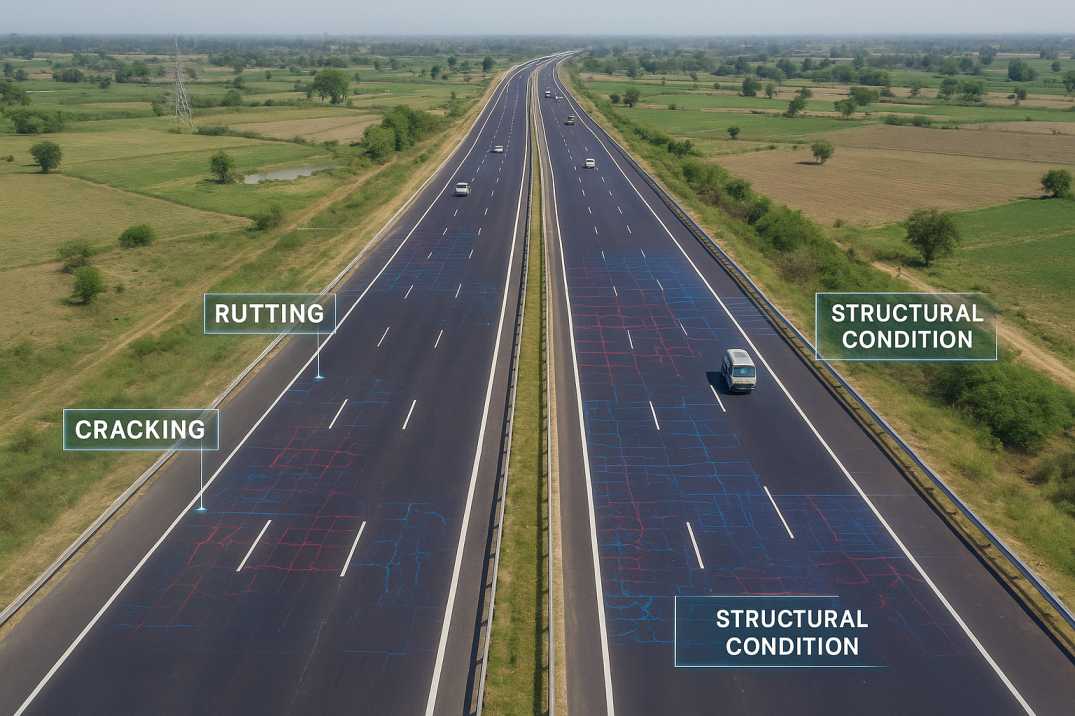
India's expressway network is expanding at an unprecedented pace, connecting major cities, industrial hubs and logistics corridors. These high-speed corridors are designed to improve mobility, reduce travel time and support national economic growth. Yet, despite modern pavement design standards from the Ministry of Road Transport and Highways and Indian Roads Congress, many expressways begin to show distress far earlier than their intended design life.
Premature failures undermine safety, increase travel time, escalate maintenance budgets and reduce overall network sustainability. Traditional inspection methods—periodic, labour-intensive and often subjective—struggle to keep pace with the scale and speed of India's fast-growing highway system.
This is where AI-driven pavement condition monitoring and predictive maintenance come into play, helping India move from reactive repairs to proactive, asset-centric expressway management.
1.1 Chronic Overloading
A significant share of freight vehicles operate above legal axle-load limits. Even pavements designed per IRC and MoRTH specifications deteriorate quickly when subjected to repeated overloading, leading to fatigue cracking, rutting and structural failures. The Traffic Analysis Agent helps identify corridors with excessive loading.
1.2 Underestimated Traffic Growth
Actual ESAL (Equivalent Standard Axle Load) values often exceed projections. Rapid industrialisation and freight growth accelerate traffic loads, shortening pavement life despite scientific forecasting.
1.3 Diverse and Extreme Climatic Conditions
India's expressways run through extreme climatic zones. High heat, heavy monsoons, freeze–thaw cycles in the north and prolonged moisture exposure collectively accelerate pavement degradation.
1.4 Construction Quality Variations
Even small deviations during construction can significantly affect long-term performance. Issues commonly contributing to failures include:
1.5 Drainage Deficiencies
Water is pavement's most destructive enemy. Failures often stem from:
1.6 Limited Frequency of Manual Inspections
Manual assessments are periodic and subjective. Many early-stage distresses form internally and remain invisible until the damage progresses. By then, repairs become costlier and more complex.
1.7 Material Aging
Bitumen oxidation and hardening, aggregate polishing, and binder embrittlement accelerate under India's extreme temperatures, reducing pavement flexibility and fatigue resistance.
2.1 Structural Distress
2.2 Functional Distress
2.3 Environmental Distress
The Indian Roads Congress emphasises several foundational principles for durable pavements:
These principles create the baseline for resilient pavements—yet implementing them consistently across thousands of kilometres remains a major challenge. AI through the Pavement Condition Intelligence Agent steps in precisely here, ensuring these principles are monitored, measured and enforced continuously.
4.1 Delhi–Mumbai Expressway
India's longest expressway faces heavy freight traffic and varied climatic conditions across its 1,350 km length, requiring continuous monitoring.
4.2 Delhi–Meerut Expressway
High-speed urban corridor with significant commuter traffic and construction activities requiring frequent condition assessment.
4.3 Eastern Peripheral Expressway
Freight bypass around Delhi with heavy truck traffic and specialised pavement design requiring performance verification.
4.4 Western Peripheral Expressway
Companion to EPE with similar freight demands and monitoring requirements.
4.5 Agra–Lucknow Expressway
High-speed corridor through agricultural regions with seasonal traffic variations and temperature extremes.
4.6 Purvanchal Expressway
Newly constructed corridor requiring baseline establishment and deterioration tracking.
4.7 Mumbai–Nagpur Expressway (Samruddhi Mahamarg)
Major economic corridor with diverse terrain and heavy vehicle composition requiring structural monitoring.
RoadVision AI operationalises IRC principles through scalable, automated pavement intelligence systems via its integrated suite of AI agents.
5.1 Continuous Network-Level Monitoring
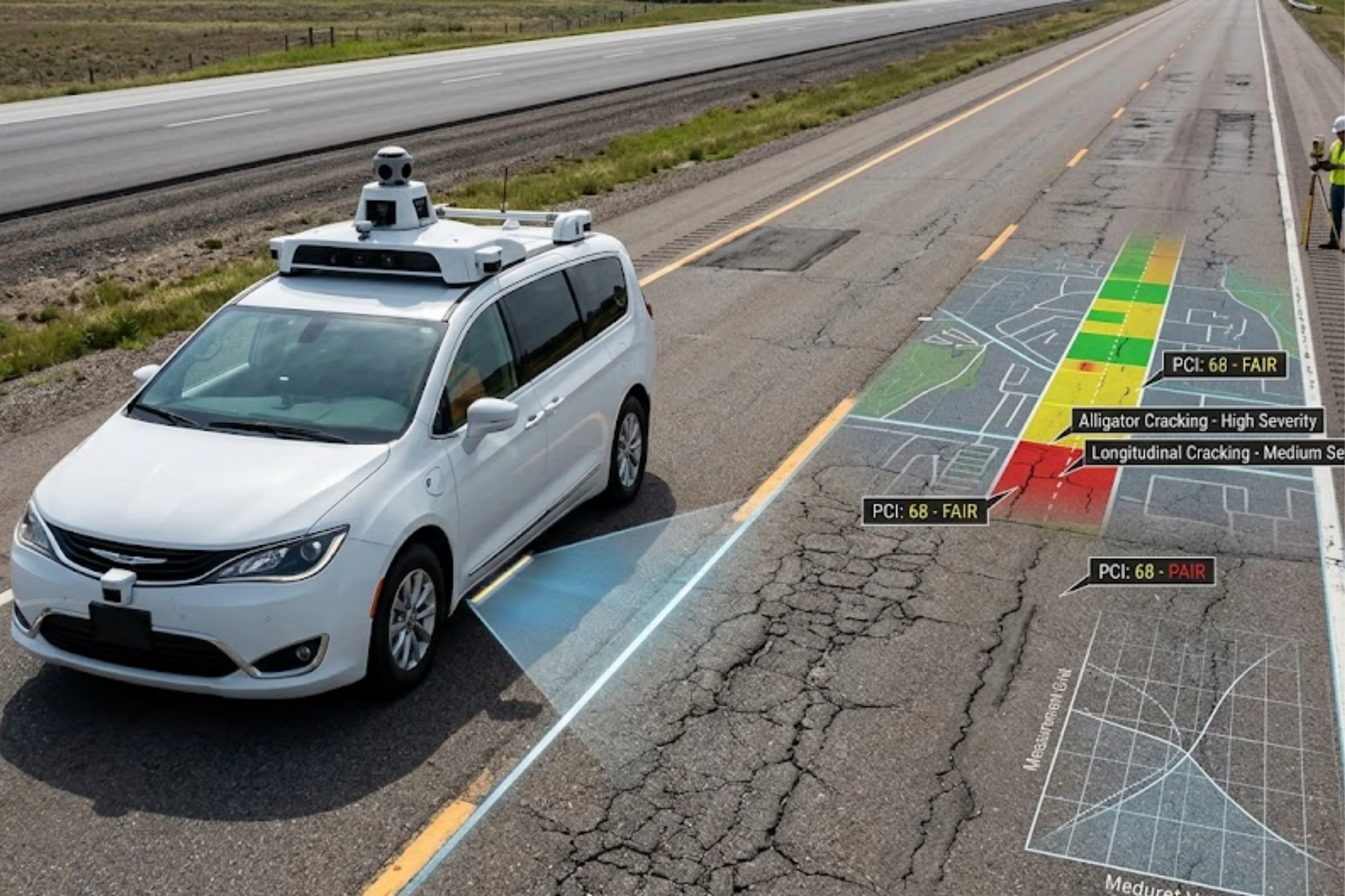
Instead of sample-based or seasonal surveys, the Pavement Condition Intelligence Agent captures network-wide pavement data through video feeds, smartphones or sensor-equipped vehicles. This ensures continuous visibility—because in road maintenance, "a stitch in time saves nine."
5.2 Automated Detection of Pavement Distresses
The Pavement Condition Intelligence Agent identifies a wide range of pavement defects including:
AI eliminates subjectivity, providing consistent, standardised IRC-aligned evaluations.
5.3 Predictive Maintenance Modelling
Using ML-driven deterioration models through the Pavement Condition Intelligence Agent, RoadVision AI forecasts:
This helps agencies fix early, fix small, and avoid expensive reconstruction later.
5.4 Integrated Road Safety & Inventory Intelligence
The platform blends pavement data with:
This creates unified insight for expressway operators, supporting holistic, safety-led management.
5.5 Fast, Scalable Digital Surveys
RoadVision AI enables survey teams to inspect hundreds of kilometres per day—without lane closures or heavy manpower. Efficiency and accuracy go hand in hand.
5.6 Improved Compliance With IRC & MoRTH Guidelines
By generating standardised, objective measurements, RoadVision AI ensures better compliance with national pavement evaluation norms, improving transparency during audits and performance-based contracts.
5.7 Drainage Performance Monitoring
The Roadside Assets Inventory Agent identifies:
6.1 Direct Costs
6.2 Indirect Costs
6.3 Opportunity Costs
Despite advanced practices, Indian expressway management faces challenges:
7.1 Data Gaps
Manual or infrequent inspections create gaps between condition updates, allowing deterioration to progress undetected.
AI Solution: Continuous monitoring through the Pavement Condition Intelligence Agent eliminates gaps.
7.2 Rapid Deterioration
Overloaded freight traffic accelerates wear beyond design predictions.
AI Solution: Real-time loading data from the Traffic Analysis Agent informs deterioration models.
7.3 Regional Climate Variability
Diverse climatic zones across India complicate uniform maintenance strategies.
AI Solution: Region-specific models account for local climate conditions.
7.4 Resource Constraints
Limited manpower and equipment restrict inspection frequency and coverage.
AI Solution: Automated surveys reduce resource requirements.
7.5 Reactive Maintenance
Event-based maintenance addresses failures after they occur rather than preventing them.
AI Solution: Predictive maintenance through RoadVision AI enables proactive intervention.
7.6 Construction Quality Documentation
Limited as-built records make performance prediction difficult.
AI Solution: Digital records through the Roadside Assets Inventory Agent maintain complete history.
AI bridges these gaps by providing clarity, foresight and continuous surveillance.
8.1 Extended Pavement Life
8.2 Reduced User Costs
8.3 Better Asset Management
India's expressways are national assets that require meticulous, technology-driven care. Premature failures can be avoided when pavement condition is monitored continuously through the Pavement Condition Intelligence Agent, predictive insights guide maintenance decisions via the Traffic Analysis Agent, and IRC principles are enforced objectively.
The platform's ability to:
transforms how expressway management is approached across India.
AI-powered pavement condition monitoring through RoadVision AI is transforming how India manages its highways. It improves safety, extends pavement life, reduces costs and enhances overall road performance through the Road Safety Audit Agent and Roadside Assets Inventory Agent. As the old saying goes, "Prevention is better than cure," and with AI, expressway operators finally have the tools to prevent rather than merely repair.
If your organisation aims to adopt smart, data-driven pavement management, book a demo with RoadVision AI today and discover how our platform can help you protect India's expressway assets.
Early failures are caused by overloading, climate stress, construction variations and limited inspection frequency.
AI enables continuous assessment, automated defect detection and predictive insights that support proactive maintenance.
AI enhances manual inspections by providing objective, large-scale, and continuous monitoring but does not completely replace human oversight.

The Autonomous Road Engineer
AI-powered road condition monitoring, asset management, & infrastructure intelligence helping agencies move from reactive maintenance to predictive road management.



.webp)