
Australia's road network—valued at more than $250 billion—is one of the nation's most critical public assets. From regional highways stretching across the outback to urban arterials supporting growing suburbs, these roads are essential for mobility, freight, and economic resilience. Yet maintaining such an enormous network is no small feat.
Many local councils and transport authorities still rely on traditional, manual pavement inspections that are slow, inconsistent, and increasingly unsuited to modern infrastructure demands. As traffic volumes increase and maintenance budgets tighten, the old ways simply do not keep pace. In other words, you can't fix tomorrow's problems with yesterday's tools.
This is where AI-driven pavement inspection and laser profiling are changing the game—bringing precision, speed, and predictive intelligence to road asset management across Australia.
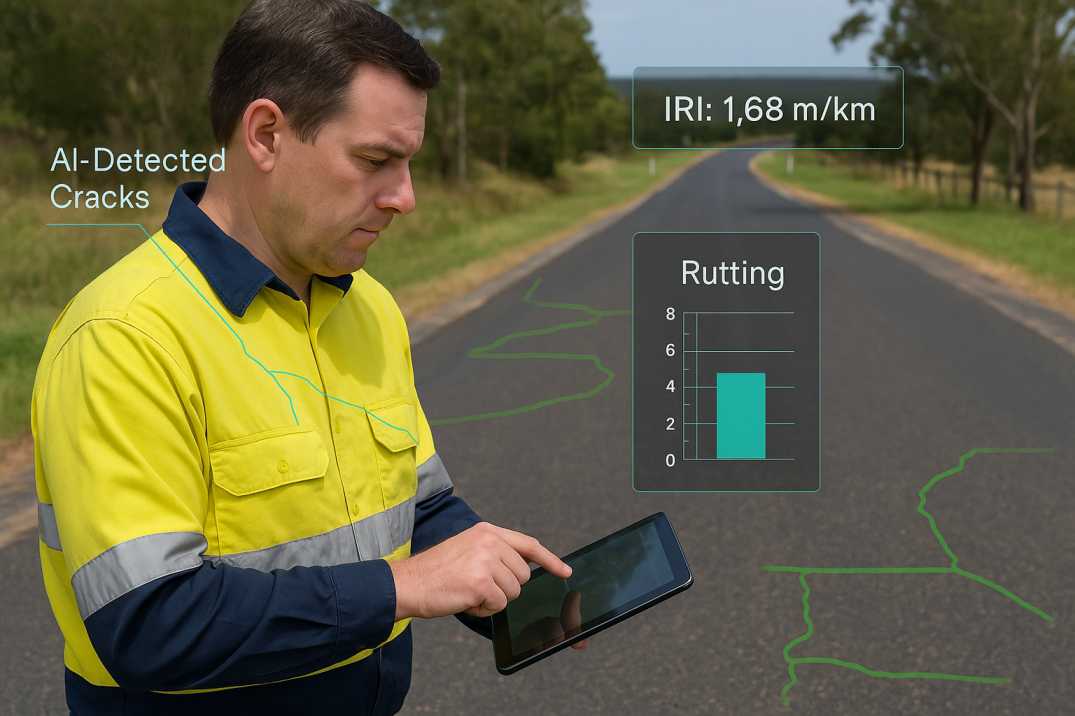
The Austroads Guide to Asset Management and Part 5B: Pavement Condition Assessment emphasise the importance of objective, repeatable, and data-driven inspection methodologies.
However, many councils still rely on:
These methods often lead to inconsistent evaluations, deferred maintenance, funding misallocation, and—worst of all—safety risks for road users.
Australia's geography further complicates the challenge. The vast network spans:
When conditions vary so dramatically, a scalable, automated, and high-resolution method is not just useful—it's indispensable.
Although Australia follows Austroads pavement assessment standards, the underlying engineering principles align with global practices, including the mechanistic-empirical framework used in Indian Roads Congress (IRC) design guidelines. At their core, modern pavement condition assessment relies on three fundamental principles:
2.1 Accurate Surface Profiling
Laser profilers measure attributes such as:
This laser-based approach is far more precise than traditional roughness measurements or manual rut-bar assessments, capturing continuous data at highway speeds.
2.2 Objective Condition Ratings
The Pavement Condition Intelligence Agent converts raw laser and image data into reliable pavement indicators including:
No subjectivity, no "best guess"—just engineering-grade data that stands up to audit scrutiny.
2.3 Predictive Asset Modelling
AI uses historical patterns and multi-year deterioration curves to forecast:
This aligns squarely with the Austroads lifecycle planning framework, reinforcing evidence-based decision-making across all levels of government.
The integration of AI and laser profiling is best realised through platforms like RoadVision AI, which delivers end-to-end automated pavement intelligence across Australia through the Pavement Condition Intelligence Agent.
3.1 High-Speed Laser Pavement Surveys
RoadVision AI's mobile profiling units capture:
All at traffic speeds, meaning zero traffic disruption and no lane closures—a critical advantage on busy Australian roads.
3.2 AI Surface Profiling and Defect Detection
Advanced computer vision algorithms identify:
AI eliminates the variability inherent in human inspections, producing repeatable condition scores suitable for audits, funding applications, and long-term planning.
3.3 Integrated Road Asset Management for Councils
RoadVision AI feeds directly into:
The outcome? Councils can stretch their budgets further and intervene before roads deteriorate to unsafe levels, achieving the elusive goal of "fixing it before it's busted."
3.4 Compliance with Australian Standards
RoadVision AI's methodologies align with:
As the saying goes, "measure twice, cut once"—precise measurement ensures smarter, more efficient maintenance that maximises return on every infrastructure dollar.
3.5 Integration with Safety and Traffic Data
The Road Safety Audit Agent and Traffic Analysis Agent complement pavement data with:
Even with advanced tools, road agencies face several persistent challenges:
4.1 Geographic Scale and Diversity
Surveying large rural networks across Western Australia, Queensland, and the Northern Territory is costly and time-intensive with traditional methods. AI-enabled surveys using existing fleet vehicles dramatically reduce these costs.
4.2 Ageing Infrastructure
Many pavements are operating beyond their design life, requiring more frequent assessments to detect accelerated deterioration. Laser profiling enables this increased frequency without proportional cost increases.
4.3 Skilled Workforce Shortages
Regional councils often lack the specialist engineers needed for detailed pavement evaluations and interpretation of condition data. AI platforms democratise access to expert analysis through automated reporting and actionable recommendations.
4.4 Budget Constraints
Competing priorities mean pavement maintenance often gets deferred—until problems become more expensive to fix. Predictive modelling helps councils demonstrate the cost-effectiveness of preventive maintenance to secure funding.
4.5 Data Integration
Legacy asset management systems may struggle to ingest high-resolution laser data. RoadVision AI addresses this through flexible export formats and API integration with major Australian PMS platforms.
AI and laser profiling directly address these issues by delivering faster, more scalable assessments with minimal staff input while improving data quality and consistency.
Australia's extensive road network is both a national asset and a national responsibility. With ageing infrastructure, climate pressures, and growing mobility demands, traditional inspection methods are no longer adequate to meet the challenges of the 21st century.
Laser profiling and AI represent a major leap forward—offering accuracy, speed, and foresight that manual surveys simply cannot match. It's a classic case of "a stitch in time saves nine": early detection is far cheaper than late intervention, and predictive maintenance beats emergency repairs every time.
RoadVision AI is at the forefront of this transformation—combining laser profiling, digital twins, AI-driven road safety audits, and predictive modelling into a unified pavement intelligence ecosystem through the Pavement Condition Intelligence Agent, Road Safety Audit Agent, Traffic Analysis Agent, and Roadside Assets Inventory Agent.
By adopting these technologies today, councils, transport authorities, and engineering consultants can:
If you're ready to revolutionise your inspection process and modernise your pavement management strategy, book a demo with RoadVision AI today and discover how the future of pavement condition surveys can transform your approach to road asset management.
Q1. What is laser profiling in pavement condition surveys?
Laser profiling uses sensors to measure road roughness, rutting, and surface texture, producing high-resolution condition data for asset evaluation.
Q2. Is AI surface profiling compliant with Austroads standards?
Yes, AI-enhanced profiling aligns with Austroads methods for IRI, rut depth, and pavement fault detection, offering data accuracy and consistency.
Q3. How does AI improve road inspections in Australia?
AI enables faster, automated inspections with predictive maintenance insights, reducing costs and improving pavement lifespan.

The Autonomous Road Engineer
AI-powered road condition monitoring, asset management, & infrastructure intelligence helping agencies move from reactive maintenance to predictive road management.


.webp)
.webp)
.webp)