
Canada's expansive geography and extreme winter climate pose formidable challenges for road authorities. Heavy snowfall, black ice formation, frost heaves, and repeated freeze–thaw cycles accelerate pavement deterioration and compromise road safety. The result: cracks, potholes, rutting, drainage failures, and rapid loss of surface integrity—issues that place tremendous pressure on maintenance budgets and risk the safety of millions of drivers.
To address this, winter road maintenance in Canada must evolve from traditional, reactive operations to proactive, predictive, and data-driven strategies. AI-enabled solutions offer exactly that—accurate forecasting, early defect detection, and intelligent planning. When the weather changes "faster than you can say Jack Frost," advanced systems become indispensable.
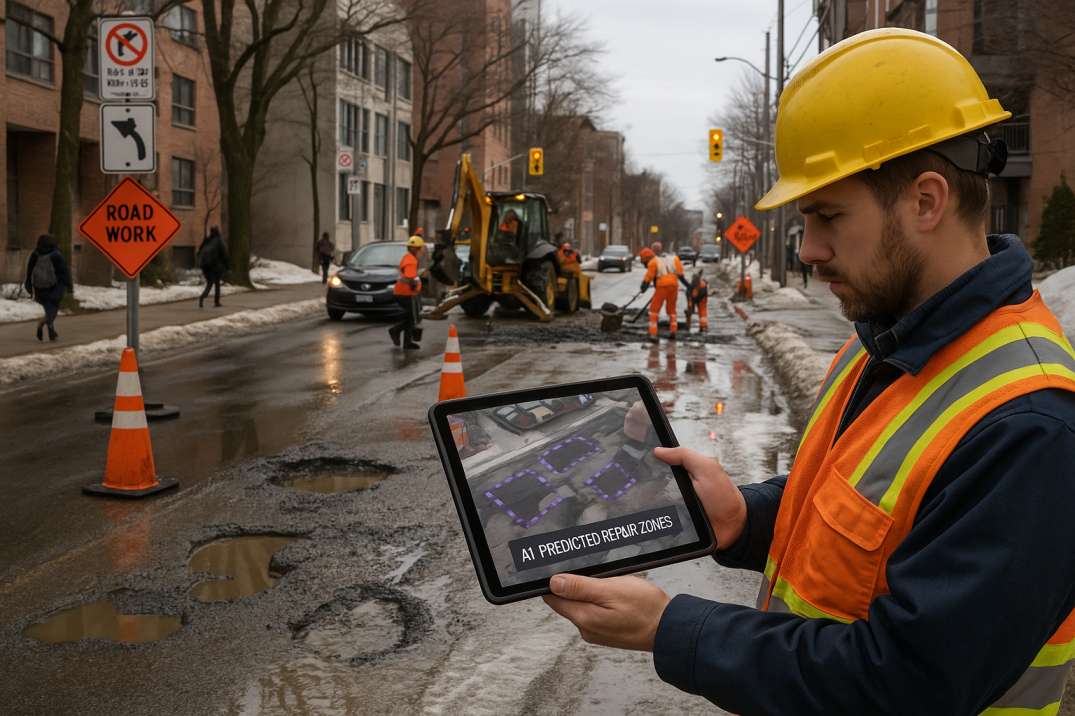
Winter maintenance costs continue to rise, and conventional inspection methods—manual surveys, spot checks, and weather-dependent fieldwork—are no longer efficient. They often fail to detect early-stage freeze-related damage, and insights arrive too late to prevent costly rehabilitation.
Government and provincial agencies are shifting gears. Transport Canada has already committed investments toward AI-powered predictive maintenance technologies, which support smarter planning for snow removal, de-icing operations, and pavement preservation. Provinces like Ontario, Alberta, and Quebec are adopting sensor networks, automated visual inspections, and AI-based forecasting tools to make winter road asset management more resilient.
Key challenges that demand AI intervention include:
AI is not merely an upgrade—it is a necessity for a country where winter can make or break infrastructure.
While India's IRC guidelines were developed for local environments, the core principles—structured assessments, defect categorisation, preventive maintenance, and geometric safety—are globally relevant and adaptable. Canadian winter maintenance mirrors these principles through:
AI platforms elevate these principles by automating compliance, enabling consistent monitoring, and delivering actionable insights that match Canadian climatic realities through the Pavement Condition Intelligence Agent and Road Safety Audit Agent.
In essence, AI does not replace standards—it reinforces and operationalises them.
AI-powered platforms like RoadVision AI help Canadian agencies stay ahead of winter damage by transforming raw road data into real-time, predictive intelligence.
3.1 Early Detection of Snow-Induced Damage
Using high-resolution cameras, computer vision, and drone mapping, the Pavement Condition Intelligence Agent identifies:
The platform classifies damages by severity, enabling quick decisions—because "a stitch in time saves nine."
3.2 Predictive Maintenance Powered by Weather and Traffic Data
By correlating weather forecasts, historical freeze–thaw behaviour, and traffic loads, RoadVision AI predicts where damage is likely to occur before it becomes critical. This supports:
This aligns seamlessly with Canadian winter asset management practices and provincial requirements.
3.3 AI-Driven Safety Risk Mapping for Winter Roads
Slippery curves, black ice zones, and hidden cracks pose high accident risks. With AI-based safety audits through the Road Safety Audit Agent, RoadVision AI identifies:
It generates risk heatmaps so authorities can warn drivers and address hazards promptly before crashes occur.
3.4 Automated Road Inventory & Compliance Tracking
Winter storms often damage signs, guardrails, shoulders, and drainage infrastructure. The Roadside Assets Inventory Agent captures:
This supports compliance with provincial standards from bodies such as Ontario Ministry of Transportation, Alberta Transportation, and British Columbia Ministry of Transportation.
3.5 Strategic Spring Rehabilitation Planning
Spring brings the heaviest repair workloads after winter damage peaks. RoadVision AI assists municipalities and provinces with:
This aligns with digital infrastructure mandates from Infrastructure Canada, supporting smarter investments in road renewal.
Despite the advantages, several challenges must be addressed:
But as the proverb goes, "Where there's snow, there's opportunity." Canada's growing digital infrastructure strategy, supported by investments from Infrastructure Canada and provincial transportation ministries, is steadily bridging these gaps through pilot programmes, technology demonstrations, and capacity building initiatives.
Winter damage to road infrastructure is unavoidable—but widespread failure is not. With AI-driven winter road asset management, Canadian authorities can adopt a proactive, predictive, and cost-efficient approach to maintaining safe road networks through the harshest conditions.
RoadVision AI brings together computer vision, digital twins, safety audits, pavement assessment, and automated inspections through its integrated suite of AI agents to:
Through the Pavement Condition Intelligence Agent, Road Safety Audit Agent, and Roadside Assets Inventory Agent, RoadVision AI empowers agencies to move from reactive, labour-intensive inspections to real-time, data-driven, future-ready maintenance planning.
In short, RoadVision AI ensures that Canadian roads remain safe, resilient, and well-maintained—even when winter tests them to their limits.
If your municipality, province, or agency is ready to transform winter road maintenance from reactive to predictive, book a demo with RoadVision AI today and discover how intelligent asset management can protect your network through every season.
Q1. Can AI predict where winter road damage will occur?
Yes. AI uses historical deterioration data, traffic loads, and climate models to forecast damage before it happens.
Q2. Does AI work in extreme cold regions of Canada?
Yes. RoadVision and other platforms are built to operate in harsh Canadian winters using thermal-resistant hardware and robust datasets.
Q3. Is AI only for highways or also local roads?
AI road asset management systems can be scaled for highways, municipal roads, and rural routes alike.

The Autonomous Road Engineer
AI-powered road condition monitoring, asset management, & infrastructure intelligence helping agencies move from reactive maintenance to predictive road management.


