
Road traffic injuries remain one of the leading causes of fatalities globally, especially in low- and middle-income regions. Traditional approaches to identifying accident-prone locations—commonly called blackspots—have relied heavily on manual surveys, historical reports, and delayed data analysis. These methods are often reactive, fragmented, and limited in scale.
Today, AI based blackspot analysis is transforming how governments, transport authorities, and researchers identify, analyze, and prevent road accidents. By combining artificial intelligence with Geographic Information Systems (GIS), it is now possible to map accident hotspots dynamically, predict risks, and prioritize interventions with precision.
This blog simplifies how AI and GIS work together to map road accident hotspots and why this approach is becoming essential for modern road safety systems.

A road accident hotspot (or blackspot) is a location where a higher-than-average number of crashes occur within a specific period. These could be intersections, curves, pedestrian crossings, or highway segments.
Traditional identification methods rely on:
While useful, these approaches often:
This is where AI for road safety changes the paradigm.
Automated blackspot analysis refers to the use of machine learning, computer vision, and spatial analytics to automatically detect, analyze, and predict high-risk road locations.
Instead of relying only on historical accident data, AI systems integrate:
The output is not just a map of past accidents—but a predictive model of future risks.
Geographic Information Systems (GIS) provide the spatial foundation for analyzing road safety data. GIS enables:
When combined with AI, GIS evolves from a visualization tool into an intelligent decision-making system.
This integration forms the backbone of GIS based accident mapping, where spatial intelligence meets predictive analytics.
AI systems collect large volumes of structured and unstructured data, including:
This creates a comprehensive dataset that reflects real-world road conditions.
Raw data is often inconsistent and incomplete. AI models:
This ensures accuracy in further analysis.
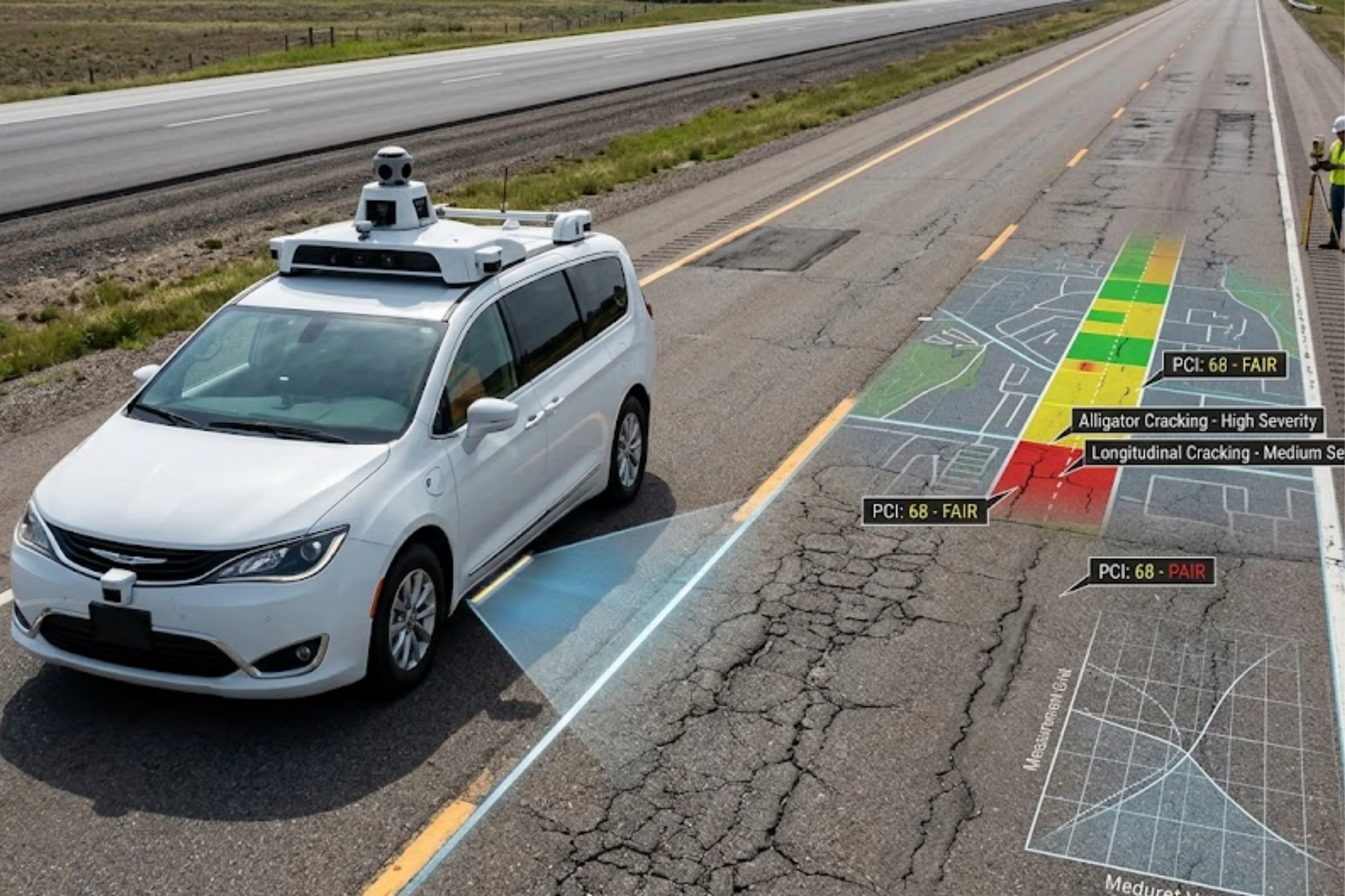
Using advanced vision models, AI can:
This enables automated, large-scale safety audits without manual intervention.
GIS tools process the cleaned data to:
This is where traffic accident hotspot detection becomes precise and location-specific.
AI models analyze patterns such as:
These models can predict where future accidents are likely to occur.
Each location is assigned a risk score based on:
This helps authorities prioritize interventions effectively.
Results are displayed on GIS dashboards with:
This enables quick decision-making for planners and policymakers.
Machine learning models detect hidden patterns in large datasets, enabling predictive insights rather than reactive responses.
Computer vision analyzes visual data to detect hazards, monitor compliance, and assess infrastructure conditions.
Predictive models estimate the probability of accidents at specific locations based on historical and real-time data.
Geospatial analytics integrates spatial and non-spatial data to provide a holistic view of road safety.
Instead of reacting to accidents, authorities can prevent them by identifying risks early.
AI systems can analyze thousands of kilometers of roads quickly and consistently.
Interventions are based on evidence rather than assumptions.
Funds and efforts are directed toward the most critical locations.
Unlike periodic audits, AI enables real-time safety assessment.
AI-based hotspot mapping is highly relevant for:
Before AI, several limitations existed:
AI overcomes these challenges by automating data collection and analysis at scale.
The future of road safety lies in intelligent, autonomous systems that continuously monitor and improve road networks.
Emerging trends include:
These innovations will further enhance the effectiveness of AI for road safety systems.
For successful implementation, organizations should:
A structured approach ensures reliable and actionable insights.
AI based blackspot analysis is not just a technological advancement—it is a fundamental shift in how road safety is managed. By combining AI with GIS, authorities can move from reactive reporting to proactive prevention.
This approach enables:
RoadVision AI is building the world’s first Autonomous Road Engineers—AI systems that continuously monitor, analyze, and improve road infrastructure at scale. By combining vision intelligence and language intelligence, it transforms how road safety, traffic patterns, and infrastructure conditions are managed.
Its Blackspot Analysis Agent automatically detects crash-prone locations, analyzes contributing factors, and visualizes insights through GIS-enabled dashboards. The platform delivers evidence-backed, geo-tagged intelligence that enables governments and infrastructure agencies to take timely, data-driven action.
With multiple AI agents working together—from traffic analysis to safety audits—RoadVision AI provides a unified platform for smarter road management and safer mobility systems.
If you are looking to implement AI based blackspot analysis and transform your road safety strategy, now is the time to act.
Book a demo today and experience how AI can map, predict, and prevent road accidents at scale.
AI based blackspot analysis is the use of artificial intelligence, machine learning, GIS mapping, and computer vision to identify accident-prone road locations automatically. Unlike traditional methods that rely only on historical crash reports, AI systems analyze traffic behavior, road conditions, infrastructure quality, and environmental factors to predict high-risk zones and improve road safety planning.
GIS (Geographic Information Systems) helps visualize and analyze accident locations spatially. In GIS based accident mapping, road safety data such as crash records, traffic flow, weather conditions, and road geometry are layered onto digital maps to identify accident clusters and risk patterns. When combined with AI, GIS enables predictive hotspot detection and smarter traffic safety decision-making.
AI-powered traffic accident hotspot detection helps authorities improve road safety through faster risk identification, predictive crash analytics, and data-driven interventions. It enables continuous monitoring, efficient resource allocation, smarter infrastructure planning, and proactive accident prevention across highways, urban roads, and smart city transportation networks.

The Autonomous Road Engineer
AI-powered road condition monitoring, asset management, & infrastructure intelligence helping agencies move from reactive maintenance to predictive road management.


.webp)
.webp)