
ndia's rural road network under the Pradhan Mantri Gram Sadak Yojana (PMGSY) is one of the most ambitious infrastructure programmes globally. With over 6 lakh kilometres of roads connecting villages to economic and social opportunities, maintaining quality standards at scale has become a critical challenge.
Today, the issue is no longer road construction it is ensuring continuous quality compliance. Traditional survey methods are slow, inconsistent, and incapable of handling this scale. This is where AI road inspection is transforming how rural roads are monitored and maintained.
PMGSY roads must meet defined pavement performance standards across their lifecycle. These include maintaining acceptable Pavement Condition Index (PCI), roughness levels (IRI), and limits on distress types like cracking, potholes, and rutting.
Monitoring these parameters across thousands of kilometres requires frequent, reliable, and standardized data collection—something manual inspections struggle to achieve efficiently.
Manual inspections have long been the backbone of road quality monitoring, but they fall short at scale:
These inefficiencies highlight the need for road condition monitoring software that can operate at scale with accuracy and speed.
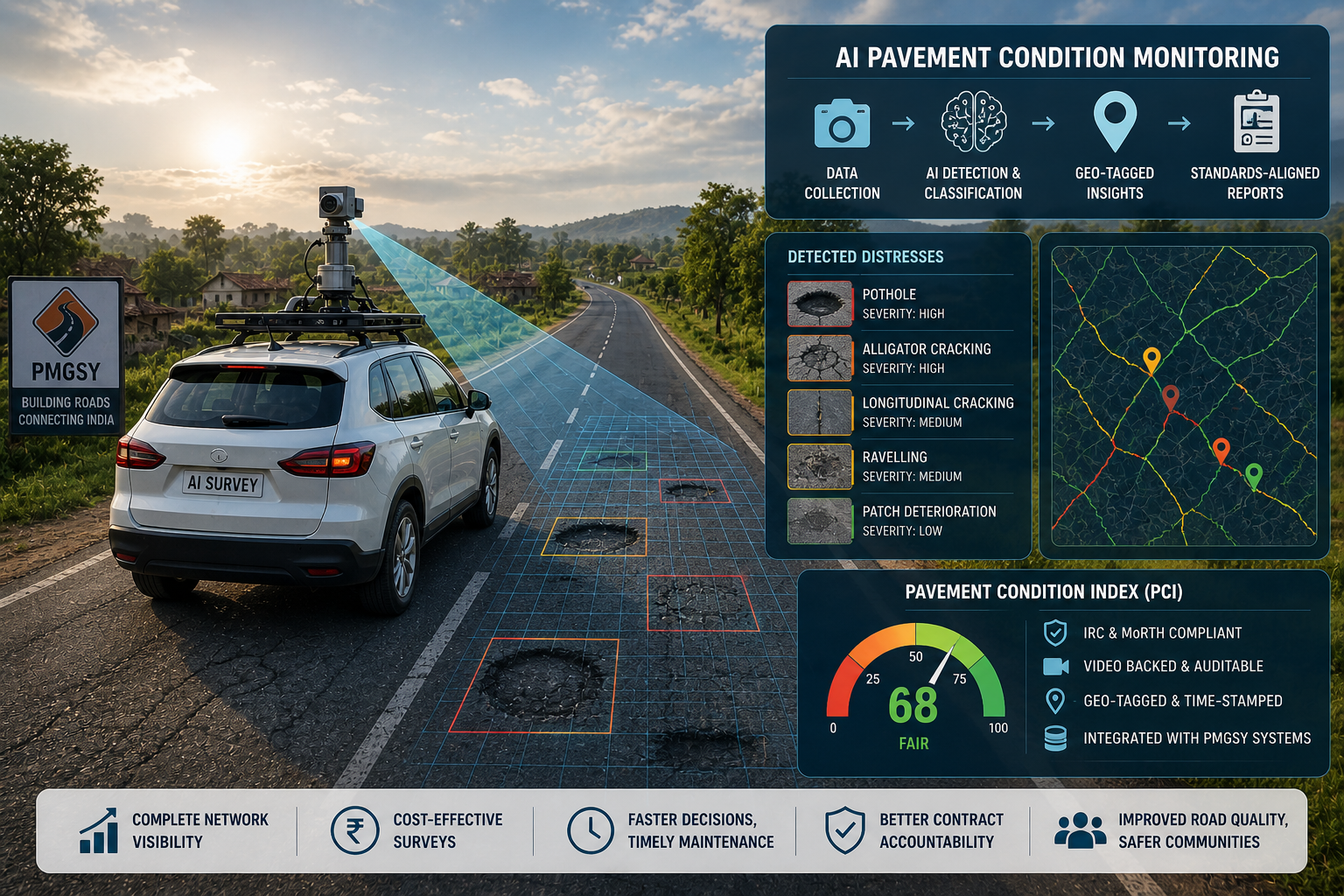
Modern systems powered by computer vision for road inspection are redefining how road surveys are conducted. Instead of manual inspections, vehicles equipped with cameras capture continuous road data at normal speeds.
High-resolution video is collected using dashcams or mounted cameras, enabling rapid coverage of large road networks.
Using automated pavement distress detection, systems automatically identify and classify issues such as potholes, cracks, ravelling, and rutting. Each defect is geo-tagged and assigned a severity score.
Through automated pavement analysis, the system processes large datasets and generates standardized outputs aligned with engineering benchmarks.
Unlike periodic manual surveys, smart road monitoring system enables continuous tracking of road conditions, helping authorities identify deterioration trends early.
AI systems can calculate PCI at scale using standardized methodologies, making large-scale condition assessment practical and consistent.
With GIS-based road inspection, every defect is mapped and recorded with precise location data, creating a transparent and auditable system.
Adopting predictive maintenance for roads brings significant operational advantages:
Instead of reactive maintenance, departments can proactively address issues before they escalate.
At the project level, AI enables:
This is further strengthened by automated road asset management software, which centralizes all condition data and reporting workflows.
Beyond pavements, AI systems also assess roadside infrastructure like signage, drainage, and safety barriers. Integrated insights allow for coordinated maintenance actions, improving overall road safety and efficiency.
Monitoring 6 lakh kilometres manually is impractical. AI makes it feasible to survey entire districts in weeks instead of years. This shift is not just an improvement it is a necessity for modern infrastructure management.
Successful adoption requires:
India is moving toward digital infrastructure management. With advancements in AI, cloud computing, and connectivity, the ecosystem is ready for large-scale adoption.
AI-driven systems will soon become a standard requirement, especially with the rise of AI in infrastructure management enabling smarter, faster, and more transparent decision-making.
RoadVision AI is building the world’s first Autonomous Road Engineers, combining vision and language intelligence to transform road monitoring.
Its platform enables end-to-end automation powered by digital road asset management, from pavement condition assessment to compliance reporting. Every insight is geo-tagged, video-backed, and aligned with engineering standards.
For PMGSY stakeholders, this means moving from manual processes to intelligent, data-driven road management at scale.
AI road inspection systems help monitor PMGSY roads by automating pavement condition assessment using computer vision, video analytics, and geo-tagged surveys. These systems can detect potholes, cracks, rutting, and surface deterioration at scale, enabling faster and more consistent rural road quality monitoring compared to traditional manual inspections.
Manual inspections are difficult because the PMGSY network spans more than 6 lakh kilometres across rural India. Traditional surveys are time-consuming, inconsistent, and limited in coverage. Modern road condition monitoring software powered by AI enables continuous and scalable monitoring with standardized outputs, real-time reporting, and GIS-based evidence collection.
AI-powered pavement condition monitoring improves maintenance planning, reduces survey costs, enables predictive maintenance, and enhances contractor accountability. Using technologies such as automated pavement distress detection and GIS-based road inspection, authorities can identify deteriorating sections early, prioritize repairs scientifically, and ensure long-term compliance with PMGSY quality benchmarks.

The Autonomous Road Engineer
AI-powered road condition monitoring, asset management, & infrastructure intelligence helping agencies move from reactive maintenance to predictive road management.


.webp)
.webp)
%20(1).webp)