
Every year, more than 1.19 million people lose their lives in road traffic crashes across the world. A disproportionate number of these fatalities occur in low- and middle-income countries, where rapid urbanisation and infrastructure gaps create highly unsafe road environments. This reality raises a critical question: how can governments shift from reactive safety measures to a proactive, system-driven approach that prevents accidents before they occur?
The answer increasingly lies in the Vision Zero framework—a revolutionary road safety philosophy that originated in Sweden in 1997. Unlike traditional approaches that accept a certain number of fatalities as inevitable, Vision Zero challenges this assumption entirely. It proposes a bold yet ethical standpoint: no loss of human life on the road is acceptable.
Today, this philosophy—rooted in Nordic road safety principles—is gaining traction in emerging markets across Asia, Africa, Latin America, and the Middle East. With the integration of modern technologies like AI road safety audit systems, predictive road safety analytics, and digital road safety platforms, countries now have the opportunity to leapfrog traditional limitations and build safer road ecosystems at scale.
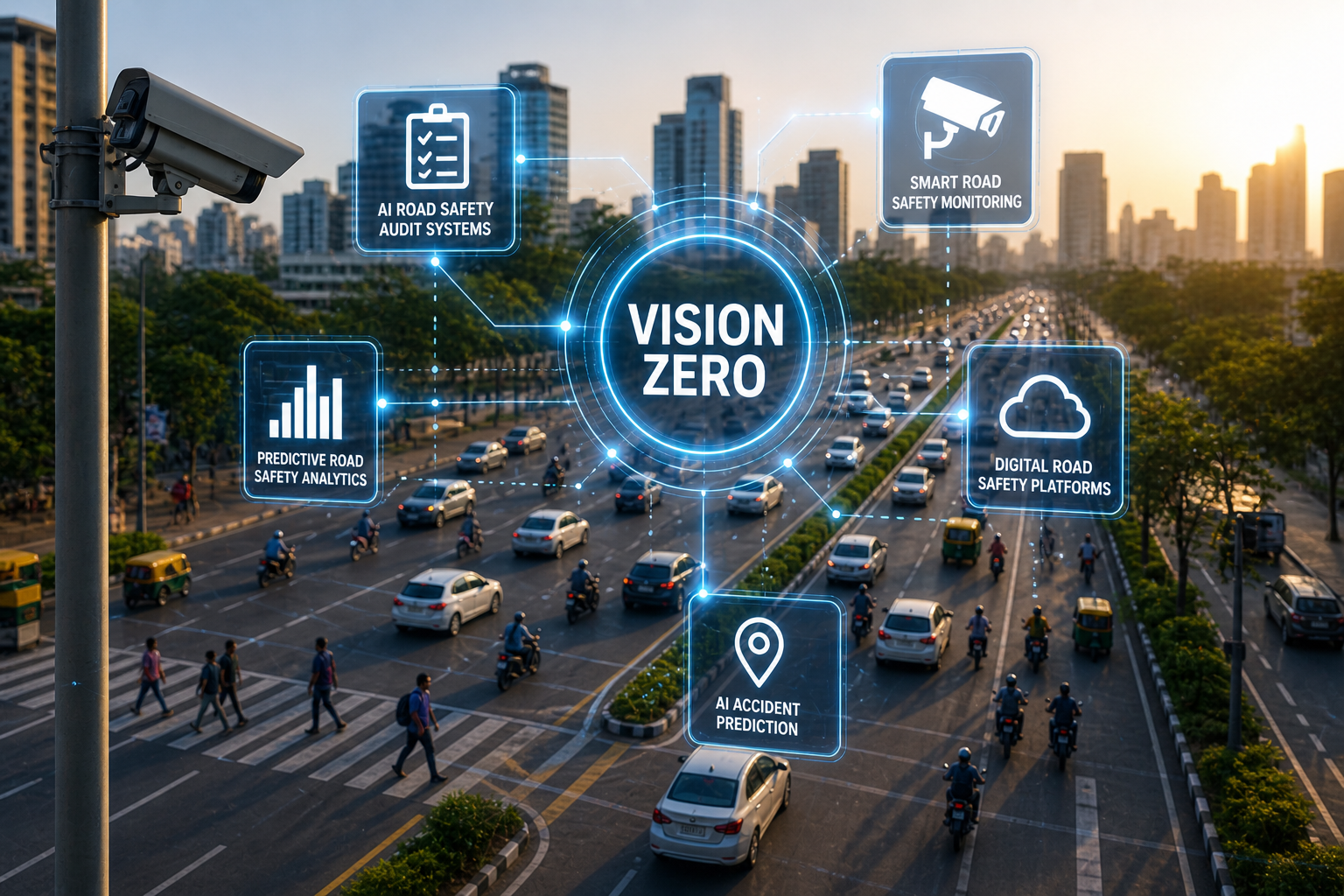
The Vision Zero framework represents a paradigm shift in how road safety is perceived and implemented. Instead of placing responsibility solely on road users, it distributes accountability across the entire system—road designers, policymakers, enforcement agencies, and vehicle manufacturers.
At its core, Vision Zero is built on a few fundamental principles:
This approach has led to remarkable outcomes in Nordic countries. Sweden, for example, has reduced road fatalities by over 80% since the 1970s. Other countries like Norway and Finland have followed similar models, adapting the philosophy to their local contexts while maintaining its ethical foundation.
The success of Nordic countries is not accidental. It is the result of long-term planning, strong political commitment, and a deep reliance on data-driven decision-making.
Central to Nordic road safety is the Safe System Approach, which views the road network as an interconnected ecosystem. Instead of addressing isolated issues, it considers how roads, vehicles, speed, and human behaviour interact.
Key components include:
Nordic countries have embedded road safety into national policy frameworks. Dedicated agencies, stable funding, and strict evaluation mechanisms ensure that safety is never compromised.
A strong emphasis on data collection and analysis allows these countries to continuously refine their strategies. Today, this has evolved into advanced ecosystems supported by smart road safety monitoring and digital road safety platforms, enabling real-time decision-making.
Emerging economies face a severe road safety crisis. Despite having only around 60% of the world’s vehicles, they account for over 90% of global road fatalities. Rapid urban growth, increased motorisation, and weak enforcement systems contribute to this imbalance.
Several factors are driving the adoption of Vision Zero in these regions:
The United Nations Decade of Action for Road Safety (2021–2030) calls for a 50% reduction in road deaths. This global initiative aligns closely with Vision Zero principles, encouraging countries to adopt systemic safety approaches.
International funding bodies now require road safety compliance for infrastructure investments. This has made Vision Zero not just an ethical choice but a financial necessity.
A new generation of planners and engineers trained in Safe System thinking is pushing for change within governments, accelerating adoption.
While Vision Zero offers a powerful framework, its adoption in emerging markets comes with significant challenges.
Unlike Nordic countries, roads in emerging markets are highly heterogeneous. Cars, motorcycles, bicycles, pedestrians, and informal transport systems often share the same space, making standard solutions difficult to apply.
Budget constraints make large-scale infrastructure upgrades challenging. This increases the importance of cost-effective solutions like AI road safety audit systems, which can assess large networks quickly and affordably.
Even when safety laws exist, enforcement is often inconsistent. Without behavioural compliance, infrastructure improvements alone are insufficient.
Reliable road safety data is often missing or incomplete. This limits the ability to make evidence-based decisions, highlighting the importance of predictive road safety analytics and automated data collection tools.
Responsibility for road safety is often divided across multiple agencies, leading to inefficiencies and lack of coordination.
Despite these challenges, several countries are making notable progress.
India has adopted a Safe System approach within its national road safety policy. The use of AI road safety audit systems is expanding, enabling large-scale road assessments and identification of high-risk areas.
The country is focusing on high-risk corridors, using AI accident prediction tools to allocate resources more effectively.
Countries like the UAE are integrating Vision Zero into smart city initiatives, supported by advanced smart road safety monitoring technologies.
Technology is transforming road safety by making data-driven approaches accessible and scalable.
These systems automate road inspections using computer vision and machine learning. They significantly reduce the cost and time required for traditional audits.
By analysing historical data and risk factors, these tools help predict where accidents are likely to occur, enabling proactive interventions.
Continuous monitoring systems provide real-time insights into road conditions, helping authorities prioritise maintenance and prevent hazards.
These platforms integrate multiple data sources into a unified system, enabling holistic analysis and better decision-making.
Advanced algorithms identify high-risk locations and patterns, allowing authorities to act before accidents happen.
For emerging markets, successful adoption requires a structured approach:
Vision Zero is not just a safety framework—it is a design philosophy.
Urban planners must rethink how cities are built:
With tools like AI road safety audit systems, planners can evaluate designs before implementation, ensuring safer outcomes from the start.
Tracking progress is essential for long-term success. Key indicators include:
Using digital road safety platforms, governments can monitor these indicators efficiently and maintain transparency.
Vision Zero is a long-term commitment. While immediate improvements are possible, achieving zero fatalities requires sustained effort over decades.
Emerging markets have a unique advantage—they can adopt modern technologies like predictive road safety analytics and smart road safety monitoring without going through decades of manual processes.
The combination of global policy support, technological innovation, and growing expertise creates an unprecedented opportunity to transform road safety worldwide.
Achieving Vision Zero is no longer just a policy ambition—it’s an execution challenge. Emerging markets don’t lack intent; they lack scalable, data-driven systems to act fast and effectively.
This is where RoadVision AI comes in. Built as an AI road safety audit and infrastructure intelligence platform, it enables governments and road agencies to move from manual inspections to autonomous, real-time decision-making. With capabilities like predictive road safety analytics, smart road safety monitoring, and integrated digital road safety platforms, RoadVision AI helps identify risks, prioritize interventions, and improve safety outcomes at scale.
Instead of reacting to accidents, authorities can now predict and prevent them—turning Vision Zero from a long-term vision into a practical, achievable roadmap.
Book a demo with RoadVision AI today and see how AI-powered road intelligence can accelerate your journey toward safer roads.
Vision Zero is a road safety strategy that originated in Sweden with the goal of eliminating all road traffic fatalities and serious injuries. Instead of accepting accidents as unavoidable, the framework focuses on designing safer roads, improving infrastructure, managing vehicle speeds, and creating systems that reduce human error impact. Today, many countries are combining Vision Zero principles with AI road safety audit systems and predictive analytics to improve road safety outcomes.
AI helps implement Vision Zero by enabling real-time road safety monitoring, automated risk detection, and predictive accident analysis. Technologies such as AI road safety audits, smart road safety monitoring, and predictive road safety analytics allow governments and agencies to identify hazardous locations, prioritize interventions, and continuously monitor infrastructure conditions more efficiently than traditional manual methods.
Emerging markets are adopting Vision Zero because they face disproportionately high road fatality rates due to rapid urbanization, infrastructure gaps, and mixed traffic conditions. AI-powered digital road safety platforms provide scalable and cost-effective ways to improve road safety, optimize infrastructure investments, and move from reactive accident response toward proactive prevention strategies.

The Autonomous Road Engineer
AI-powered road condition monitoring, asset management, & infrastructure intelligence helping agencies move from reactive maintenance to predictive road management.


.webp)
.webp)
%20(1).webp)