
Traffic volume analysis has always been a cornerstone of transportation engineering. From planning new highways to optimizing urban intersections, accurate traffic data determines how efficiently and safely a road network performs. Traditionally, engineers relied on manual counts, loop detectors, and limited sensor-based systems. While these methods laid the foundation for traffic engineering, they often struggle to meet the demands of modern, complex transportation systems.
Today, a significant shift is underway. Engineers and planners are rapidly adopting AI based traffic analysis to overcome limitations in traditional methods and unlock deeper insights into traffic behavior. This transition is not just about automation—it is about precision, scalability, and intelligence.
This blog explores why this shift is happening, how AI is transforming traffic volume analysis, and what it means for traffic engineers and highway planners.
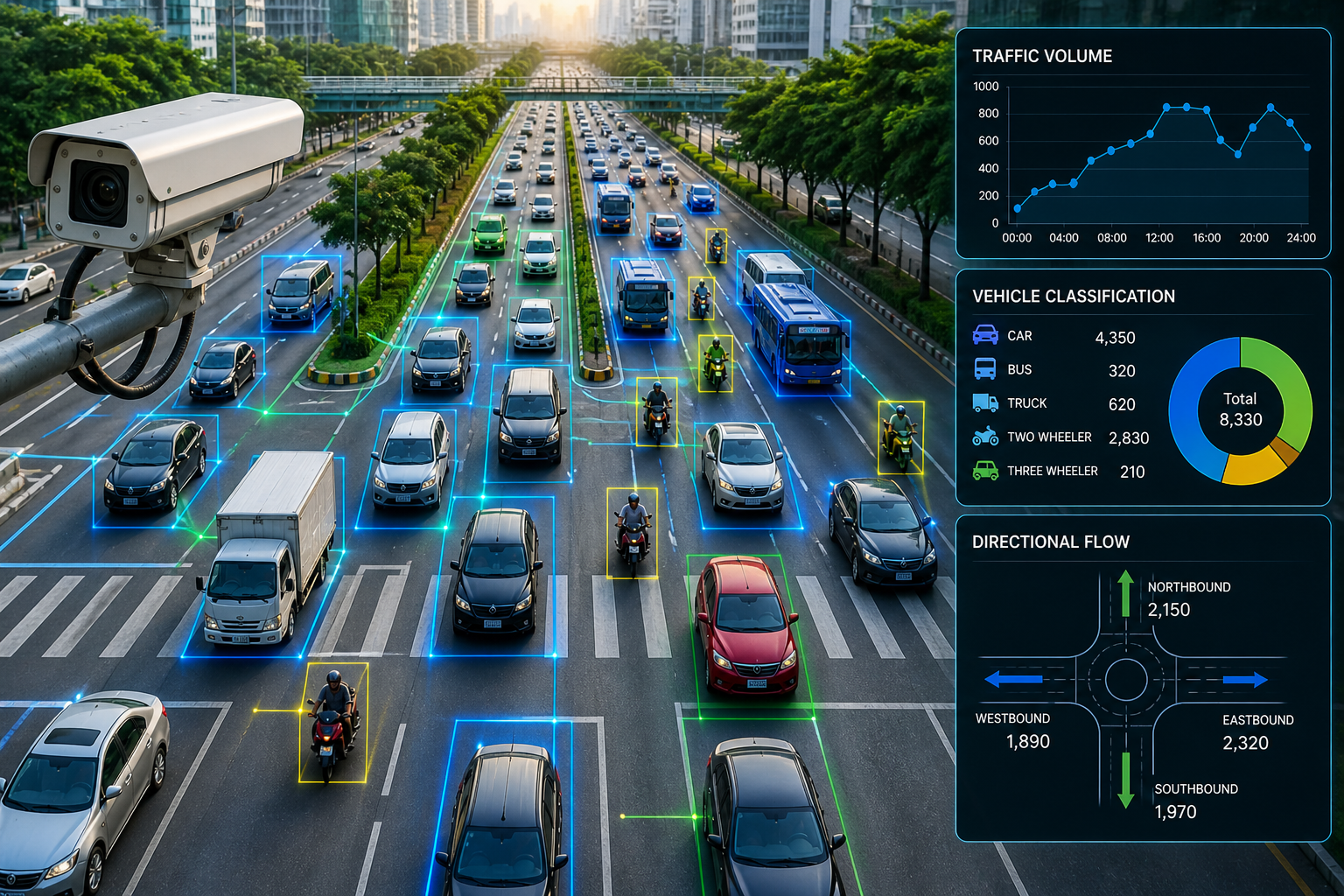
Traffic volume analysis is essential for:
Accurate traffic counts directly influence metrics such as peak hour factors, level of service, and roadway efficiency. Even minor inaccuracies can lead to under-designed infrastructure or over-investment.
However, traditional systems often fall short when dealing with dynamic, real-world traffic environments.
Before understanding the shift to AI, it is important to recognize the challenges engineers face with conventional approaches:
Manual traffic counting requires field personnel, making it labor-intensive, expensive, and prone to human error.
Most surveys are conducted for short durations, which may not represent true traffic patterns across different days or seasons.
Traditional methods often struggle to accurately classify mixed traffic, especially in regions with diverse vehicle types.
Sensors like loop detectors require installation and maintenance, which increases operational costs and limits scalability.
Conventional systems provide static data, making it difficult to respond to real-time traffic conditions.
These limitations create gaps between actual traffic behavior and engineering decisions.
Automated traffic analysis introduces a fundamentally different approach. Instead of relying on limited data points, it leverages video intelligence, machine learning, and automated analytics to continuously monitor and interpret traffic.
At its core, AI systems can:
This shift enables engineers to move from reactive analysis to proactive and predictive planning.
One of the biggest advantages of AI traffic monitoring systems is accuracy. AI models can analyze video feeds frame by frame, ensuring precise vehicle detection and counting.
Unlike manual methods, AI can:
This level of accuracy significantly improves confidence in engineering decisions.
Traditional surveys are limited by time and manpower. In contrast, traffic volume analysis using AI enables continuous monitoring across multiple locations simultaneously.
Benefits include:
This is particularly valuable for large-scale highway and urban projects.
Mixed traffic conditions are common, especially in developing regions. AI excels in identifying diverse vehicle types such as:
Accurate classification improves:
This leads to more realistic and effective road design.
Modern traffic systems require real-time decision-making. AI powered traffic analytics provide instant insights into:
Engineers can now respond dynamically rather than relying on outdated data.
Intersections are critical points in any road network. AI enables detailed analysis of:
With smart traffic analysis tools, engineers can optimize signal timings and reduce delays effectively.
While initial implementation of AI systems may seem significant, the long-term benefits outweigh the costs.
AI eliminates:
This results in lower operational expenses and higher efficiency.
AI transforms raw data into actionable insights. Engineers can now rely on:
This enhances planning accuracy and reduces uncertainty in infrastructure projects.
AI helps cities manage congestion by analyzing traffic flow in real time and optimizing signal systems.
For highways, AI based traffic analysis supports:
AI plays a key role in integrating traffic systems with broader smart city initiatives, enabling coordinated mobility solutions.
Traffic volume data combined with AI insights helps identify high-risk zones and improve road safety strategies.
Modern AI systems are trained to align with established engineering principles and methodologies. This ensures that:
AI does not replace engineering judgment—it enhances it by providing reliable, high-resolution data.
While the shift to AI is accelerating, some challenges remain:
Video-based systems raise privacy questions. However, modern AI solutions anonymize data and focus on patterns rather than identities.
Many agencies use legacy systems. AI platforms are increasingly designed to integrate seamlessly with existing workflows.
Engineers may need training to interpret AI-driven insights. User-friendly dashboards and visualization tools are addressing this gap.
The future of traffic engineering is deeply connected with AI. Emerging trends include:
As transportation systems become more complex, AI traffic monitoring systems will become essential rather than optional.
For traffic engineers and highway planners, adopting AI is not just about technology—it is about staying relevant in a data-driven world.
With intelligent traffic analysis, professionals can:
The ability to analyze traffic at scale with precision is becoming a competitive advantage.
The transition from traditional methods to AI based traffic analysis marks a significant evolution in transportation engineering. Engineers are no longer limited by fragmented data and manual processes. Instead, they have access to continuous, high-quality insights that reflect real-world traffic behavior.
This shift is enabling smarter planning, better design, and more efficient road networks.
RoadVision AI is building the world’s first Autonomous Road Engineers by combining vision intelligence and language intelligence to transform how road infrastructure is monitored and managed. Its AI-driven platform analyzes traffic, road conditions, safety risks, and infrastructure assets at scale using video-backed, geo-tagged intelligence.
With dedicated AI agents for traffic analysis, safety audits, and road monitoring, RoadVision AI enables governments and infrastructure companies to move from manual processes to fully automated, data-driven decision-making.
The Traffic Analysis capabilities provide:
All insights are visualized through GIS-enabled dashboards, making them actionable and easy to interpret for engineers and planners.
If you are looking to upgrade your traffic analysis capabilities and move towards intelligent, scalable solutions, now is the time to adopt AI.
Book a demo with RoadVision AI and experience how AI based traffic analysis can transform your traffic engineering workflows and decision-making process.
AI based traffic analysis uses artificial intelligence, computer vision, and video analytics to automatically monitor, detect, count, and classify vehicles across roads and intersections. Unlike traditional manual surveys or sensor-based systems, AI can continuously analyze traffic patterns in real time, helping engineers improve road planning, congestion management, and transportation efficiency.
Engineers are adopting AI traffic monitoring systems because traditional traffic surveys are time-consuming, expensive, and limited in coverage. AI-powered systems provide higher accuracy, continuous monitoring, advanced vehicle classification, real-time congestion insights, and scalable traffic analysis across large road networks. This helps transportation agencies make faster and more data-driven infrastructure decisions.
AI-powered traffic volume analysis enables precise vehicle counting, lane-wise flow tracking, turning movement analysis, and peak-hour traffic monitoring using video intelligence. These insights help engineers optimize signal timings, reduce congestion, improve intersection performance, and design safer, more efficient transportation networks through intelligent traffic analytics.

The Autonomous Road Engineer
AI-powered road condition monitoring, asset management, & infrastructure intelligence helping agencies move from reactive maintenance to predictive road management.


.webp)
.webp)