India's rapidly expanding road network—one of the largest in the world—faces increasing stress from rising traffic volumes, diverse climatic conditions, and aging assets. Ensuring that pavements remain safe and serviceable is not just a maintenance concern; it is a road-safety imperative. The Indian Roads Congress, through IRC 115, provides the technical backbone that links pavement condition directly with safety outcomes.
As the proverb goes, "A stitch in time saves nine," and in road infrastructure, early detection of pavement distress can prevent accidents, reduce repair costs, and extend asset life. Modern AI-driven tools are now transforming how agencies implement these guidelines—bringing precision, scale, and accountability to India's road safety ecosystem.
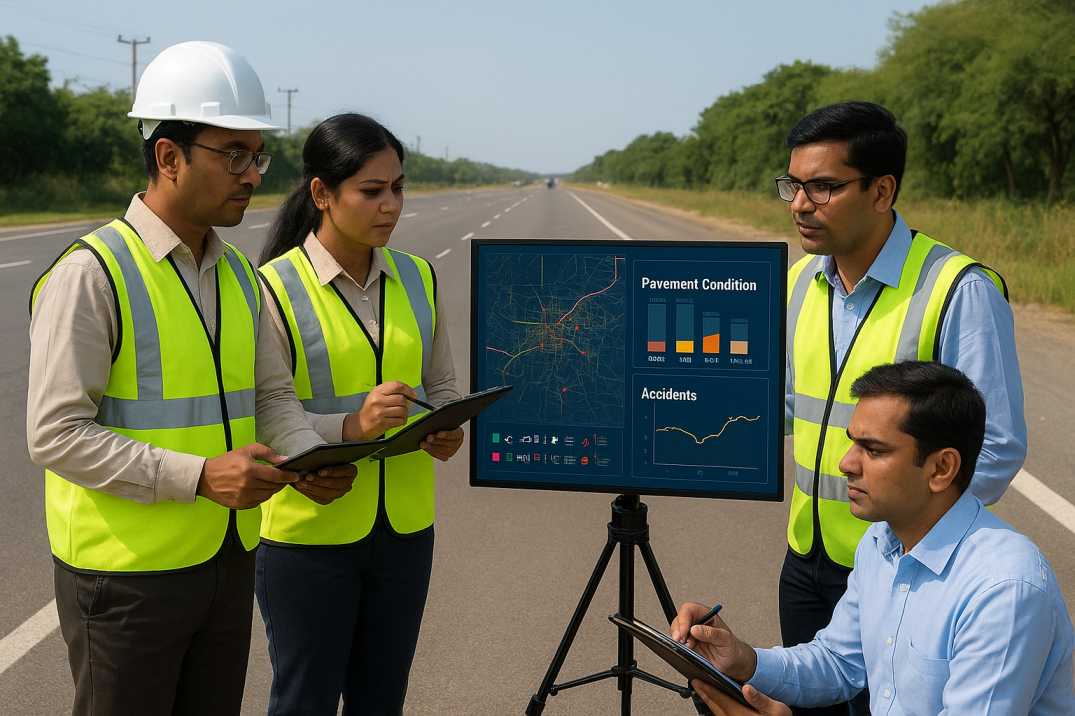
A road is only as safe as the surface vehicles travel on. Deterioration such as potholes, rutting, ravelling, and cracking has a well-documented correlation with crash risk. Two-wheelers and pedestrian-heavy corridors, in particular, face elevated vulnerability when pavements deteriorate.
Poor pavement condition often acts as a silent threat—not immediately visible in high-level assessments but capable of triggering:
This is why integrating pavement surveys with road safety audit India processes is essential for evidence-based risk mitigation.
IRC 115 standardizes the methodology for pavement condition surveys across Indian highways and urban roads. It prescribes:
2.1 Systematic Distress Identification
Documentation of all distress types including:
2.2 Measurement Protocols for Severity and Extent
Standardized methods for quantifying:
2.3 Development of a Pavement Condition Index (PCI)
A numerical score (0-100) that quantifies overall pavement health, enabling:
2.4 Uniform Reporting Formats
Standardized templates for compliance with Ministry of Road Transport and Highways (MoRTH) mandates, ensuring consistency across agencies and projects.
2.5 Integration of Structural and Functional Condition Indicators
Combining surface condition data with structural capacity assessments for comprehensive pavement evaluation.
The document essentially ensures that pavement condition data is quantifiable, comparable, and actionable across agencies. It forms the technical foundation for linking pavement health with safety audits, performance indicators, and maintenance planning.
A high-quality road safety audit India depends heavily on reliable pavement data. When PCI falls, crash risk rises—especially in corridors with high speeds, sharp curves, or mixed traffic.
Key correlations between pavement condition and safety include:
Integrating IRC 115-based surveys into safety audits enables agencies to:
Simply put, pavement condition acts as the "first line of defence" in road safety. Without accurate condition assessment, even the most detailed safety audit remains incomplete.
RoadVision AI brings automation, precision, and scale to the traditionally manual and time-consuming IRC 115 survey process. Through AI-based pavement maintenance, dashcam-driven inspections, and computer vision, RoadVision AI streamlines the entire workflow—from defect detection to safety-focused decision-making.
4.1 AI-Driven Pavement Surveys
The Pavement Condition Intelligence Agent provides:
4.2 Integrated Road Safety Audit Solutions
The Road Safety Audit Agent enables:
4.3 Predictive Pavement Analytics
Machine learning models:
4.4 Digital Road Maintenance Systems
The Roadside Assets Inventory Agent provides:
4.5 Traffic Data Integration
The Traffic Analysis Agent correlates:
As the saying goes, "Measure twice, cut once." RoadVision AI ensures that decisions are based on accurate measurements—every time.
Despite its importance, agencies face several implementation hurdles:
5.1 Variability in Manual Data Quality
Different inspectors produce inconsistent results, making network-wide comparisons unreliable and trend analysis difficult.
5.2 Limited Trained Manpower for Distress Indexing
Skilled pavement engineers are in short supply, especially in smaller districts and remote areas.
5.3 Fragmented Maintenance Workflows
Multiple contractors and authorities with different systems create data silos that prevent coordinated planning.
5.4 Time-Consuming Field Surveys
Manual surveys of large networks take months, meaning decisions are based on outdated information.
5.5 Inconsistent Documentation
Variations in reporting formats make it difficult to compare data across projects and justify funding requests.
5.6 Delayed Link to Safety Audits
Pavement data and safety audits are often conducted separately, missing opportunities for integrated analysis.
These challenges slow down maintenance cycles and compromise safety outcomes. However, AI-enabled systems through RoadVision AI provide a practical path to standardization, scalability, and real-time compliance with IRC norms.
IRC 115 acts as the bridge between pavement engineering and road safety. By mandating structured pavement assessments, it ensures that safety audits are rooted in measurable evidence—not assumptions. As India moves toward a Smart Roads future, the fusion of AI and IRC-based methodologies through the Pavement Condition Intelligence Agent and Road Safety Audit Agent will be essential.
RoadVision AI empowers agencies to adopt end-to-end digital compliance with IRC 115—from field surveys to predictive maintenance and safety audits. With automated defect detection, digital twin mapping, and real-time analytics, it helps engineers:
The platform's integrated approach—combining the Pavement Condition Intelligence Agent, Road Safety Audit Agent, Traffic Analysis Agent, and Roadside Assets Inventory Agent—delivers comprehensive infrastructure intelligence that transforms how agencies approach road safety.
If India aims to reduce crashes, optimize budgets, and enhance commuter experience, integrating AI-driven pavement assessments is no longer optional—it is the road ahead. Book a demo with RoadVision AI today and discover how linking pavement condition with safety audits can transform your approach to road asset management.
Q1: Why is IRC 115 important for road safety in India?
It standardizes pavement surveys, ensuring that safety audits are based on reliable, uniform data.
Q2: How does AI improve compliance with IRC 115?
AI automates distress detection, reduces human error, and accelerates survey timelines while ensuring accuracy.
Q3: Can road safety audits be conducted without pavement surveys?
No. Pavement condition data is essential for identifying risks that directly affect road user safety.

The Autonomous Road Engineer
AI-powered road condition monitoring, asset management, & infrastructure intelligence helping agencies move from reactive maintenance to predictive road management.


.webp)
.webp)