
Road pavements are constantly exposed to heavy traffic loads, changing weather conditions, water infiltration, and environmental stress. Over time, these factors gradually weaken road surfaces and create visible defects known as pavement distress.
For highway agencies, infrastructure consultants, and road engineers, identifying pavement distress early is essential for maintaining road quality, reducing repair costs, and improving transportation safety. Modern technologies such as road condition monitoring AI and automated road inspection software are now helping engineers detect these issues faster and more accurately than traditional surveys.
This guide explains the ten most important pavement distress types, their causes, impacts, and why understanding them is critical for effective pavement management.
Pavement distress refers to any visible defect, deterioration, or structural damage appearing on road surfaces. These defects may affect:
Distress can occur on both asphalt and concrete pavements. If not addressed early, minor surface defects can eventually develop into major structural failures requiring expensive rehabilitation.
Today, many agencies use AI based road condition assessment systems to monitor deterioration trends and prioritize maintenance activities.
Early detection of pavement damage offers several benefits:
With growing road networks, manual inspections alone are no longer sufficient. Technologies such as road video analytics software and intelligent inspection systems are increasingly becoming essential for large-scale pavement monitoring.
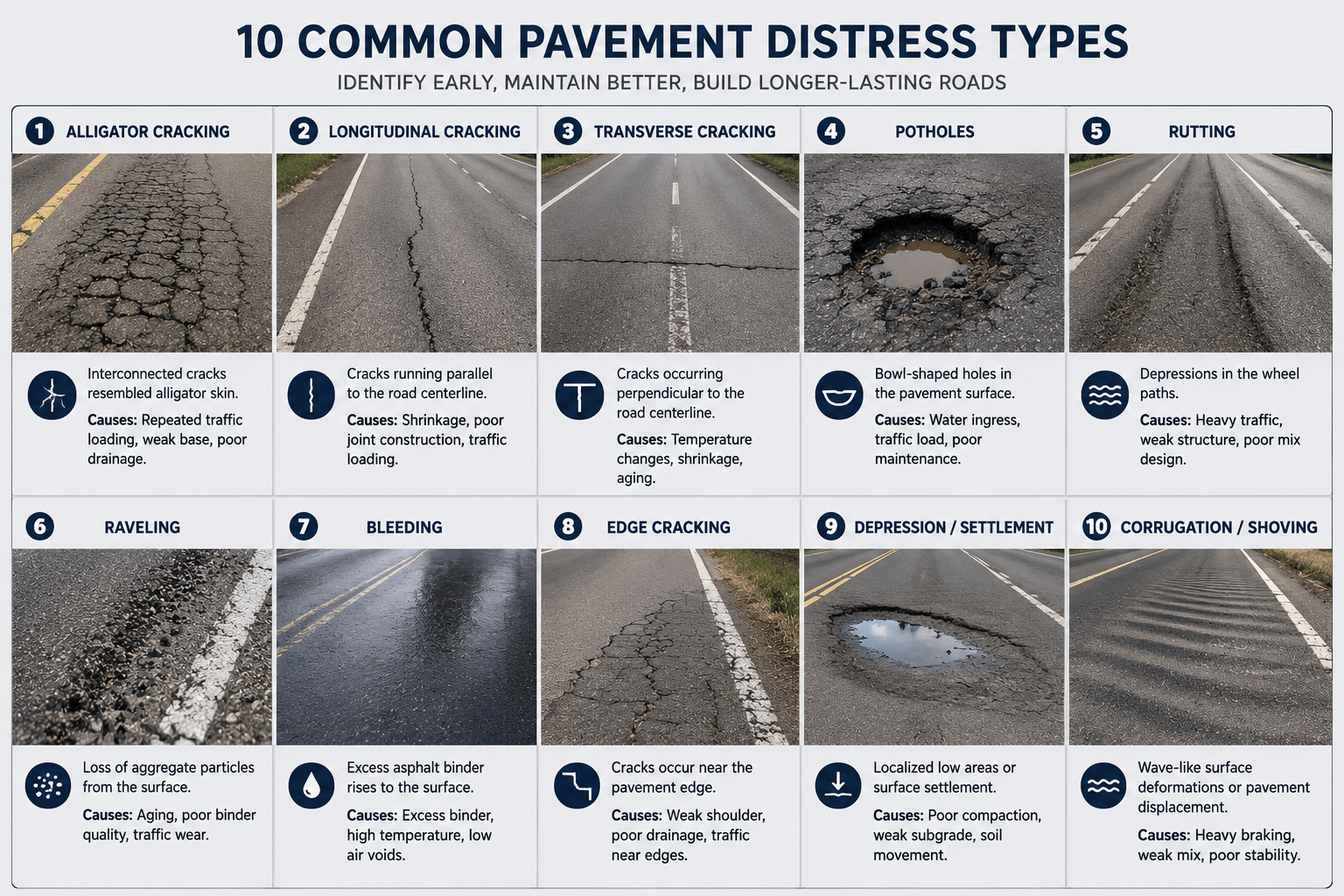
Alligator cracking is one of the most serious pavement distress types. It appears as interconnected cracks resembling alligator skin.
This type of distress usually indicates structural failure within the pavement layers. Surface patching alone is often insufficient because the underlying pavement structure may already be damaged.
Longitudinal cracks run parallel to the road centerline.
These cracks can gradually widen and allow water to penetrate deeper pavement layers.
Modern road survey AI platform systems can automatically detect longitudinal cracks using video-based inspections.
Transverse cracks develop perpendicular to the roadway centerline.
Cold weather regions often experience more transverse cracking due to thermal stress cycles.
Potholes are bowl-shaped cavities formed when pavement material breaks apart under traffic loads.
Potholes significantly affect ride quality and vehicle safety.
Many highway agencies now deploy AI pothole detection software for faster identification across extensive road networks.
Rutting appears as depressions in wheel paths caused by repeated vehicle loading.
Rutting can trap water on road surfaces, increasing hydroplaning risks and reducing driving safety.
Advanced road surface inspection drone technologies are increasingly used to monitor rutting conditions on highways.
Raveling occurs when aggregate particles gradually detach from the pavement surface.
If left untreated, raveling can accelerate pavement deterioration.
Bleeding occurs when excess asphalt binder rises to the pavement surface.
Bleeding can create dangerous driving conditions, especially during rainfall.
Edge cracks form near the outer edges of pavement surfaces.
Roads with narrow shoulders are particularly vulnerable to edge cracking.
Depressions are localized low areas on the pavement surface.
Depressions often collect standing water, further accelerating pavement deterioration.
Corrugation creates wave-like surface patterns, while shoving refers to localized pavement displacement.
These distresses negatively affect ride comfort and pavement performance.
Traditional pavement inspections rely heavily on manual surveys, which are time-consuming and difficult to scale across large transportation networks.
Modern technologies now automate road inspections through:
Solutions powered by road distress detection AI can rapidly identify cracks, potholes, rutting, and other pavement defects with high consistency.
Additionally, dashcam road survey AI systems allow agencies to conduct surveys using ordinary vehicles without requiring specialized inspection fleets.
Frequent inspections help identify deterioration before severe failures occur.
Water is one of the leading causes of pavement damage. Effective drainage reduces moisture-related deterioration.
Preventive treatments are significantly more cost-effective than full reconstruction.
Digital inspection technologies improve maintenance planning and resource allocation.
Continuous monitoring helps agencies predict deterioration patterns and optimize maintenance schedules.
As transportation networks expand, traditional pavement inspection methods are becoming increasingly difficult to scale. AI-powered road intelligence platforms are enabling agencies to monitor pavement conditions faster, more accurately, and more efficiently.
RoadVision AI is building the world’s first Autonomous Road Engineers through Agentic AI technology designed specifically for road infrastructure. The platform combines vision intelligence and language intelligence to automate pavement surveys, roadside asset inventory, safety audits, and road network analysis using video-based data.
With geo-tagged and video-backed intelligence, RoadVision AI helps governments, highway authorities, and infrastructure companies shift from reactive maintenance toward intelligent and data-driven pavement management.
If your organization is looking to improve road inspections, accelerate defect detection, and enhance infrastructure decision-making, Book a Demo with RoadVision AI and discover how AI-powered road engineering can transform pavement management at scale.
Pavement distress refers to visible defects or structural deterioration on road surfaces, including cracks, potholes, rutting, raveling, and surface deformation. Early detection is critical because small defects can quickly develop into major structural failures if left untreated. Using road condition monitoring AI and automated inspection systems helps agencies reduce maintenance costs, improve road safety, and extend pavement lifespan.
Some of the most common pavement distress types include alligator cracking, longitudinal cracking, transverse cracking, potholes, rutting, bleeding, raveling, edge cracking, depressions, and corrugation. Modern road distress detection AI platforms can automatically identify and classify these defects using video analytics, dashcams, drones, and computer vision technology.
AI-powered inspection systems use computer vision, geospatial intelligence, and automated analytics to detect pavement defects faster and more consistently than manual surveys. Solutions such as dashcam road survey AI and automated road inspection software help highway agencies monitor large road networks continuously, prioritize maintenance scientifically, and move toward predictive pavement management strategies.

The Autonomous Road Engineer
AI-powered road condition monitoring, asset management, & infrastructure intelligence helping agencies move from reactive maintenance to predictive road management.


.webp)
.webp)
.webp)