
India's road construction boom has placed unprecedented pressure on agencies to manage traffic safely and efficiently—especially in active work zones. Every year, a significant number of crashes occur near construction sites due to poor signage, inadequate barricading, or inconsistent traffic control. As the saying goes, "A small leak can sink a great ship," and in the context of road projects, even minor lapses can lead to major safety risks.
To address these challenges, the Indian Roads Congress (IRC) has issued clear standards for work zone traffic management under IRC SP:55. However, traditional manual surveys and field inspections frequently struggle to keep pace with expanding infrastructure demands.
This is where AI-driven road asset management solutions such as RoadVision AI are proving transformative—offering automated, scalable, and regulation-aligned monitoring capabilities.
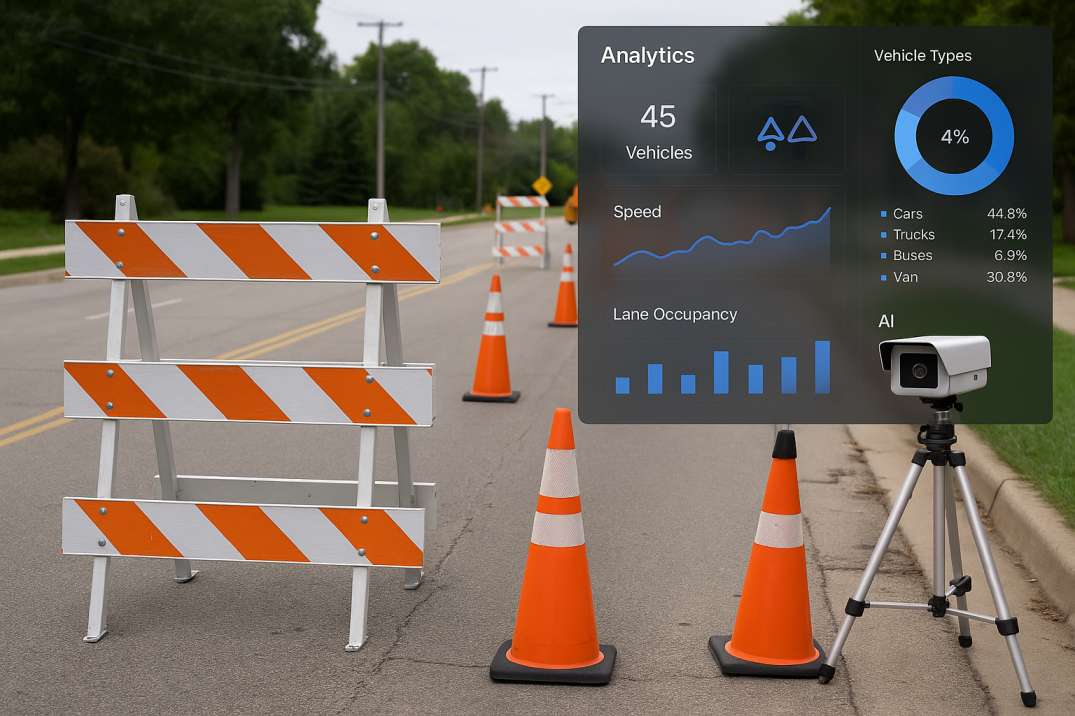
IRC SP:55, formally titled Guidelines on Traffic Management in Work Zones, outlines India's official standards for maintaining safety and operational efficiency in temporary work zones. It defines:
These guidelines aim to:
Compliance with IRC SP:55 is not optional—it is integral to safe execution of road works across national highways, state roads, and urban corridors.
At its core, IRC SP:55 is built on four major principles:
2.1 Safety First
Work zones must minimise risk for workers, drivers, and pedestrians through proper signage, barriers, and traffic control measures.
2.2 Clarity and Consistency
Signage must be uniform and placed according to IRC layouts to reduce driver confusion and ensure predictable responses.
2.3 Smooth Traffic Flow
Diversions and lane closures must ensure predictable and manageable traffic movement without creating dangerous bottlenecks.
2.4 Risk-Based Monitoring
Conditions must be continuously monitored, especially during peak hours, bad weather, or night operations when risks are highest.
These principles demand real-time oversight and consistent reporting—an area where AI outperforms manual methods.
3.1 Automated Work Zone Asset Verification
The Roadside Assets Inventory Agent automatically detects and logs essential work zone assets such as:
This ensures that every asset mandated under IRC SP:55 is in place, compliant, and visible—without manual counting or spot checks.
3.2 Real-Time Traffic Monitoring in Work Zones
The Traffic Analysis Agent uses camera-based computer vision to analyse:
The system flags deviations from IRC SP:55 requirements in real-time, enabling immediate corrective action before incidents occur.
3.3 AI-Powered Work Zone Safety Audits
Through visual analytics, the Road Safety Audit Agent identifies:
AI enables faster, more comprehensive audits and ensures that agencies "measure twice and cut once" when setting up work zones.
3.4 Pavement Condition Monitoring Within Work Zones
The Pavement Condition Intelligence Agent helps identify:
This is essential for maintaining safety during prolonged construction phases where temporary pavements may deteriorate rapidly.
3.5 Automated Compliance Reporting and Documentation
RoadVision AI generates:
This speeds up approvals, improves accountability, reduces paperwork, and provides undeniable evidence of compliance—or non-compliance—for dispute resolution.
Despite the advantages, both traditional and AI-based methods face challenges:
Traditional Challenges:
Challenges in AI Implementation:
However, RoadVision AI mitigates these issues through offline capture capabilities, device-agnostic technology that works with standard smartphones, and simple user interfaces that require minimal training.
Meeting IRC SP:55 requirements doesn't need to be complex or resource-heavy. With AI-driven systems, agencies can monitor work zones more safely, accurately, and efficiently—at scale across hundreds of simultaneous projects. As infrastructure expands under programs like Bharatmala and PMGSY, adopting such tools becomes not just beneficial but essential for protecting workers and road users alike.
RoadVision AI is pioneering this shift by integrating advanced computer vision, digital twins, and automated analytics into road safety and asset management workflows. From traffic surveys to work zone audits and pavement assessments, RoadVision AI ensures full IRC SP:55 compliance through its integrated suite of AI agents while reducing costs, minimising risks, and improving overall operational efficiency.
As the proverb goes, "The proof of the pudding is in the eating." The growing adoption of AI across India's road sector is clear proof that technology-driven compliance is the way forward.
If your organisation manages road construction projects, maintenance works, or infrastructure development, book a demo with RoadVision AI today and discover how intelligent work zone management can transform your safety outcomes and compliance reporting.
Q1. What is IRC SP 55 in road construction?
IRC SP 55 is a guideline by the Indian Roads Congress for traffic management in work zones during road construction and maintenance.
Q2. How does AI improve traffic surveys in work zones?
AI enables real-time data capture, reduces manual effort, improves accuracy, and enhances compliance with IRC regulations.
Q3. Is Roadvision AI compliant with IRC SP 55 guidelines?
Yes, Roadvision AI’s tools are designed to support full compliance with IRC SP 55 through automated inspection and monitoring.
The Autonomous Road Engineer
AI-powered road condition monitoring, asset management, & infrastructure intelligence helping agencies move from reactive maintenance to predictive road management.


.webp)
.webp)
.webp)