

AI road condition monitoring Saudi Arabia — Vision 2030-aligned inspection, giga-project corridor intelligence, and desert-climate pavement analytics for MoT, Roads General Authority, NEOM, and PIF megaproject operators.
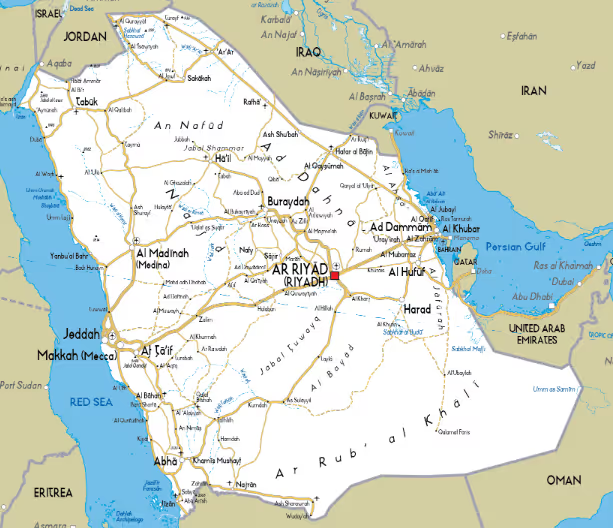
Saudi Arabia is executing the most ambitious national transformation programme in the Middle East — Vision 2030. At its core is a massive infrastructure investment agenda with NEOM, the Red Sea Project, Qiddiya, and dozens of giga-projects generating new road demand. Saudi Arabia Highway Inspection AI and AI Road Condition Monitoring Saudi Arabia calibrated to Arabian Peninsula conditions are the operational standards the Vision 2030 Road Asset Management Platform demands.
MOT manages inter-city expressways; MOMRA oversees urban roads; giga-project zones run independent programmes. Saudi Arabia Expressway Network Condition Monitoring, powered by AI Road Condition Monitoring Saudi Arabia, aligned to Vision 2030 Road Asset Management Platform requirements, is the defining operational need.
Pavement surface temperatures of 55°C+ cause severe asphalt rutting, bleeding, and shoving on Saudi highways. Standard IRI surveys overstate roughness without heat correction.
Seasonal wadis and urban flash floods — particularly in Jeddah, Makkah, and Asir region — cause rapid pavement failure that periodic surveys miss entirely.
NEOM, Red Sea, Qiddiya, and Diriyah Gate are generating tens of thousands of kilometres of new road infrastructure requiring immediate monitoring.
Jubail, Yanbu, and Ras Al-Khair industrial corridors carry extraordinary petrochemical and construction freight loads beyond design assumptions.
The 13 regions range from well-resourced Riyadh and Makkah to remote Al Jawf and Najran, where road agencies have minimal monitoring capacity.
MOT Saudi Arabia pavement management software must demonstrate measurable infrastructure quality improvements — V2030 road KPI reporting demands current data.
Calibrated to Saudi MOT technical specifications, SASO standards, and Arabian Peninsula climate conditions.
Saudi MOT's primary condition metric — combining IRI, rutting depth, cracking, and surface distress. RoadVision AI generates MOT PCI-compatible outputs with Gulf heat seasonal corrections.
Network-scale IRI aligned to MOT thresholds — Good <2.5 m/km | Fair 2.5-4.0 | Poor >4.0 m/km — with Arabian Peninsula summer correction factors.
Distress detection and deterioration modelling calibrated to SASO road construction standards — accounting for high-temperature performance requirements.
Asset inventory and safety audit outputs referenced to MOT's Road Design Manual — the definitive Saudi technical standard for road geometry and signage.
Condition monitoring outputs structured to demonstrate V2030 infrastructure quality targets — supporting MOT and NTP reporting.
Roadside asset inventory aligned to GCC unified road sign and marking standards — for MOT compliance and GCC cross-border route coordination.
Desert Heat Calibration: Saudi pavement surface temperatures of 50-55°C cause IRI readings to overstate road roughness by up to 20%. RoadVision AI applies MOT-validated seasonal correction factors for accurate year-round monitoring.
Each agent configured to Gulf climate, MOT workflows, V2030 KPIs, and giga-project handover requirements.
Network-scale PCI and IRI from dashcam and LiDAR — Arabian Peninsula heat-calibrated with MOT seasonal correction across 221,000 km.
Network-scale PCI and IRI from dashcam and LiDAR — Arabian Peninsula heat-calibrated with MOT seasonal correction across 221,000 km.
MOT PCI thresholds; SASO compatible; direct MOT PMS export
SAR 450–1,000 / lane-km vs. SAR 3,500–9,000 traditional survey
Annual network-wide coverage across all 13 regions
Continuous PCI and IRI monitoring across Saudi Arabia's expressway and primary road network.
Continuous PCI and IRI monitoring across Saudi Arabia's expressway and primary road network.
MOT performance threshold tracking and V2030 infrastructure quality dashboards
Riyadh, Jeddah, Makkah, Madinah, Dammam, Abha corridors
Condition monitoring of NEOM, Red Sea Project, Qiddiya, Diriyah Gate, and Amaala internal road networks.
NEOM, Red Sea Project, Qiddiya, Diriyah Gate, Amaala internal road networks
Development authority reporting templates and asset handover documentation
Continuous monitoring from day one — protecting capital value of new infrastructure
Satellite damage detection within hours of Jeddah, Makkah, Asir, and Madinah flash flood events.
Satellite damage detection within hours of Jeddah, Makkah, Asir, and Madinah flash flood events.
Emergency route accessibility mapping and MOT disaster response documentation
Hours, not weeks — matching MOT emergency procurement cycles
Continuous condition monitoring of Jubail, Yanbu, Ras Al-Khair, and Jizan industrial city freight corridors.
Jubail, Yanbu, Ras Al-Khair, and Jizan industrial city freight corridors.
Heavy vehicle ESAL modelling and petrochemical logistics impact reporting
Replaces reactive resheeting with scheduled structural intervention
Automated high-accident location identification aligned with MOT road safety methodology.
Automated high-accident location identification aligned with MOT road safety methodology.
Saudi National Road Safety Strategy — supporting V2030 safety targets
MOI reporting; MOT blackspot prioritisation
Enabling annual coverage across all 13 regions including remote areas
Early PCI 70-85 intervention prevents full resurfacing at PCI below 55
Current, auditable condition data supports MOT transformation targets
Continuous monitoring protects capital value of new NEOM and Red Sea roads
Three phases aligned to Saudi government procurement frameworks, MOT workflows, and rapid giga-project delivery pace.
200-800 representative lane-km — MOT expressway segments, MOMRA urban roads, or giga-project corridors. Baseline PCI and IRI with Gulf heat corrections validated.
Full MOT / MOMRA jurisdiction coverage. Integration with MOT PMS, giga-project authority systems, V2030 KPI dashboards, and industrial corridor monitoring.
Desert climate deterioration modelling, expressway performance dashboards, giga-project asset monitoring, flash flood protocols, and V2030 NTP documentation.
Procurement: Compatible with Saudi Government Tenders and Procurement Law (Royal Decree M/128). Available through ETIMAD government procurement platform. Arabic and English documentation.
Whether you manage MOT inter-city expressways, MOMRA urban roads, giga-project corridors, or industrial freight routes — RoadVision AI delivers Vision 2030-aligned road intelligence.
The Autonomous Road Engineer
AI-powered road condition monitoring, asset management, & infrastructure intelligence helping agencies move from reactive maintenance to predictive road management.
RoadVision AI Private Limited,
Office No. 308 & 310, B Block, Ansal
Chamber - 1, Bhikaji Cama Place,
Near Engineers India Limited (EIL)
Bhawan, New Delhi - 110066


