
Road infrastructure projects today are no longer focused only on construction. The emphasis has shifted toward long-term performance, operational efficiency, maintenance quality, and infrastructure sustainability. Governments and highway authorities increasingly adopt Public-Private Partnership (PPP) models to finance, develop, and manage road networks effectively.
Among the most widely used approaches are BOT (Build-Operate-Transfer), TOT (Toll-Operate-Transfer), and HAM (Hybrid Annuity Model). Although these models differ in financial structure and responsibilities, one challenge remains common across all of them: ensuring roads remain safe, compliant, and operationally efficient throughout their lifecycle.
As road networks become larger and more complex, traditional inspections are becoming difficult to scale. Technologies such as AI based BOT road survey, intelligent monitoring systems, and automated infrastructure platforms are helping organizations move toward smarter road intelligence.
But an important question remains:
Which model requires AI monitoring the most—BOT, TOT, or HAM?
To answer this, it is important to understand how these models work and where AI creates the greatest value.
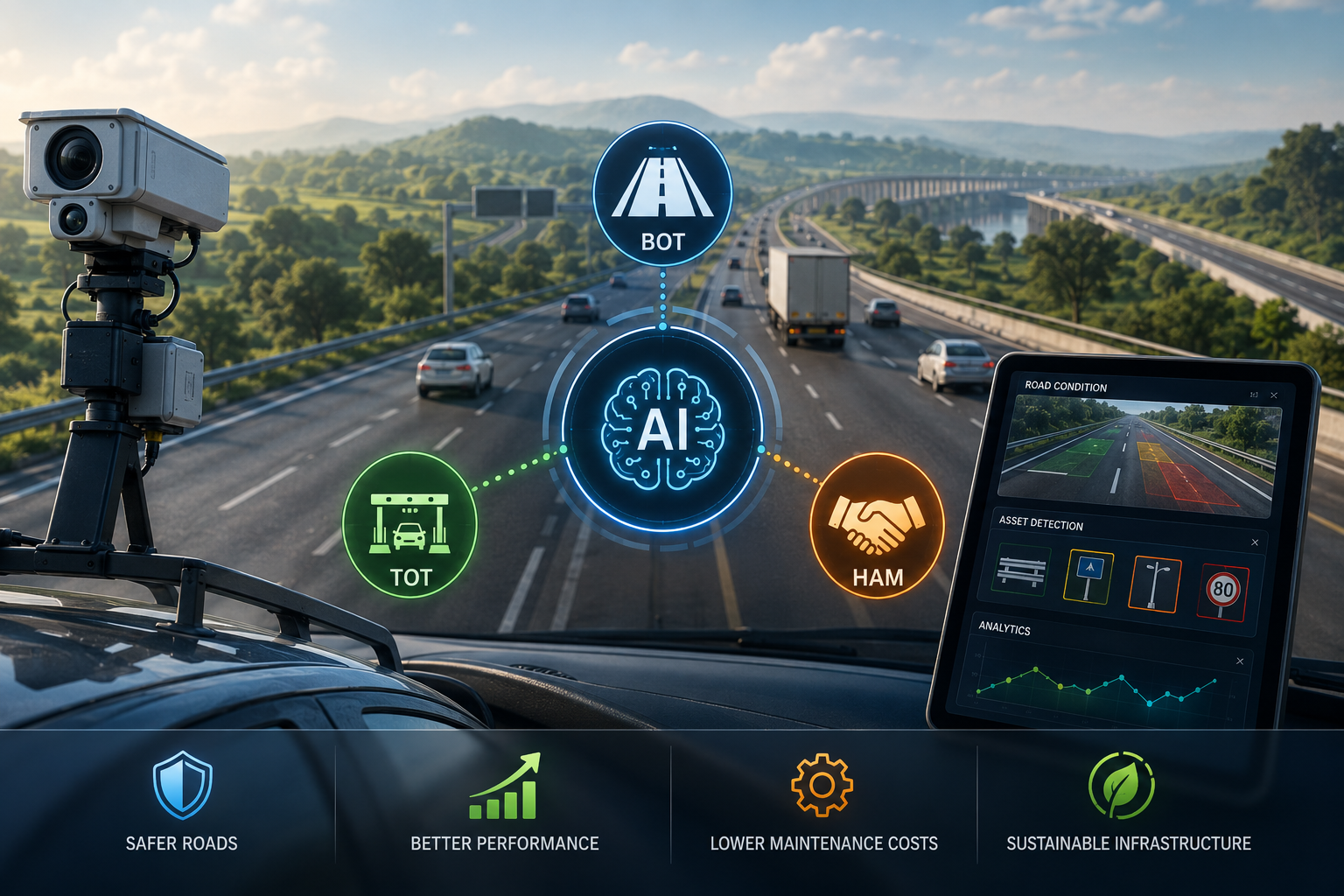
BOT is a project model where a private company finances, designs, constructs, operates, and maintains a road project for a fixed concession period.
The private operator generally recovers its investment through:
After the concession period ends, ownership of the road returns to the government authority.
BOT projects usually involve:
In the TOT model, private operators manage road assets that are already constructed.
Rather than building roads, operators focus on:
The operator typically pays an upfront amount to manage the asset and recovers investment through toll revenues.
TOT projects primarily emphasize:
HAM combines public funding with private participation.
Typically:
HAM reduces traffic-related financial risk while maintaining long-term maintenance obligations.
Road performance directly affects:
Traditional monitoring methods often involve:
While these methods have been used for decades, they create several limitations:
Modern solutions using road condition monitoring AI are changing this approach by enabling continuous visibility into road conditions.
AI systems collect and analyze data using:
The software automatically detects:
Solutions such as automated road inspection software enable organizations to monitor large road networks more efficiently than manual methods.
Among BOT, TOT, and HAM models, BOT projects typically experience the greatest dependency on road performance.
This is because the private operator carries responsibility for both infrastructure quality and financial outcomes.
In BOT projects, operators are responsible for:
Any decline in road quality can directly influence profitability.
Road conditions affect how users experience infrastructure.
Poor road quality can result in:
Continuous monitoring becomes important because early identification of problems prevents larger failures.
BOT projects often extend over many years.
During these periods, roads continuously experience:
Manual inspections alone may fail to provide sufficient visibility.
Technologies such as road maintenance management system platforms allow operators to identify deterioration early and optimize maintenance activities.
BOT operators benefit significantly from predictive maintenance strategies because preventing failures is often more cost-effective than repairing them later.
AI monitoring helps move from:
Reactive maintenance → Preventive maintenance → Predictive maintenance
Although TOT projects involve existing road assets, monitoring remains extremely important.
The focus shifts from construction risk toward operational optimization.
TOT operators need visibility into:
One major challenge is scale.
Many operators manage multiple highway corridors across different regions.
Maintaining visibility across these assets through manual methods becomes difficult.
Solutions such as road asset inventory management software help automate asset tracking and infrastructure intelligence.
AI monitoring allows operators to reduce operational effort while improving maintenance decisions.
HAM reduces financial risk associated with traffic volume, but long-term infrastructure quality still remains critical.
Road quality directly influences:
Key challenges include:
Road infrastructure must meet predefined quality levels throughout the project lifecycle.
Delayed identification of road defects can increase lifecycle costs.
Authorities require accurate road condition reporting.
Solutions using road condition reporting software improve documentation and support data-driven maintenance planning.
All three road models benefit from AI monitoring, but the level of dependency differs.
BOT projects generally require the highest level of monitoring because revenue, asset performance, and maintenance efficiency are directly connected.
TOT projects require extensive monitoring because of operational complexity and large asset portfolios.
HAM projects also benefit significantly, especially for compliance and maintenance performance management.
However, BOT projects experience the greatest direct financial impact when infrastructure conditions deteriorate.
This makes AI monitoring especially valuable in BOT environments.
Road infrastructure management is increasingly moving toward intelligent systems.
Future developments may include:
Technologies such as road video analytics software and pavement survey automation are already changing how infrastructure operators monitor road assets.
As transportation systems continue expanding, AI monitoring will increasingly become a core operational requirement rather than an optional technology.
Managing BOT, TOT, and HAM projects requires continuous visibility into road conditions, safety performance, and infrastructure health. Traditional inspections often struggle to provide the speed and scalability needed for modern highway networks.
RoadVision AI is building the world's first Autonomous Road Engineers through Agentic AI technology specifically designed for road infrastructure. The platform combines vision intelligence and language intelligence to automate pavement surveys, roadside asset inventory, safety audits, and road network intelligence using video-backed analysis.
With geo-tagged and evidence-backed insights, RoadVision AI helps governments, concessionaires, highway operators, and infrastructure companies shift from reactive operations toward intelligent road management.
If your organization is looking to improve infrastructure visibility, reduce operational effort, and enable smarter road decisions, Book a Demo with RoadVision AI and discover how AI-powered road engineering can transform highway monitoring at scale.
Among BOT, TOT, and HAM models, BOT (Build-Operate-Transfer) projects typically benefit the most from AI based BOT road survey and intelligent monitoring systems. Since private operators are responsible for construction, maintenance, operational performance, and revenue generation, continuous monitoring becomes critical for maintaining road quality, reducing lifecycle costs, and protecting long-term profitability.
AI-powered road monitoring systems use computer vision, dashcams, GPS data, and automated analytics to detect pavement defects, roadside asset damage, safety risks, and infrastructure deterioration. Solutions such as automated road inspection software and road condition monitoring AI help highway operators improve maintenance planning, automate reporting, optimize inspections, and move from reactive maintenance toward predictive infrastructure management.
Predictive maintenance helps concessionaires and highway authorities identify infrastructure deterioration before failures become severe. In BOT, TOT, and HAM projects, this reduces maintenance costs, improves road safety, extends asset lifespan, and ensures compliance with operational standards. AI-driven monitoring platforms enable continuous infrastructure visibility, helping operators make faster and more data-driven maintenance decisions.
The Autonomous Road Engineer
AI-powered road condition monitoring, asset management, & infrastructure intelligence helping agencies move from reactive maintenance to predictive road management.


.webp)
.webp)
.webp)