
America's roads are reaching a tipping point. Crumbling pavements, widening cracks, and growing maintenance backlogs have put immense pressure on transportation agencies. Despite billions spent annually, the United States still struggles with deteriorating highways—slowing freight movement, increasing vehicle repair costs, and risking public safety.
With rising expectations from motorists and tightening budgets, the question grows louder: Can AI actually keep America's roads from falling apart?
A new wave of AI-based road maintenance, digital pavement monitoring, and predictive highway management is reshaping how infrastructure is inspected, repaired, and preserved. Through technologies like AI-based pavement surveys, dashcam-based road assessments, and smart asset management, agencies are moving from reactive patchwork to predictive precision.
As the saying goes, "A stitch in time saves nine," and America's highways may finally be ready to sew up their problems proactively.
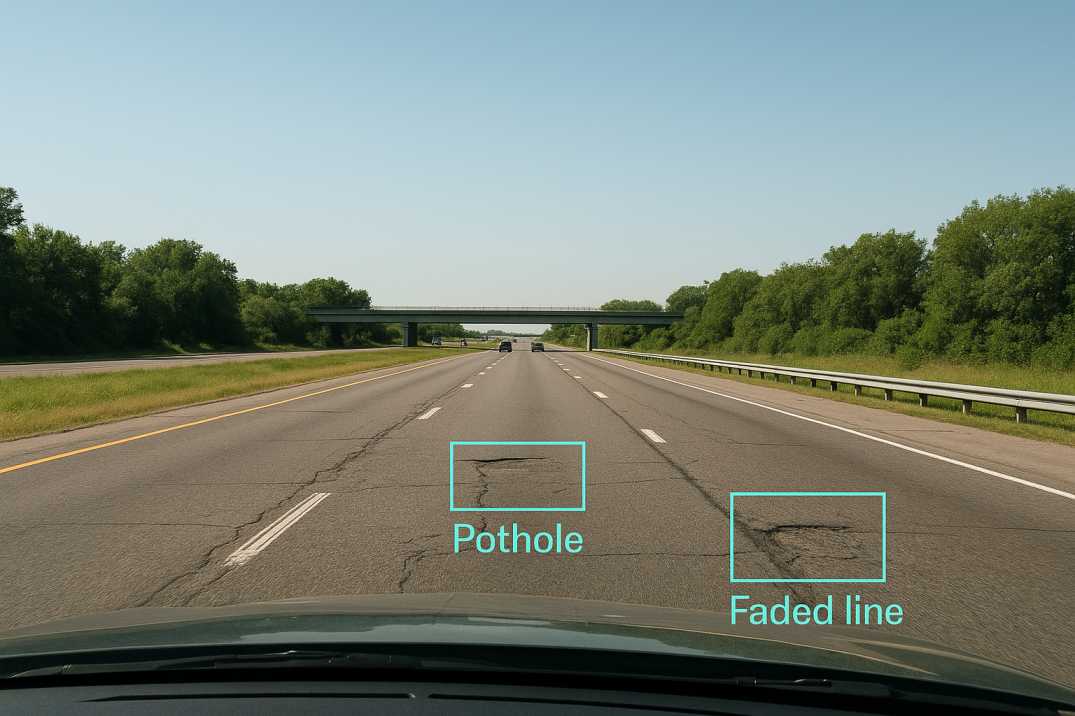
The condition of U.S. highways is no secret. Reports from the Federal Highway Administration (FHWA) show that many pavements are in "fair" or "poor" condition. Weather extremes, heavy freight corridors, and aging designs accelerate deterioration faster than maintenance cycles can keep up.
Traditional inspections rely on manual surveys—expensive, slow, and often subject to human error. With more than 4 million miles of public roads, the scale alone makes reactive maintenance unsustainable.
Key drivers for AI adoption include:
AI changes the equation. By automating detection, forecasting deterioration, and optimizing budgets, predictive maintenance through the Pavement Condition Intelligence Agent and Traffic Analysis Agent supports:
In short, it gives agencies the foresight they've always needed but never had.
2.1 Continuous Digital Monitoring
Instead of periodic manual inspections, highways require real-time data collection through cameras, sensors, and onboard vehicle technology. The Pavement Condition Intelligence Agent enables this continuous oversight at traffic speeds.
2.2 AI-Based Distress Detection
Machine learning models detect:
Severity levels are classified instantly, providing objective, repeatable assessments.
2.3 Predictive Deterioration Modeling
Forecasting algorithms estimate when pavement will fail—considering:
2.4 Integrated Road Asset Management
A unified asset repository through the Roadside Assets Inventory Agent helps agencies track inventory, pavement condition, and maintenance history, enabling better investment prioritization across the network.
2.5 Scalable Dashcam-Based Surveys
Low-cost dashcams mounted on regular fleet vehicles capture continuous roadway footage, enabling daily situational awareness without dedicated survey vehicles or additional staff.
2.6 Safety Integration
The Road Safety Audit Agent correlates pavement condition with crash data to identify high-risk locations requiring priority attention.
These principles reflect globally recognized best practices, equivalent to IRC guidelines, and align with U.S. performance-based, data-driven planning requirements under the FAST Act and Bipartisan Infrastructure Law.
RoadVision AI translates these principles into intelligent, actionable maintenance workflows for U.S. agencies through its integrated suite of AI agents:
3.1 AI-Powered Pavement Condition Surveys
The Pavement Condition Intelligence Agent uses high-resolution imaging and computer vision to detect cracks, potholes, bleeding, and edge failures automatically—saving days of fieldwork while improving accuracy and coverage.
3.2 Digital Pavement Monitoring & Digital Twins
Continuous monitoring builds a digital twin of the network through the Roadside Assets Inventory Agent, enabling engineering teams to:
3.3 Dashcam-Based Road Surveys
Dashcam technology transforms everyday vehicle travel into large-scale pavement assessment. AI analyzes millions of frames to identify defects with precision, providing:
3.4 Predictive Maintenance Modeling
By combining traffic density from the Traffic Analysis Agent, weather history, and material data, RoadVision AI forecasts deterioration timelines, allowing DOTs to:
3.5 Integrated Road Inventory & Safety Audits
From signage to guardrails to lane markings, the Roadside Assets Inventory Agent maps and updates asset records automatically, while the Road Safety Audit Agent identifies safety hazards, supporting comprehensive compliance with federal and state requirements.
3.6 MIRE-Compliant Data Collection
The platform supports collection of MIRE Fundamental Data Elements, helping states meet federal requirements for roadway data.
Through this ecosystem, agencies shift from firefighting potholes to preventing them altogether—a transformation that saves money, time, and lives.
Even with transformative potential, several hurdles must be addressed:
4.1 Data Overload
The USA's massive road network generates huge volumes of video, sensor, and imaging data, demanding strong cloud architecture and data governance.
AI Solution: Edge processing reduces bandwidth requirements, while scalable cloud storage handles long-term archiving.
4.2 Integration with Legacy Systems
Many DOTs still rely on outdated GIS or spreadsheet-based tracking systems, making integration the first major obstacle.
AI Solution: Flexible APIs and export formats enable gradual integration without disrupting existing workflows.
4.3 Funding & Procurement Cycles
Adoption often depends on multi-year budgets, grant approvals, and procurement processes—slowing rapid deployment.
AI Solution: Pilot projects demonstrate ROI, building the case for broader investment.
4.4 Workforce Upskilling
Engineers, inspectors, and planners need training to maximize the value of AI outputs and dashboards.
AI Solution: Comprehensive training and user-friendly interfaces ensure successful adoption.
4.5 Climate and Geographic Diversity
From desert highways to frost-prone northern states, AI models must understand region-specific deterioration patterns.
AI Solution: Models trained on diverse U.S. conditions account for regional variations.
4.6 Standardization Across States
Different states use varying data formats and assessment protocols.
AI Solution: Configurable outputs map to specific state requirements while maintaining core consistency.
But as the saying goes, "Every cloud has a silver lining," and AI is proving that innovation can turn these challenges into opportunities through platforms like RoadVision AI.
America's infrastructure crisis cannot be solved by patching potholes one season at a time. The future lies in predictive maintenance, AI-driven inspections, and data-powered asset management through the Pavement Condition Intelligence Agent, Traffic Analysis Agent, Road Safety Audit Agent, and Roadside Assets Inventory Agent.
By adopting AI-based pavement monitoring, deploying dashcam-based surveys, and embracing smart road asset management, U.S. agencies can:
RoadVision AI stands at the forefront of this transformation. With its advanced digital twin technology, AI-driven inspections, and predictive maintenance tools, it empowers DOTs, counties, and municipalities to move from reactive fixes to proactive planning—creating safer, smoother, smarter road networks that serve communities effectively.
The platform's ability to:
transforms how America approaches highway maintenance at every level of government.
If you're ready to move from guesswork to precision, from deterioration to prevention, it's time to explore what AI can do for your highways. Book a demo with RoadVision AI today and discover how predictive highway maintenance can stop America's roads from crumbling.
Q1: How does AI asset management USA differ from traditional road inspections?
AI asset management uses sensors, dashcams, and predictive analytics to automatically detect road conditions, whereas traditional inspections rely heavily on manual surveys.
Q2: What is the advantage of dashcam-based road surveys?
They allow continuous, low-cost, and real-time pavement monitoring across wide networks without requiring special survey vehicles.
Q3: Why is predictive maintenance important for US highways?
It lowers repair costs, prevents sudden failures, and improves road safety by fixing issues before they escalate.

The Autonomous Road Engineer
AI-powered road condition monitoring, asset management, & infrastructure intelligence helping agencies move from reactive maintenance to predictive road management.


.webp)
.webp)
.webp)