
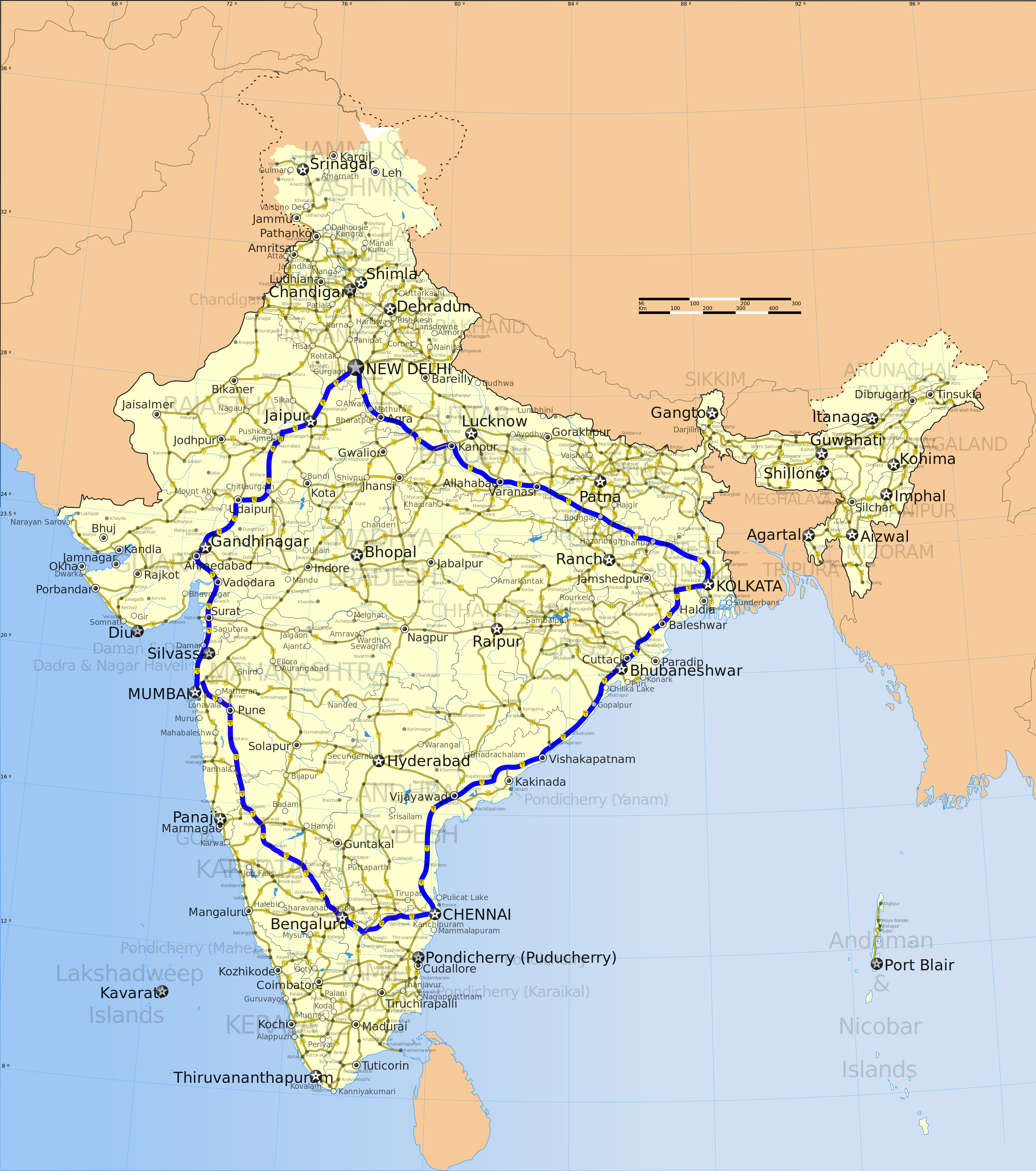
The Golden Quadrilateral (GQ) is one of India's most transformative infrastructure achievements—linking Delhi, Mumbai, Chennai, and Kolkata across more than 5,800 km of high-capacity highways. It forms the backbone of national logistics, freight mobility, and economic integration. But the sheer scale and high-traffic intensity of this network pose a critical challenge: how do we maintain such a massive system efficiently, safely, and sustainably?
Traditional road inspections—manual, time-consuming, and resource-heavy—are no longer enough. With growing traffic volumes, structural aging, and rising safety concerns, digital highway monitoring and AI-powered inspection tools through the Pavement Condition Intelligence Agent and Road Safety Audit Agent are becoming indispensable for India's next phase of infrastructure management.
Every day, millions of vehicles traverse the GQ—from long-haul trucks to local commuters. This constant load results in:
When left unchecked, these issues escalate into costly repairs and safety hazards. As the saying goes, "A stitch in time saves nine"—and digital road asset management helps authorities detect trouble long before it becomes a crisis.
Road asset management India solutions powered by AI through the Pavement Condition Intelligence Agent, Traffic Analysis Agent, Road Safety Audit Agent, and Roadside Assets Inventory Agent ensure:
Highway monitoring in India must comply with the standards of the Indian Roads Congress (IRC), which provides guidelines for geometric design, pavement evaluation, road safety audits, and asset management practices.
Some key IRC-aligned principles include:
3.1 Preventive and Predictive Maintenance
IRC emphasises shifting from reactive repairs to structured, proactive maintenance cycles through the Pavement Condition Intelligence Agent.
3.2 Standardised Pavement Evaluation
Systematic pavement condition surveys based on IRC:82, IRC:37, and related codes ensure consistent assessment across the network.
3.3 Safety-First Approach
IRC safety guidelines mandate the identification and rectification of black spots, signage compliance, and visibility standards through the Road Safety Audit Agent.
3.4 Uniform Asset Documentation
Every highway asset—signs, guardrails, medians, culverts—should be catalogued digitally for traceability through the Roadside Assets Inventory Agent.
3.5 Sustainable Highway Management
Standards encourage long-term planning, cost optimisation, and environmentally conscious design.
3.6 Traffic Analysis for Design Validation
The Traffic Analysis Agent provides data to validate design assumptions against actual usage patterns.
Digital highway monitoring systems are perfectly aligned with these principles, making compliance smoother and more accurate.
4.1 Delhi–Mumbai Corridor
Passing through the industrial heartland of India, this section faces heavy freight traffic and requires continuous monitoring for pavement fatigue and bridge health.
4.2 Mumbai–Chennai Corridor
Crossing diverse terrain including the Western Ghats, this section demands attention to gradient safety, monsoon damage, and curve geometry.
4.3 Chennai–Kolkata Corridor
Coastal sections face humidity, salt exposure, and cyclone risks, requiring specialised monitoring for corrosion and storm damage.
4.4 Kolkata–Delhi Corridor
Traversing the Gangetic plains, this section deals with flood-prone areas, high water tables, and intense agricultural traffic.
As one of India's leading technology partners in road monitoring, RoadVision AI embeds IRC principles directly into its workflows through its integrated suite of AI agents. Its best practices include:
5.1 AI-Driven Pavement Condition Detection
The Pavement Condition Intelligence Agent uses high-resolution cameras and computer vision algorithms to automatically detect:
—far earlier than the human eye, enabling proactive intervention.
5.2 Digital Twin Creation of Highway Assets
RoadVision AI builds digital replicas of roadway sections through the Roadside Assets Inventory Agent to:
5.3 IRC-Compliant Road Safety Audits
The Road Safety Audit Agent uses AI-based analysis to ensure consistent alignment with IRC safety norms through:
5.4 Automated Road Inventory Inspection
The Roadside Assets Inventory Agent maps and tags every asset for maintenance planning and compliance reporting, including:
5.5 Traffic Surveys Using AI
The Traffic Analysis Agent provides advanced traffic analytics that help:
5.6 Bridge and Structure Monitoring
Integrated monitoring of bridge decks, expansion joints, and substructures through the Pavement Condition Intelligence Agent ensures early detection of structural issues.
These practices make large-scale corridor management—such as the Golden Quadrilateral—scalable, consistent, and highly cost-efficient.
Despite technological improvements, several challenges still persist:
6.1 Diverse Climate Zones
The GQ passes through deserts, coastal regions, plains, and monsoon-heavy areas—each impacting pavement lifespan differently and requiring adaptive monitoring strategies.
AI Solution: The Pavement Condition Intelligence Agent adapts to regional conditions through location-calibrated algorithms.
6.2 High Freight Density
Heavy trucks accelerate rutting, structural damage, and joint failures, particularly in wheel paths.
AI Solution: The Traffic Analysis Agent tracks loading patterns to inform strengthening priorities.
6.3 Urban–Rural Variability
The corridor must handle high-speed expressway movement and mixed rural traffic simultaneously, creating diverse safety challenges.
AI Solution: The Road Safety Audit Agent tailors assessments to corridor context.
6.4 Rapid Infrastructure Aging
Many GQ segments are now two decades old and nearing major rehabilitation cycles, requiring increased scrutiny.
AI Solution: Continuous monitoring tracks deterioration trends for optimal rehabilitation timing.
6.5 Resource Allocation Constraints
Without accurate condition data, funds are often allocated reactively rather than strategically, wasting limited resources.
AI Solution: Data-driven prioritisation through the Pavement Condition Intelligence Agent ensures optimal budget allocation.
6.6 Coordination Across Jurisdictions
Multiple state agencies and NHAI divisions manage different segments, requiring coordinated data sharing.
AI Solution: Centralised platforms ensure all stakeholders work from the same verified data.
6.7 Utility Trenching Damage
Repeated excavation by utility providers weakens pavement integrity and creates premature failures.
AI Solution: The Roadside Assets Inventory Agent tracks trenching locations and impacts.
AI-based monitoring through RoadVision AI directly addresses these gaps by providing granular, real-time intelligence across the entire corridor.
The Golden Quadrilateral is not just a road network—it is an economic lifeline for India. Keeping it robust, efficient, and safe requires more than periodic inspections; it demands continuous digital oversight and predictive intelligence through the Pavement Condition Intelligence Agent, Traffic Analysis Agent, Road Safety Audit Agent, and Roadside Assets Inventory Agent.
As the proverb says, "Forewarned is forearmed." AI empowers highway authorities with the foresight needed to prevent failures, reduce costs, and protect millions of daily road users who depend on this critical corridor.
The platform's ability to:
transforms how India's most important highway corridor is managed.
RoadVision AI is at the forefront of this transformation. By leveraging digital twins, computer vision, predictive analytics, and IRC-compliant workflows, it helps governments and concessionaires:
With the right technology through RoadVision AI, India can set global benchmarks in intelligent highway management—turning the Golden Quadrilateral into a world-class digital corridor that serves as a model for other nations.
Book a demo with RoadVision AI today to discover how AI can reshape highway monitoring across India's largest and most important road networks.
Q1. What is the role of AI in monitoring the Golden Quadrilateral?
AI enables real-time detection of pavement and asset conditions, helping reduce costs and improve highway safety.
Q2. How does a digital highway monitoring system work?
It uses AI-powered cameras and sensors to analyze road conditions, automate inspections, and support predictive maintenance.
Q3. Why is road asset management important for India?
With heavy traffic and diverse climates, India’s highways need continuous monitoring to ensure safety, efficiency, and durability.

The Autonomous Road Engineer
AI-powered road condition monitoring, asset management, & infrastructure intelligence helping agencies move from reactive maintenance to predictive road management.


.webp)
.webp)
.webp)