
Dubai has established itself as a global pioneer in smart infrastructure, and its municipalities carry the responsibility of maintaining a road network that reflects the city's reputation for excellence. With more than 18,000 lane-kilometres under the oversight of the Dubai Roads and Transport Authority (RTA), the city's rapid expansion, extreme summer temperatures, and heavy vehicle loads make road maintenance a continuous challenge.
Traditional pavement inspections—often manual, time-consuming, and subjective—are falling short in a city with such ambitious smart city targets. As the saying goes, "You can't drive the future on yesterday's roads." To build an adaptable, efficient, and data-driven maintenance ecosystem, Dubai municipalities are increasingly turning to AI-powered pavement management systems.
Dubai's roads endure unique stressors that accelerate pavement deterioration beyond typical rates:
Manual surveys struggle to keep pace with the scale and frequency of inspections needed across Dubai's expanding network. This creates delays in identifying defects, increases maintenance costs, and raises the potential for safety hazards on roads that serve millions of residents and visitors.
AI-driven pavement management transforms the process by offering:
Simply put, AI enables municipalities to "fix the roof before it starts raining"—addressing defects before they escalate into costly failures.
A Pavement Management System (PMS) provides a structured framework for planning, monitoring, and optimising pavement maintenance. While Dubai follows RTA and UAE road authority specifications, the engineering philosophy aligns closely with global frameworks—including mechanisms embedded in Indian Roads Congress (IRC) pavement design and maintenance principles.
2.1 Data-Driven Condition Assessment
A conventional PMS gathers information on:
The Pavement Condition Intelligence Agent elevates this by automating distress detection, improving accuracy, and eliminating the subjectivity inherent in manual inspections.
2.2 Performance Prediction Models
Borrowing from mechanistic-empirical approaches used in IRC and other international codes, AI models predict deterioration by analysing:
This enables better long-term planning and budget optimisation across 5-10 year horizons.
2.3 Optimised Maintenance Prioritisation
AI algorithms help municipalities determine:
This shifts Dubai from reactive to proactive maintenance—an essential factor for modern smart-city operations aligned with the Dubai Urban Master Plan 2040.
RoadVision AI plays a pivotal role in bringing global best practices and advanced AI capabilities to Dubai's pavement management processes through its integrated suite of AI agents.
3.1 Automated Pavement Condition Surveys
The Pavement Condition Intelligence Agent uses high-resolution imaging and sensor technology mounted on ordinary fleet vehicles to identify:
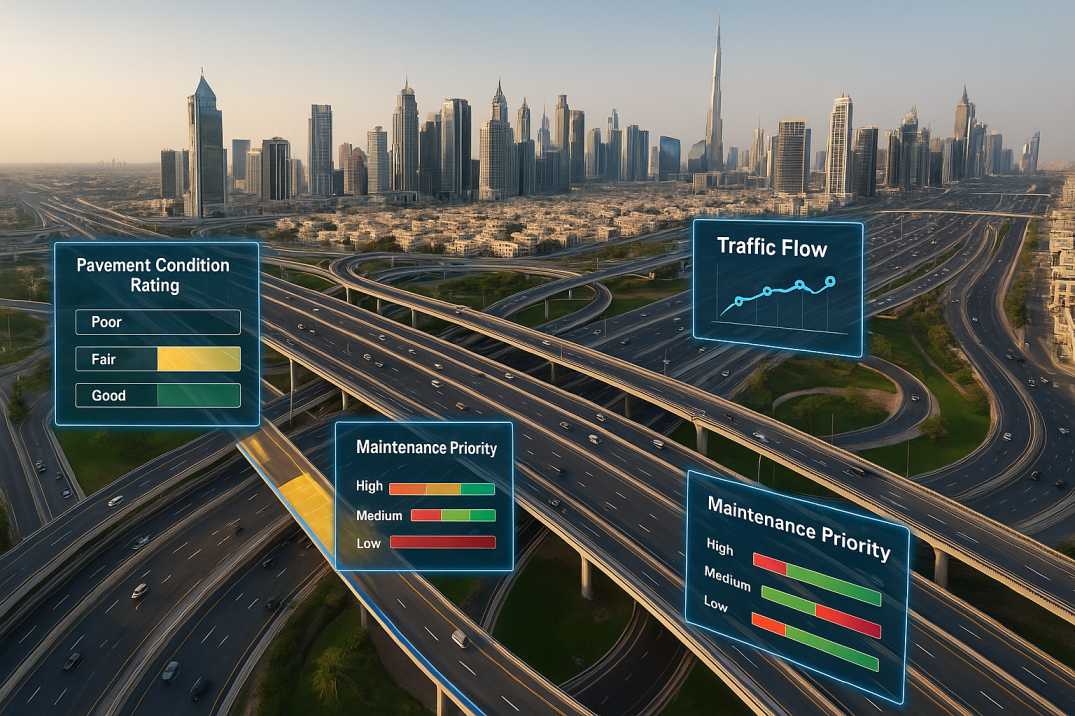
Geo-tagged outputs allow Dubai municipalities to visualise network-wide pavement health instantly on interactive dashboards, with colour-coded condition maps showing priority segments.
3.2 Predictive Maintenance with AI
RoadVision's predictive models simulate how specific road segments will deteriorate under:
This enables:
This supports Dubai's mission for sustainable, long-term infrastructure management aligned with Smart Dubai 2021 objectives.
3.3 Integration with Road Inventory Systems
The Roadside Assets Inventory Agent integrates seamlessly with digital asset registries, mapping roadside elements such as:
This improves planning, compliance, and operational coordination between maintenance teams and other municipal departments.
3.4 Enhanced Road Safety Assessments
The Road Safety Audit Agent automates detection of:
These insights contribute to Dubai's Vision Zero goals, supporting safer mobility for all users across the emirate's diverse road network.
3.5 Traffic Analysis for Pavement Loading
The Traffic Analysis Agent provides:
3.6 Alignment with Local and International Standards
RoadVision AI complies with:
"Measure smart, maintain smarter" becomes more than a motto—it becomes an operating philosophy embedded in daily workflows.
Even with advanced systems, Dubai's urban environment poses several challenges:
4.1 Harsh Weather Extremes
Surface oxidation, rutting, and binder hardening occur faster than in temperate climates, requiring more frequent condition assessments to catch deterioration early.
4.2 Rapid Urban Expansion
Construction traffic from Dubai's continuous development increases road wear unpredictably, with heavy vehicle movements on routes not originally designed for such loads.
4.3 High Road User Expectations
Dubai residents and visitors expect smooth, safe, and high-grade transport infrastructure that reflects the city's global reputation—leaving no margin for substandard conditions.
4.4 Limited Manual Inspection Scalability
Human-led surveys simply cannot keep up with the required speed or precision across 18,000+ lane-kilometres, leading to data gaps and inconsistent quality.
4.5 Integration with Smart City Platforms
Pavement data must integrate with broader smart city initiatives, requiring standardised formats and real-time connectivity that traditional methods cannot provide.
AI fills these gaps by providing unlimited scalability, automated consistency, and real-time intelligence that adapts to Dubai's dynamic environment.
Dubai's transformation into a global smart city demands infrastructure that is equally intelligent—and pavement management is no exception. AI-powered systems offer speed, accuracy, foresight, and cost efficiency that traditional methods cannot match. They bring the city one step closer to its Smart Dubai 2021 and Dubai Urban Master Plan 2040 aspirations.
RoadVision AI stands at the forefront of this shift—leveraging digital twin technology, advanced computer vision, and automated audits through the Pavement Condition Intelligence Agent, Road Safety Audit Agent, Roadside Assets Inventory Agent, and Traffic Analysis Agent to deliver a level of intelligence that helps municipalities:
As the proverb goes, "The best time to plant a tree was 20 years ago; the second-best time is now." The same is true for adopting AI in infrastructure management.
Dubai municipalities that embrace AI-powered pavement management today will shape a smoother, safer, and more future-ready road network for generations to come—a network worthy of a city that consistently looks to tomorrow.
If your municipality is ready to transform pavement management with AI-driven intelligence, book a demo with RoadVision AI today and discover how our platform can support Dubai's journey toward smarter, more sustainable infrastructure.
Q1. What is AI pavement maintenance and how is it used in Dubai?
AI pavement maintenance uses sensors and machine learning to inspect and forecast road conditions, helping Dubai municipalities optimize maintenance.
Q2. Is AI-based pavement inspection compliant with Dubai RTA guidelines?
Yes, advanced AI systems align with RTA's infrastructure monitoring standards and support smart city goals outlined in Dubai’s master plan.
Q3. How can Dubai municipalities benefit from digital road maintenance systems?
Digital systems provide real-time data, predictive insights, and asset inventory mapping—helping reduce costs and improve maintenance planning.

The Autonomous Road Engineer
AI-powered road condition monitoring, asset management, & infrastructure intelligence helping agencies move from reactive maintenance to predictive road management.


.webp)
.webp)
.webp)