
Road markings are the first line of visual communication between a highway and its users. In India's dense and fast-moving traffic environment, maintaining high-visibility markings is essential for safety, efficiency, and regulatory compliance. The updated IRC SP 55:2024 standards have raised the bar by tightening requirements for marking visibility, durability, and retro-reflectivity.
For EPC contractors, PMCs, smart city teams, and auditors, compliance is no longer just a statutory obligation—it is a critical safety mandate. Yet the reality on the ground is challenging: manual inspections are slow, inconsistent, and incapable of delivering the evidence-based reporting demanded today.
This is where AI-based road inspections step in, turning a traditionally cumbersome process into an automated, accurate, and scalable operation.
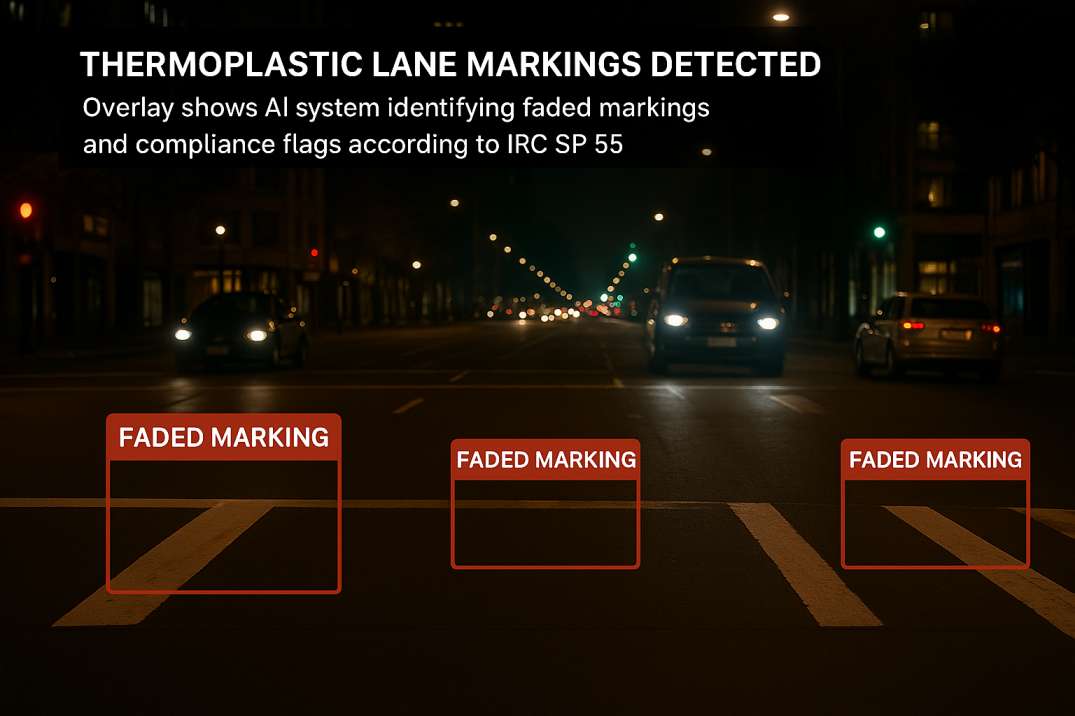
The revised IRC SP 55:2024 standards prioritize measurable visibility, uniformity, and performance of road markings. Achieving this at scale requires continuous monitoring—something manual methods struggle with.
AI-based inspections allow authorities to "measure twice, fix once," ensuring errors are caught before they become safety hazards. They digitize compliance, reduce human subjectivity, and create reliable documentation trails that align with national expectations set by bodies like the Indian Roads Congress and the Ministry of Road Transport and Highways (MoRTH).
As India expands expressways, smart city corridors, and NH networks, automation becomes the only sustainable path forward.
The latest revision reinforces performance-based specifications, with emphasis on:
2.1 High Visibility in All Conditions
Road markings must remain clear in day, night, wet, and low-light environments to ensure driver guidance regardless of weather or time.
2.2 Retro-Reflectivity Thresholds
Night-time visibility must meet minimum RL values across marking categories, ensuring markings are visible in headlight illumination.
2.3 Material Performance Requirements
Thermoplastic paint or approved premium alternatives must be used for long-term durability, with specifications for application rates and thickness.
2.4 Periodic and Evidence-Based Audits
Regulations mandate scheduled inspections at defined intervals and documented reporting with photographic evidence for regulatory review.
2.5 Special Focus Corridors
Urban arterials, expressways, and National Highways require more frequent and stringent audits due to higher traffic volumes and speeds.
These principles hinge on accurate measurement—something AI excels at through computer vision and automated analytics.
RoadVision AI India automates the entire compliance workflow using a camera mounted on any survey vehicle. The system analyses high-definition footage through computer vision, instantly detecting deviations from IRC SP 55 thresholds.
3.1 Automated Detection of Marking Distresses
The platform identifies:
3.2 Retro-Reflectivity Estimation Through AI Models
Advanced algorithms estimate RL values from visual data and flag segments falling below IRC limits—without requiring specialized handheld retro-reflectometers for every inspection.
3.3 Geo-Tagged Compliance Reports
Each finding is mapped with coordinates, timestamps, and visual evidence—eliminating paperwork, reducing audit disputes, and providing undeniable proof of condition.
3.4 Integration With Other Road Modules
RoadVision AI aligns with:
This is especially valuable for agencies like the National Highways Authority of India (NHAI) and Border Roads Organisation (BRO), who manage thousands of kilometres of critical corridors.
3.5 Scalable Across India
Whether it's a metro corridor in Mumbai, an expressway in Gujarat, or a remote state highway in the Northeast, AI surveys can cover 1,000+ km in days—not months.
As the saying goes, "A stitch in time saves nine." Early detection prevents costly rework and enhances overall corridor safety.
Challenge 4.1: Subjective Manual Inspections
Human judgement varies by inspector, time of day, and fatigue level. AI provides consistency and objectivity across the entire network, ensuring fair and accurate assessments.
Challenge 4.2: Time Constraints on Busy Corridors
Closing lanes for inspection on high-speed highways is dangerous and disruptive. AI surveys can run using existing patrol or maintenance vehicles during normal operations—no lane closures required.
Challenge 4.3: Lack of Digital Records
Traditionally, compliance data is scattered across paper reports, spreadsheets, and individual memories. AI creates a centralized digital audit trail accessible to all stakeholders.
Challenge 4.4: Limited Skilled Workforce for Frequent Audits
Technical staff qualified for retro-reflectivity measurement are scarce. AI bridges skill gaps by automating the most technical aspects of measurement and analysis.
Challenge 4.5: Difficulty in Tracking Change Over Time
Manual methods make historical comparisons nearly impossible. Historical comparisons become effortless with digital twin archives that show deterioration trends over months and years.
In essence, AI turns a once-reactive approach into a proactive maintenance ecosystem.
Complying with IRC SP 55:2024 doesn't need to be a paperwork-heavy, manpower-intensive process. With AI-powered inspection platforms like RoadVision AI, compliance transforms into a fast, transparent, and scalable workflow.
RoadVision AI uses advanced computer vision and digital twin technology to deliver:
As the proverb goes, "The road to success is always under construction." With RoadVision AI, that road becomes safer, smarter, and compliant every step of the way.
Ready to future-proof your IRC SP 55 compliance? Book a demo with RoadVision AI India today and transform your road safety and maintenance ecosystem.
Q1. What is IRC SP 55:2024 and why is it important?
It is the latest guideline by Indian Roads Congress on standards for road markings in India, ensuring road safety and visibility.
Q2. Can RoadVision AI measure retro-reflectivity digitally?
Yes, it uses AI models trained to estimate reflectivity performance from video footage with high accuracy.
Q3. How do I implement RoadVision AI on an ongoing project?
You can integrate it via any vehicle using a simple camera system. Book a demo for implementation support.
The Autonomous Road Engineer
AI-powered road condition monitoring, asset management, & infrastructure intelligence helping agencies move from reactive maintenance to predictive road management.


.webp)
.webp)
.webp)