This is a project-level account from RoadVision AI's road survey programme for NHAI's UP (East) Regional Office, covering the maintenance of the Prayagraj Bypass Junction to Mungra Badshahpur section of NH-319D, from km 21.000 to km 53.170, in Uttar Pradesh. It sets out what the survey of 20 to 21 November 2026 found, and why a maintenance contract is exactly where an independent condition record earns its keep.
The Prayagraj Bypass Junction to Mungra Badshahpur section of NH-319D in Uttar Pradesh is a road that is kept in service by maintenance, not by construction. The stretch under maintenance runs from km 21.000 to km 53.170, a length of 32.17 km, and as publicly described it is a mix of two-lane and four-lane road. On the map it runs from the south-west towards the north-east and the town of Mungra Badshahpur, close to the boundary between Prayagraj and Jaunpur districts.
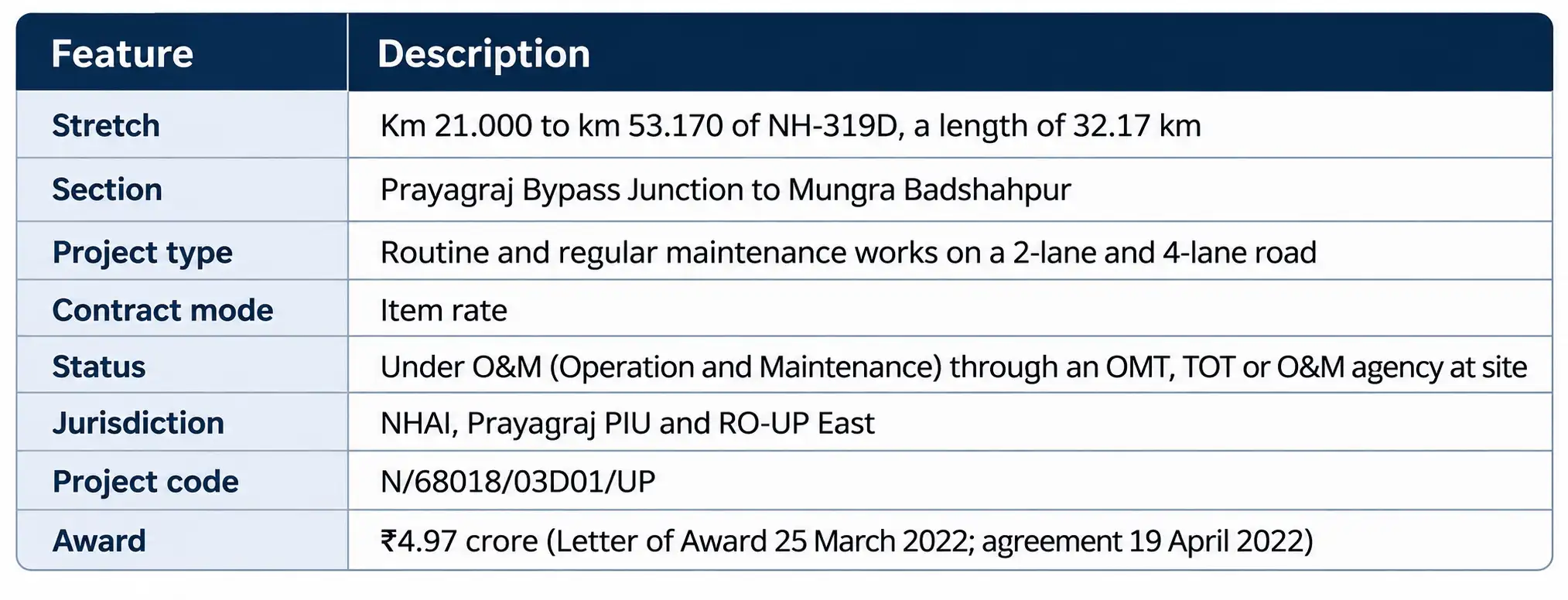
A maintenance project like this has a different job from a construction project. It does not create the road. It keeps the road in the condition users expect, year after year, and the measure of success is how little the road changes for the worse.
A maintenance contract is about keeping what exists in order rather than building something new. On an item-rate contract, where payment follows the items of work done, that makes it hard to tell, from a desk or an occasional visit, whether the work being paid for is going where the need is. A consistent, chainage-tied record answers that: it shows what is wrong, how urgent it is, and whether it has been put right by the next survey.
Every finding sits on a live GIS map, with each inspection point opening to its exact location, the defect flagged, and the frame behind it in both original and AI-annotated form. Figure 1 shows the road for the survey of 20 November 2026. Most of the line is green, meaning no defect was found along those stretches, with occasional orange and red markers, and more of them towards the north-eastern end as the road approaches Mungra Badshahpur.
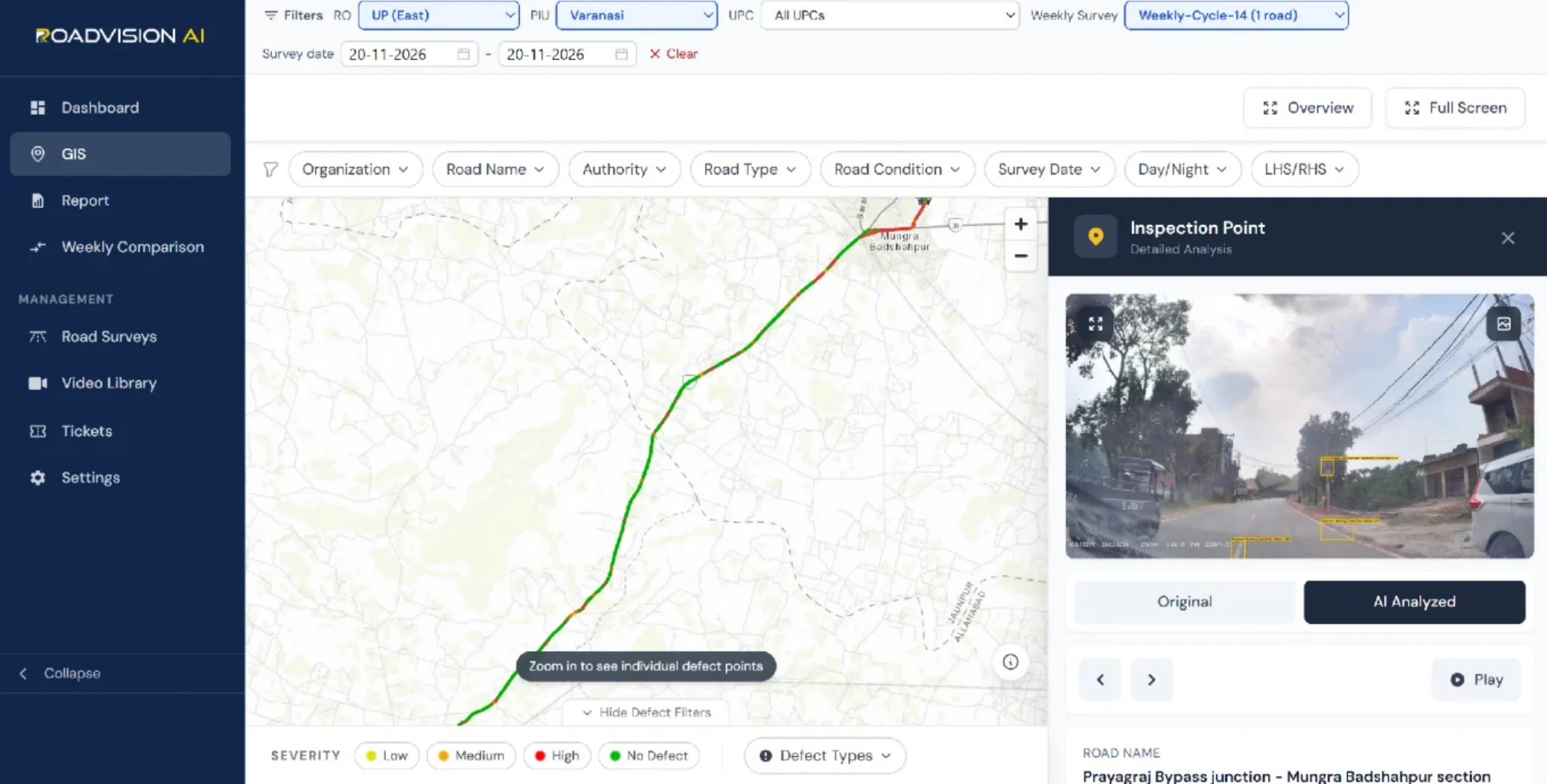
The inspection point, captured at about 12:08 pm, shows a small-town roadside of shopfronts, overhead cables and parked vehicles. Two kinds of finding have been flagged in the frame: signboards or hoardings that are not authorised, and pavement marking that has faded or is no longer visible. Neither is a fault in the road surface, and both are the kind of roadside issue that a surface-only survey would miss.
The Road Condition Overview in Figure 2 rates the 32.17 km surveyed in three bands. Most of the road, 22.89 km (71.2%), is in Good condition. A short stretch, 2.53 km (7.8%), is Fair, and 6.75 km (21.0%) is Poor.
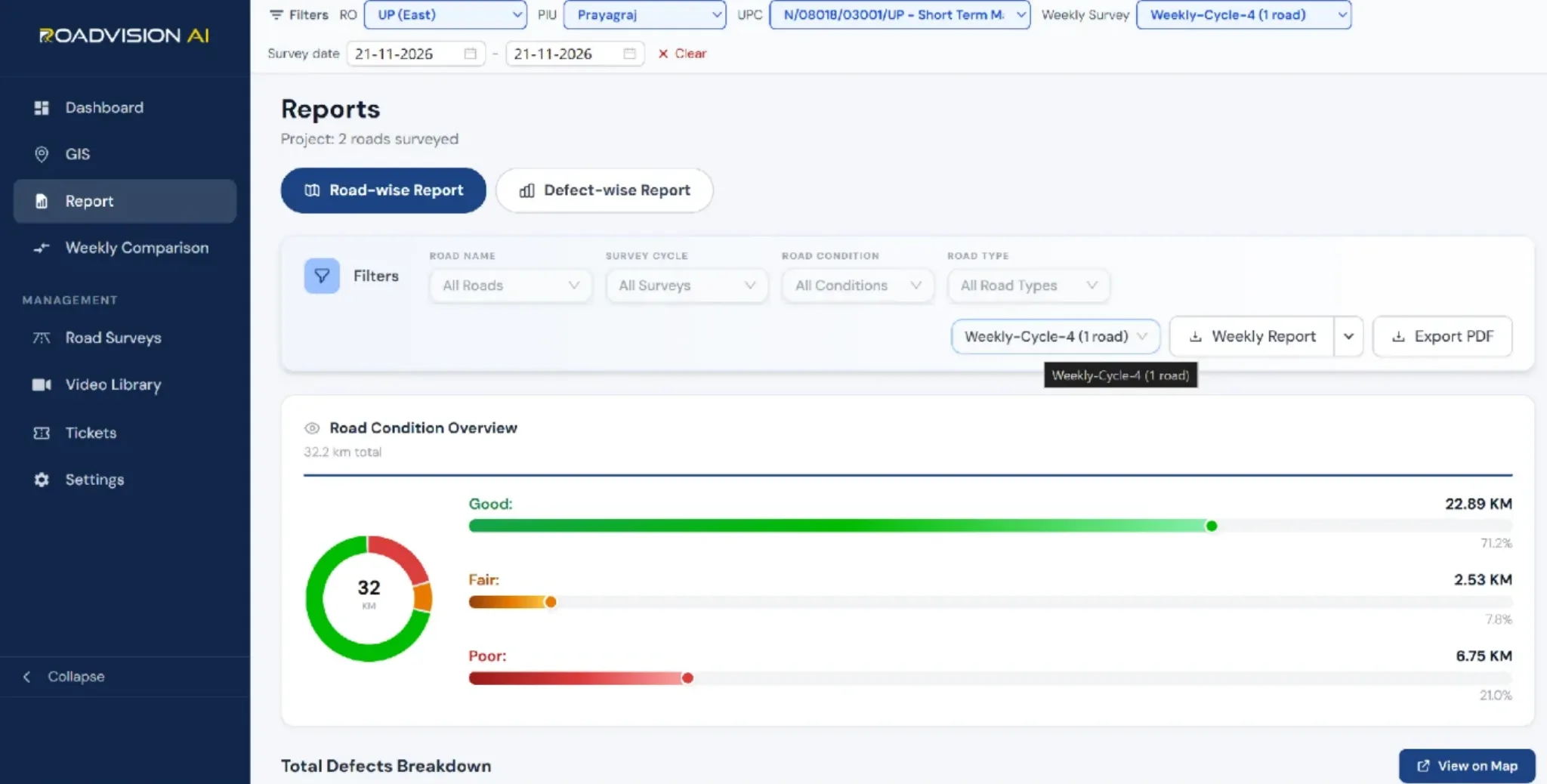
The shape of that split is the finding. There is very little in the middle. The road is, for the most part, either in good order or in need of attention, and the Fair band that usually marks a road beginning to slip is thin. That is the pattern one would hope to see on a road under regular maintenance, where wear is dealt with before it spreads. It also means that the Poor stretches, about a fifth of the road, are in effect the whole of the work ahead.
Alongside surface condition, the survey records the roadside. At the inspection point in Figure 1, the unauthorised hoarding and the faded marking sit in the same frame as a road that is otherwise in working order. They do not show up in a Good, Fair or Poor rating, but they matter to the people who use the road.
A road mostly in good shape. Seven kilometres in ten are in Good condition, which says the maintenance effort has largely kept the road in order.
A split with little in the middle. With so little Fair road, the picture is clear: most of the road needs nothing, and a minority needs attention.
The Poor stretches are a bounded job. At 6.75 km, they are a defined set of stretches that can be treated first, with a later survey confirming that they have been dealt with.
Roadside issues need their own attention. Unauthorised installations and faded markings sit outside the surface rating and need to be tracked on their own.
A baseline for the next cycle. A later survey of the same chainage shows what has been repaired, what has deteriorated and what has returned.
Snapshots. The GIS view covers 20 November 2026 and the report 21 November 2026, so both are snapshots of single survey days, not a full year of record.
Classification. Good, Fair and Poor are drawn from the detections, with lengths given to two decimals. The dashboard rounds the 32.17 km total to 32.2 km.
Changing road. The road changes between two-lane and four-lane sections, so the carriageway and the survey conditions change along the way.
Roadside surroundings. Shopfronts, overhead cables and parked vehicles can block the view of the surface and the roadside, and built-up areas can degrade GPS positioning. Detections therefore carry a QC step and are checked against the map and video.
Each survey gives the Prayagraj PIU and the UP (East) Regional Office a defect ID, chainage and survey reference for every finding, independent of the agency doing the work. A later survey of the same chainage then shows whether the finding has been closed out, so that verification does not rest on the maintaining agency's own account.
RoadVision AI is committed to continuous AI-based road condition monitoring along the Prayagraj Bypass Junction to Mungra Badshahpur section of NH-319D, giving NHAI a consistent, chainage-level record of a road that is kept in service by maintenance. Keeping that record current, survey after survey, is how a maintenance contract can be shown to be doing its job.

The Autonomous Road Engineer
AI-powered road condition monitoring, asset management, & infrastructure intelligence helping agencies move from reactive maintenance to predictive road management.