
Government road projects in India—whether national highways, rural roads, or state corridors—form the backbone of public mobility and economic growth. Yet delays often plague these projects due to unpredictable weather, material shortages, rework caused by quality lapses, and poor coordination among contractors. Such delays can jeopardize public trust and escalate project costs dramatically.
To maintain consistent quality and accountability, the Indian Roads Congress (IRC) provides comprehensive standards for design, construction, and maintenance. Meeting these standards requires rigorous, continuous construction monitoring.
Today, AI-powered infrastructure monitoring systems are enabling government agencies to significantly accelerate execution while ensuring compliance. Platforms such as RoadVision AI combine construction monitoring with AI-driven road asset management to keep projects on schedule and on spec.
As the saying goes, "A stitch in time saves nine." In road construction, timely detection saves crores.
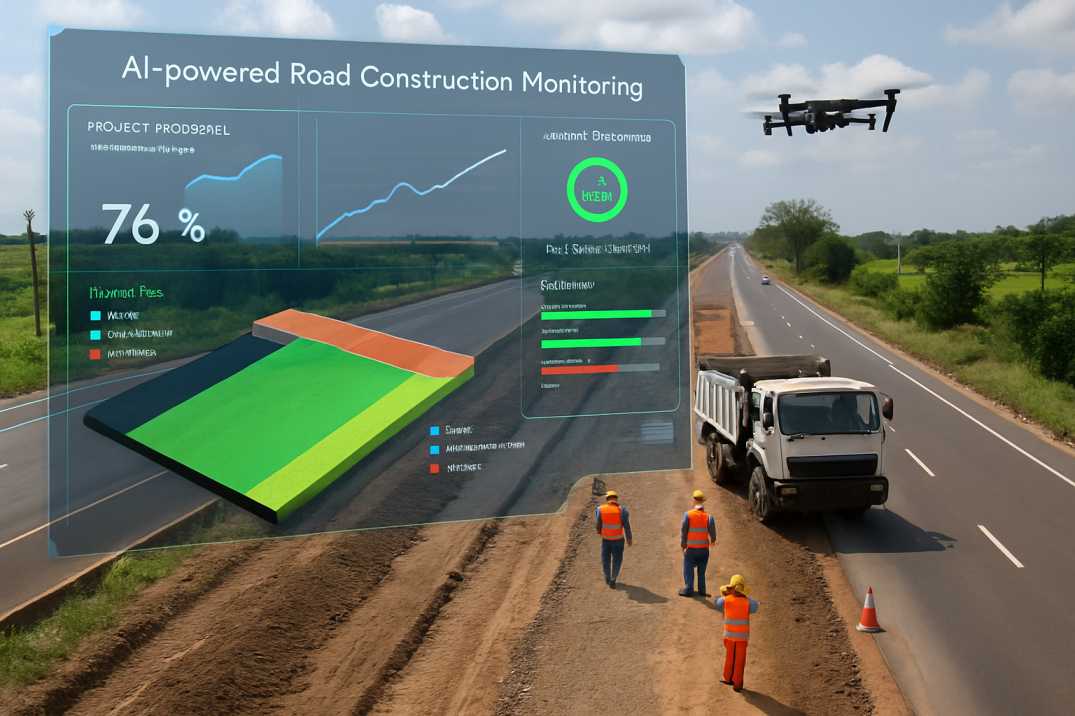
Major schemes including the National Highways Development Programme (NHDP), PMGSY, Bharatmala, and state-level PWD projects have strict completion timelines and milestone-linked payments. Construction monitoring ensures:
Without structured monitoring, even well-funded projects risk overruns, penalties, and performance failures that undermine public investment.
IRC guidelines define precise construction control practices to ensure durable pavements. Key principles include:
2.1 Material Quality Standards
IRC specifies bitumen grade, aggregate properties, moisture content, compaction density, and mix design tolerances. Continuous monitoring ensures no deviation in hotmix quality, granular layers, or structural components that could compromise pavement life.
2.2 Layer Thickness & Compaction Validation
Specifications within IRC:SP, IRC:37, and IRC:75 outline required thicknesses for granular sub-base (GSB), WMM, DBM, and BC layers. Monitoring ensures uniformity across the entire chainage, preventing weak spots that lead to premature failure.
2.3 Alignment, Camber & Level Controls
Survey checks must confirm that pavement geometry matches the approved drawings. Errors here can lead to drainage failures, poor ride quality, and long-term structural issues that are expensive to correct after completion.
2.4 Workmanship & Safety Compliance
Standards require PPE usage, proper barricading, signage, and work zone safety to prevent accidents during construction—protecting both workers and road users.
2.5 Documentation & Reporting
IRC prescribes systematic documentation through test reports, checklists, quality registers, and construction logs. This creates an auditable trail that supports milestone payments and dispute resolution.
2.6 Testing Frequency and Protocols
Specific tests at defined frequencies ensure that quality is maintained throughout construction, not just at isolated checkpoints.
When these principles are monitored rigorously, project timelines remain intact and post-construction failures are minimized.
RoadVision AI brings automation, objectivity, and speed to IRC-based construction monitoring. Instead of relying solely on manual supervision, agencies gain real-time, data-driven insights through its integrated suite of AI agents.
3.1 Automated Construction Progress Tracking
Using drones, cameras, and IoT sensors, the Pavement Condition Intelligence Agent conducts automated road construction surveys. It captures:
This aligns with IRC requirements for measurement books and milestone verification, providing objective evidence for contractor payments.
3.2 AI-Based Quality Assurance
The platform detects issues such as:
The Road Safety Audit Agent flags deviations instantly, allowing engineers to fix them before they trigger rework or penalties—saving both time and money.
3.3 Compliance-Ready Digital Documentation
RoadVision AI auto-generates digital logs aligned with IRC formats for:
This eliminates disputes, accelerates contractor–department approvals, and ensures that every milestone payment is supported by verifiable data.
3.4 Predictive Delay & Risk Analysis
By analysing real-time and historical project data, the Traffic Analysis Agent and integrated analytics predict:
This proactive intelligence ensures delays are resolved before they escalate—a key advantage in government contracts with rigid deadlines.
3.5 Seamless Integration With Road Asset Management
Once the road is commissioned, all as-built data integrates into the digital road maintenance system through the Roadside Assets Inventory Agent. This strengthens:
3.6 Multi-Project Portfolio Management
For agencies managing multiple concurrent projects, the platform provides:
3.7 Drone-Based Corridor Monitoring
The platform integrates drone surveys for:
4.1 Manual Supervision Limitations
Traditional inspection is slow, inconsistent, and dependent on individual expertise—leading to missed defects and varying quality standards across projects.
4.2 Delayed Issue Detection
Small deviations in early layers often go unnoticed until the final QC stage—resulting in costly rework that could have been prevented with real-time monitoring.
4.3 Documentation Burden
Paper-based logs and fragmented records slow down audits and approvals, creating payment delays that frustrate contractors and stall progress.
4.4 Poor Coordination Among Stakeholders
Contractors, consultants, and government engineers lack a unified live dashboard, leading to miscommunication and delayed decision-making.
4.5 Difficulty Meeting Tight Government Deadlines
Weather and logistics disruptions make manual tracking inadequate for real-time decision-making, causing cascading delays across the project network.
4.6 Disputes Over Completed Work
Without objective evidence, disagreements over quantities and quality lead to arbitration delays and stalled payments.
4.7 Inconsistent Quality Across Segments
Different teams working on different sections produce variable quality, but this inconsistency is only discovered after completion.
AI solves these challenges by ensuring every issue is visible the moment it appears through platforms like RoadVision AI.
Delivering government road projects on schedule requires far more than manpower and machinery. It demands precision, foresight, and unwavering quality control. Construction monitoring anchored in IRC principles—and enhanced by AI—creates a predictable, accountable, and high-quality execution environment.
Platforms like RoadVision AI combine digital twins, automated surveys, predictive analytics, and IRC-aligned compliance checks through the Pavement Condition Intelligence Agent, Road Safety Audit Agent, Roadside Assets Inventory Agent, and Traffic Analysis Agent to help agencies "see the road ahead" long before challenges arise.
The platform's ability to:
transforms how government agencies approach project delivery. As the proverb goes, "The proof of the pudding is in the eating." The proof of a road project is in its timely, defect-free completion—and AI makes that achievable at scale.
If your organization wants to ensure faster project execution, zero rework, and full IRC compliance across your portfolio, book a demo with RoadVision AI today and discover how intelligent construction monitoring can help you meet every deadline with confidence.
Q1. What is AI construction monitoring?
It is the use of AI-driven tools and analytics to track, assess, and manage construction activities in real time.
Q2. How does construction monitoring help in meeting deadlines?
It ensures early detection of issues, improves quality control, and enables faster decision-making.
Q3. Can RoadVision AI integrate with government project systems?
Yes, it is designed to integrate with existing reporting and compliance systems.
The Autonomous Road Engineer
AI-powered road condition monitoring, asset management, & infrastructure intelligence helping agencies move from reactive maintenance to predictive road management.


.webp)
.webp)
.webp)