AI for Traffic Sign Compliance Monitoring in India: Supporting IRC 67 Road Signage Standards
On this page
India's rapidly expanding highway and urban road network demands consistent, standardised and highly visible traffic signage to ensure safe and efficient mobility. Traffic signs are among the most critical safety assets on any corridor, guiding driver decisions, regulating speed and warning of hazards.
IRC:67 defines the official standards for traffic signs across Indian roads, covering design, colour, shape, placement and visibility requirements. However, ensuring network-wide compliance through manual inspections is increasingly difficult at scale.
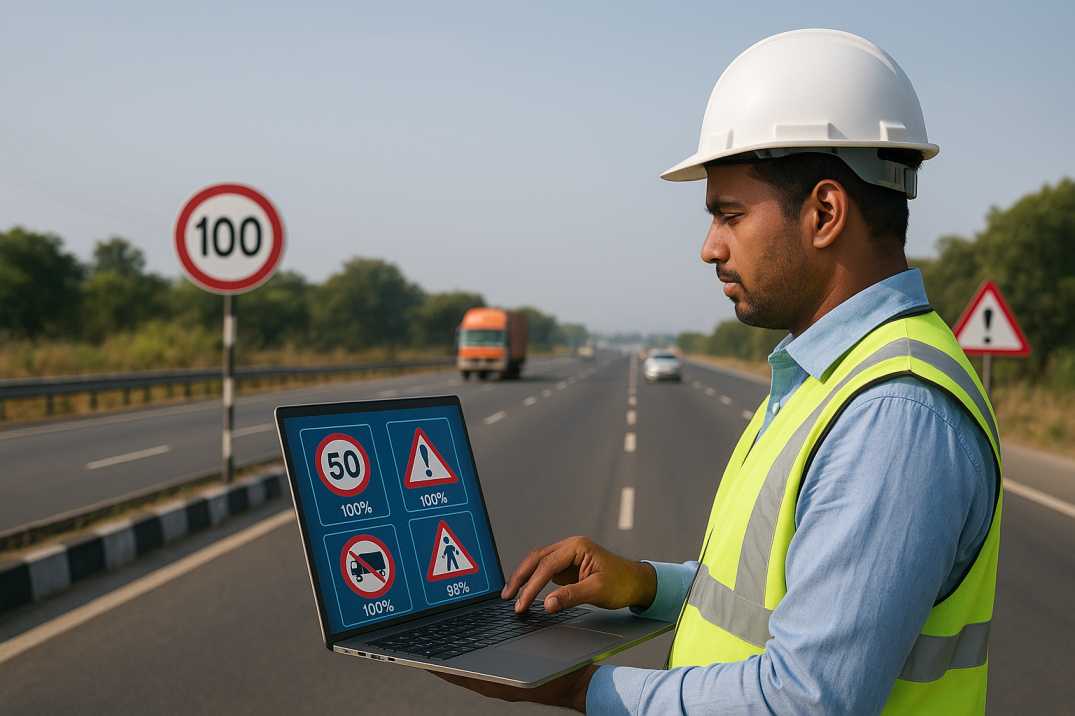
This is where road asset management in India, supported by AI-powered traffic sign compliance monitoring, is transforming how authorities inspect, evaluate and maintain signage. Through automated detection and analytics, agencies can strengthen safety outcomes and achieve sustained IRC:67 compliance across national and state road networks.
Smart Inspection
1. Understanding IRC:67 and Its Importance for Indian Roads
IRC:67 provides comprehensive guidance on traffic sign standards for national highways, state highways and urban road systems. The code ensures that road users receive consistent visual information regardless of region, roadway type or traffic volume.
The primary objectives of IRC:67 include:
Standardisation of sign shapes, colours and symbols for instant recognition
Uniform placement and mounting height requirements across networks
Minimum legibility and visibility distance standards for reaction time
Retroreflectivity requirements for night-time safety
Clear differentiation between regulatory, warning and informatory signage
Material specifications for durability under Indian climatic conditions
Maintenance cycles to ensure ongoing compliance
When signage deviates from these standards, driver response time decreases and crash risk increases — especially at curves, junctions and high-speed corridors.
2. Types of Traffic Signs Under IRC:67
2.1 Regulatory Signs
Mandatory compliance with legal requirements
Red circles, octagons (stop), rectangles
Examples: Stop, Give Way, Speed Limit, No Entry, No Parking
Examples: Destination signs, Facility information (fuel, food, accommodation)
2.4 Temporary Signs
Work zone and construction warnings
Orange background for visibility
Diversion and detour guidance
3. Challenges in Traditional Traffic Sign Monitoring
Manual traffic sign inspections remain widely used, but they are resource-intensive and difficult to implement consistently across India's vast road network.
Common challenges include:
Large inspection coverage requirements making network-wide monitoring impractical
Subjective visual assessment between inspectors leading to inconsistent ratings
Delayed identification of missing or damaged signs
Incomplete documentation and inconsistent reporting formats
Limited ability to track sign condition over time for trend analysis
Safety risks for inspectors working near live traffic
Inability to detect retroreflectivity loss at night
These limitations highlight the need for scalable, automated inspection systems through the Road Safety Audit Agent that support compliance at the network level.
4. How AI-Based Traffic Sign Monitoring Works
AI-driven traffic sign monitoring through the Road Safety Audit Agent uses computer vision models trained on Indian signage datasets. These models analyse video and image data captured from survey vehicles operating at normal traffic speeds.
Core system capabilities include:
Automated detection of traffic signs in real time
Classification aligned with IRC:67 categories (regulatory, warning, informatory)
Condition assessment for fading, damage or corrosion
Visibility and obstruction analysis (vegetation, poles, hoardings)
Geo-tagging and mapping for accurate asset inventories
Retroreflectivity estimation from visual data
Placement verification against IRC:67 standards
This approach enables consistent, repeatable inspections across thousands of kilometres without disrupting traffic operations.
5. Traffic Sign Detection Using AI for IRC:67 Compliance
Traffic sign detection using AI through the Road Safety Audit Agent does more than identify signs — it verifies whether signage meets IRC:67 requirements and highlights deviations.
Key compliance checks include:
Presence of mandatory regulatory signs at required locations
Correct symbol type and sign category matching IRC:67 specifications
Proper placement, orientation and mounting height relative to carriageway
Adequate advance visibility distance for driver reaction
Retroreflectivity and surface condition status for night visibility
Obstruction-free view from approaching traffic
Consistency with road classification and design speed
These insights allow authorities to take timely corrective action before signage deficiencies contribute to crashes.
6. Common Signage Deficiencies Detected by AI
6.1 Missing Signage
No signage at critical locations (curves, intersections, work zones)
Signs removed but not replaced after maintenance
6.2 Fading and Reflectivity Loss
UV exposure fading colours over time
Retroreflective sheeting degradation
Reduced night visibility
6.3 Physical Damage
Bent or twisted sign posts
Damaged sign faces from impacts
Corrosion and rust
6.4 Visibility Obstruction
Vegetation overgrowth blocking signs
Hoardings or structures encroaching
Poor lighting at night
6.5 Placement Errors
Signs too close to junctions for reaction
Improper mounting heights
Inadequate advance warning distances
7. AI Road Asset Inspection in India for Scalable Signage Management
Traffic signs are not isolated features — they are part of the broader road asset ecosystem. AI-based sign monitoring through the Roadside Assets Inventory Agent integrates seamlessly into digital asset management workflows.
Benefits include:
Centralised and continuously updated sign inventories with geo-tagged locations
Historical condition tracking and degradation monitoring over time
Integration with road inventory inspection datasets for holistic views
Risk-based maintenance prioritisation based on condition and safety impact
Transparent compliance reporting for audits and stakeholders
Asset lifecycle planning for replacement scheduling
This ensures signage is managed proactively across its full lifecycle.
8. AI-Powered Highway Inspection and Safety Integration
AI-powered highway inspection through the Road Safety Audit Agent enables agencies to evaluate signage alongside pavement condition, roadway geometry and traffic behaviour for a holistic safety perspective.
Supporting corridor-level road safety audits with comprehensive data
Identifying safety-critical zones requiring enhanced warning signage
Improving compliance at curves, junctions and work zones
Enabling proactive risk mitigation rather than reactive replacement
Correlating signage condition with crash history for prioritisation
This strengthens highway safety outcomes across India's most heavily travelled corridors.
9. AI Road Safety Monitoring Through Signage Analytics
Signage analytics through the Road Safety Audit Agent plays a direct role in reducing accident risk and improving driver awareness.
AI supports safety by:
Detecting missing or non-compliant signs before they contribute to crashes
Monitoring degradation trends over time for preventive replacement
Enabling faster maintenance response cycles with automated alerts
Supporting evidence-based safety planning with objective data
Reducing inspection errors and contractor dependency through automation
Providing night-time visibility assessment through retroreflectivity analysis
When combined with AI-driven traffic surveys from the Traffic Analysis Agent, authorities can also evaluate how drivers respond to signage under real operating conditions.
10. IRC:67 Compliance Parameters
10.1 Sign Dimensions
Size based on road classification and design speed
Letter height for legibility distance
Border width and colour
10.2 Placement
Mounting height (typically 2.1-2.4 m above carriageway)
Lateral offset from edge of road
Advance distance before decision point
Spacing between sequential signs
10.3 Visibility
Minimum retroreflectivity levels
Clear zone free from obstructions
Night visibility requirements
Daytime colour contrast
11. Integrating AI Sign Monitoring Into Road Asset Management Frameworks
Modern road asset management in India depends on continuous, high-quality data inputs. AI-based sign monitoring through the Roadside Assets Inventory Agent provides real-time visibility into compliance status and asset condition across the network.
Strategic advantages include:
Network-wide compliance tracking with GIS visualisation
Improved lifecycle and replacement planning with condition data
Data-driven budgeting and investment prioritisation for signage
Consistent reporting across regions and contractors
Long-term safety performance monitoring aligned with IRC standards
Integration with maintenance work order systems for corrective action
AI is redefining how traffic sign compliance is monitored across India. By aligning automated sign detection and condition assessment through the Road Safety Audit Agent with IRC:67 standards, authorities can ensure consistent signage, improved safety performance and stronger regulatory compliance.
The platform's ability to:
Detect signs automatically across entire networks
Classify by IRC:67 categories with high accuracy
Assess condition and visibility for proactive maintenance
Identify missing signage at critical locations
Generate IRC-compliant reports for audits
Integrate all data sources for unified asset management
Scale from urban to rural networks efficiently
transforms how traffic sign compliance is managed across India.
Through scalable AI-powered inspection workflows, India is advancing toward a smarter, safer and more uniform road environment.



.webp)
.webp)
.webp)