
Road infrastructure is one of the most valuable public assets managed by governments, highway authorities, municipalities, and private operators. Roads support transportation, logistics, emergency services, and economic growth. However, maintaining road networks efficiently has become increasingly difficult due to aging infrastructure, rising traffic loads, climate impacts, and limited maintenance budgets.
For decades, most road agencies relied on reactive maintenance strategies. Roads were repaired only after visible deterioration appeared or complaints were received from road users. While this approach may seem practical in the short term, it often leads to higher repair costs, reduced pavement lifespan, and increased safety risks.
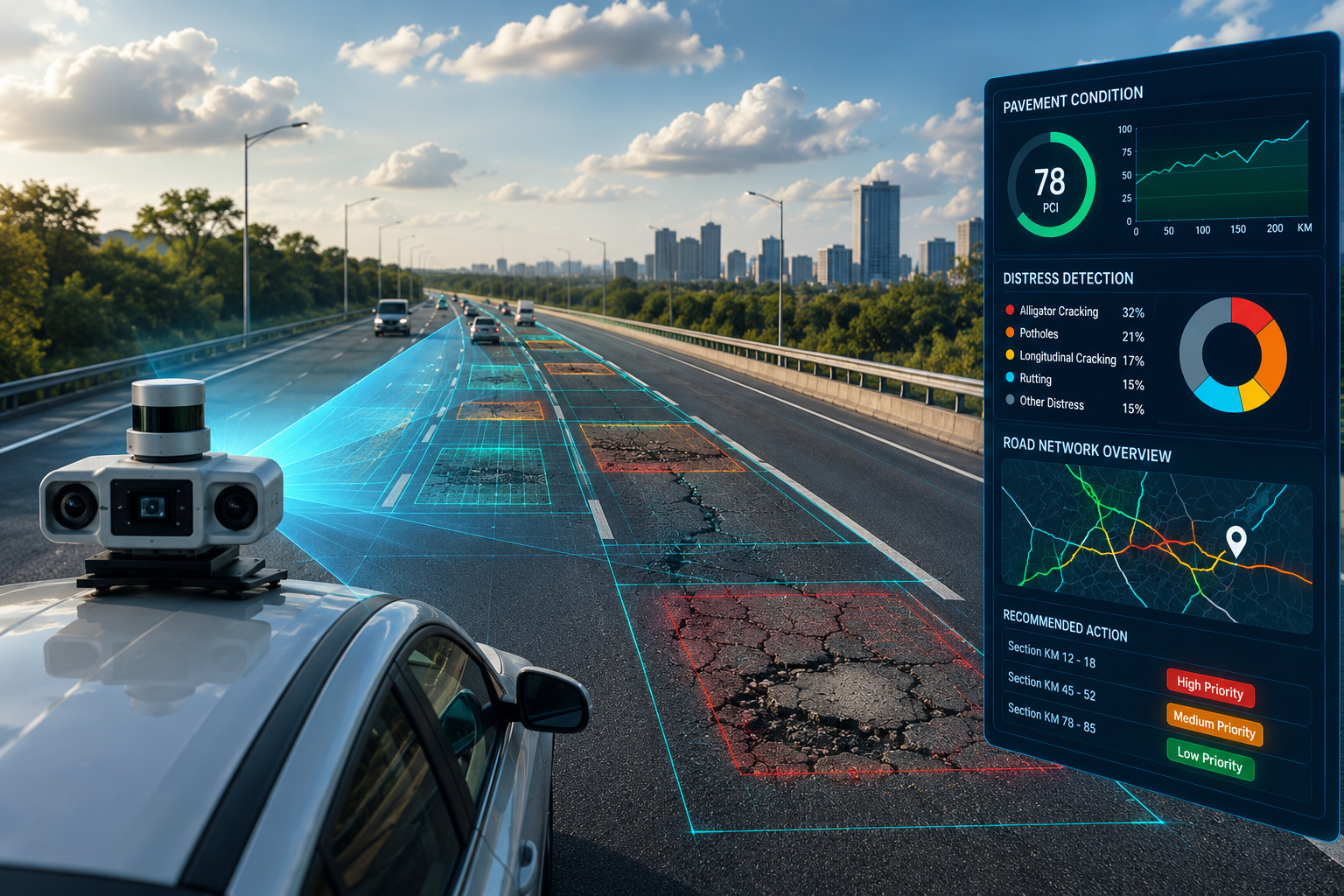
Today, transportation agencies are rapidly shifting toward predictive road maintenance AI to improve infrastructure management. Artificial intelligence, computer vision, and automated road analytics are helping organizations detect pavement deterioration earlier, prioritize repairs intelligently, and optimize maintenance budgets before road failures become severe.
This transition is transforming the future of roadway maintenance and pavement management worldwide.
Reactive maintenance is the traditional method where repairs are performed only after defects become noticeable. In most cases, maintenance activities begin after potholes, cracking, rutting, surface failures, or damaged road assets are already affecting road performance.
Common examples include:
Although reactive maintenance has been widely used for years, it creates multiple operational and financial challenges.
One of the biggest problems is that minor pavement defects often develop into major structural failures when left untreated. Small cracks allow water infiltration into lower pavement layers, weakening the road structure over time. What could have been solved through preventive maintenance may eventually require costly rehabilitation or reconstruction.
Reactive maintenance also depends heavily on manual surveys and periodic inspections. These inspections are time-consuming, inconsistent, and difficult to scale across large highway networks. Since road conditions change continuously, many agencies struggle to maintain updated infrastructure data.
Another challenge is delayed decision-making. By the time defects are identified, surveyed, documented, and approved for repair, pavement conditions may have deteriorated significantly further.
This is why many transportation organizations are moving away from reactive maintenance models.
Predictive road maintenance AI uses artificial intelligence, machine learning, computer vision, and roadway analytics to detect deterioration patterns before major failures occur.
Instead of waiting for roads to fail, predictive systems continuously monitor pavement conditions and identify early warning signs of deterioration.
Modern AI-based systems analyze:
These systems help agencies forecast deterioration trends and schedule maintenance proactively rather than reactively.
The result is a more efficient, data-driven infrastructure management strategy.
Modern predictive maintenance platforms follow a structured workflow that combines automated inspections, AI analytics, and predictive modeling.
Vehicles equipped with cameras, smartphones, or survey systems collect roadway imagery during normal driving operations. This allows agencies to monitor large road networks frequently without requiring extensive field teams.
This process is commonly used in modern digital road survey systems.
AI algorithms automatically analyze roadway imagery to detect pavement distress types such as:
Advanced platforms can also identify damaged roadside assets, signs, barriers, and safety infrastructure.
This capability is driving the adoption of automated road inspection solutions across highway agencies and municipalities.
Once defects are identified, the system evaluates pavement health using condition scoring models and analytics. Agencies gain detailed insights into road performance, deterioration severity, and maintenance priorities.
Modern road condition assessment software enables transportation teams to standardize pavement evaluations across large road networks.
Machine learning models analyze historical patterns and current conditions to predict future pavement deterioration.
This helps agencies answer critical questions such as:
This proactive strategy improves long-term infrastructure planning significantly.
Road networks today face more pressure than ever before. Increased freight movement, urban expansion, population growth, and extreme weather conditions accelerate pavement deterioration rapidly.
Reactive maintenance creates several long-term problems.
Emergency repairs and large-scale rehabilitation projects are significantly more expensive than preventive interventions. Delaying maintenance often increases total lifecycle costs substantially.
By identifying defects early, predictive systems help agencies preserve pavements before structural damage becomes severe.
Manual inspections provide only periodic snapshots of road conditions. Agencies often lack continuous visibility into pavement performance across their entire network.
Predictive systems solve this challenge through continuous monitoring and automated condition tracking.
Traditional inspection workflows involve:
AI-driven systems automate much of this process, reducing operational delays and improving decision-making speed.
Poor pavement conditions contribute to:
Predictive maintenance helps agencies address safety issues before they become critical.
The shift toward predictive maintenance offers significant operational and financial advantages.
Predictive systems help agencies prioritize repairs based on actual deterioration risk rather than assumptions or complaints.
This improves maintenance planning and reduces unnecessary spending.
Many transportation organizations now rely on road AI based O&M software to optimize maintenance budgets and improve infrastructure decision-making.
Traditional road inspections across large networks may take months. AI-powered systems process thousands of kilometers of roadway imagery much faster.
This allows agencies to update pavement condition data continuously instead of annually.
Modern platforms combine pavement analytics with roadside asset intelligence, enabling agencies to manage:
This creates a centralized infrastructure management workflow.
Predictive systems support road lifecycle analysis AI by helping agencies understand how roads deteriorate over time and when interventions are most cost-effective.
This improves strategic maintenance planning and asset preservation.
Early detection of pavement defects and degraded safety infrastructure improves roadway safety conditions for drivers and pedestrians.
AI-powered systems also support proactive risk management across highways and urban roads.
Artificial intelligence is changing pavement management from static reporting into continuous infrastructure intelligence.
Modern AI pavement condition monitoring systems provide:
These capabilities allow transportation agencies to transition from reactive operations toward proactive infrastructure management.
As road networks become more connected and data-driven, predictive maintenance will play an increasingly important role in improving efficiency and reducing lifecycle costs.
The growth of automated highway maintenance strategies is already reshaping how road agencies manage large transportation networks.
Although predictive systems provide major advantages, implementation still involves certain challenges.
Organizations may face difficulties related to:
However, the long-term benefits generally outweigh the initial transition challenges.
As AI technology becomes more accessible and scalable, adoption is expected to accelerate globally.
The future of AI-based roadway infrastructure management is moving toward automation, predictive analytics, and continuous monitoring.
Emerging technologies will further improve:
Transportation agencies that adopt predictive systems early will gain major advantages in operational efficiency, cost optimization, and infrastructure sustainability.
Those that continue relying only on reactive maintenance may struggle with increasing repair costs, growing infrastructure backlogs, and declining road
performance.
Reactive maintenance has long been the standard approach for roadway infrastructure management, but growing infrastructure demands are making this model increasingly inefficient. Waiting for visible failures before taking action often leads to higher repair costs, shorter pavement lifespan, and greater safety risks.
The shift toward predictive road maintenance AI is enabling transportation agencies to monitor road conditions continuously, detect deterioration earlier, prioritize maintenance intelligently, and optimize long-term infrastructure investments.
With advancements in road condition monitoring AI, automated inspections, and predictive analytics, agencies can now move from reactive repairs to proactive infrastructure preservation strategies that improve efficiency, safety, and sustainability.
At RoadVision AI, we help highway authorities, municipalities, and infrastructure operators modernize roadway management through AI-powered pavement analytics and intelligent infrastructure monitoring. Our platform supports scalable road assessments, predictive maintenance planning, automated roadway inspections, and real-time infrastructure intelligence across large road networks.
If your organization is looking to improve maintenance efficiency, reduce infrastructure costs, and adopt smarter roadway management strategies, book a demo with RoadVision AI to explore how AI-driven infrastructure analytics can transform your operations.
Predictive road maintenance AI uses artificial intelligence, computer vision, and roadway analytics to detect pavement deterioration before major failures occur. It helps transportation agencies monitor road conditions continuously, prioritize repairs proactively, and reduce long-term maintenance costs.
Reactive maintenance repairs roads only after visible damage appears, such as potholes or severe cracking. Predictive maintenance uses AI-powered road condition monitoring and automated inspections to identify early signs of deterioration, allowing agencies to perform preventive maintenance before roads fail.
AI-powered predictive maintenance improves infrastructure visibility, reduces repair costs, enhances roadway safety, speeds up inspections, and helps agencies optimize maintenance budgets. It also supports smarter pavement management through automated defect detection, predictive analytics, and real-time infrastructure intelligence.

The Autonomous Road Engineer
AI-powered road condition monitoring, asset management, & infrastructure intelligence helping agencies move from reactive maintenance to predictive road management.


.webp)
.webp)
.webp)