
Urban roads are among the most critical public assets managed by municipal corporations in India. Every day, city roads support millions of commuters, public transport systems, emergency services, logistics fleets, and economic activities. However, maintaining urban road infrastructure has become increasingly challenging due to rapid urbanization, rising traffic density, climate impact, limited manpower, and budget constraints.
Traditional road inspection methods are no longer sufficient for modern cities. Manual inspections are slow, inconsistent, expensive, and difficult to scale across thousands of kilometers of urban roads. By the time defects are identified and maintenance work begins, the road condition often worsens significantly.
In 2026, municipal corporations are shifting toward intelligent infrastructure management powered by Artificial Intelligence, Computer Vision, GIS mapping, drone surveys, cloud analytics, and automation platforms. Cities are adopting smarter ways to inspect roads, detect defects, prioritize repairs, and improve public safety.
This transition is driving the adoption of municipal road inspection software across India and globally.
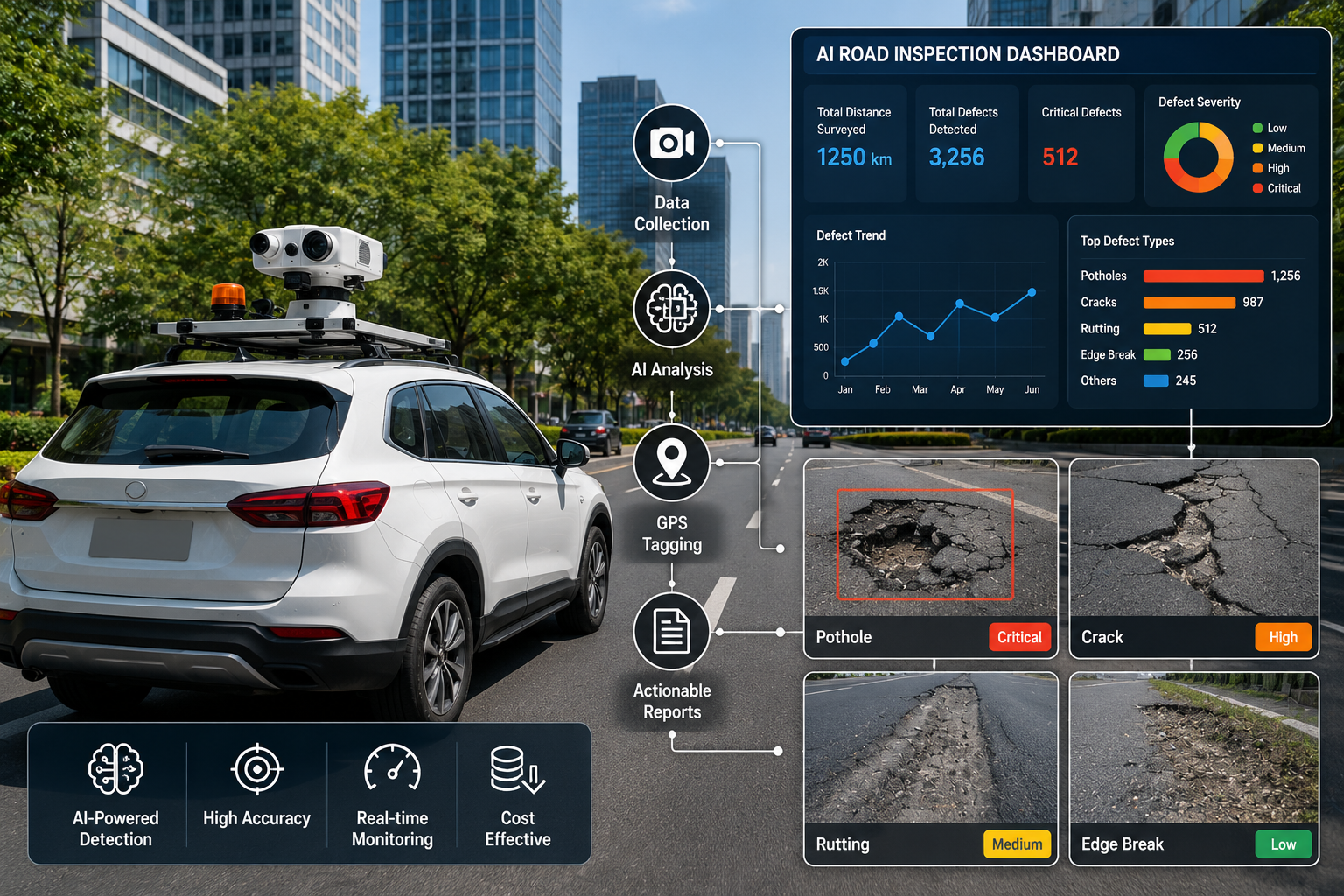
Most Urban Local Bodies (ULBs) and municipal corporations still rely heavily on manual road inspection processes. These workflows typically involve engineers physically visiting roads, taking photographs, recording observations manually, and preparing reports afterward.
This approach creates multiple operational challenges:
In rapidly growing Indian cities, manual surveys alone cannot provide continuous monitoring of road infrastructure.
This is where city road inspection AI and intelligent automation systems are transforming municipal operations.
Municipal road inspection software is a digital platform designed to automate road condition assessment, defect detection, infrastructure monitoring, asset mapping, inspection reporting, and maintenance planning.
These systems combine multiple advanced technologies such as:
The software continuously captures road data and converts it into actionable insights for engineers, municipal authorities, consultants, and decision-makers.
Instead of relying solely on manual inspections, municipal corporations can monitor roads at scale using automated systems.
Modern urban road condition monitoring systems use multiple technologies simultaneously to collect and analyze road data in real time.
Vehicles equipped with AI-enabled dashcams continuously capture road footage while moving across city roads. The software automatically detects defects such as:
Computer Vision algorithms classify defects based on severity, dimensions, and location accuracy.
This enables scalable AI road inspection without deploying large field teams.
Drones are increasingly used for inspecting:
Drone inspections provide high-resolution aerial imagery and help municipal corporations identify defects that are difficult to detect from ground-level surveys.
Drone-based inspections are particularly useful during monsoon seasons and emergency response operations.
Modern automated road asset management software integrates GIS-based mapping systems to visualize road conditions geographically.
Municipal authorities can monitor:
GIS dashboards significantly improve planning and resource allocation.
Field engineers now use mobile based road inspection applications connected directly to centralized dashboards.
These applications enable:
This reduces paperwork and improves coordination between municipal departments.
One of the biggest advancements in 2026 is predictive road maintenance.
Using historical road data, traffic volume analysis, rainfall impact, pavement deterioration trends, and machine learning algorithms, modern systems can predict which roads are likely to fail in the future.
This enables municipal corporations to move from reactive repairs toward proactive maintenance planning.
Instead of repairing potholes after public complaints, authorities can prevent failures before they become severe.
Automated inspection systems can survey hundreds of kilometers daily compared to limited manual inspection capacity.
This significantly improves city-wide road visibility.
Automated workflows reduce dependency on large inspection teams and repetitive manual processes.
Municipal corporations can lower operational expenses while increasing inspection frequency.
Early defect detection reduces accident risks caused by potholes, damaged shoulders, poor lane markings, and surface failures.
Safer roads directly improve citizen satisfaction and reduce liability risks.
Using pavement condition monitoring systems, authorities can prioritize maintenance activities based on road condition severity and traffic importance.
This helps optimize road maintenance budgets effectively.
Digital inspection records improve transparency across:
Municipal corporations can track repair timelines, recurring defects, and contractor performance more efficiently.
Integrated citizen reporting systems allow complaints to be directly linked with inspection dashboards.
This accelerates response times and improves public trust in municipal governance.
Indian urban infrastructure faces unique challenges that make automation essential.
Indian cities are expanding rapidly, increasing the pressure on municipal road networks.
Urban Local Bodies are responsible for maintaining thousands of kilometers of roads with limited inspection manpower.
Continuous ULB road survey systems help municipalities monitor road conditions more efficiently.
Heavy rainfall significantly accelerates pavement deterioration across Indian cities.
Waterlogging, poor drainage, overloaded traffic, and utility cuts create recurring road failures.
Automated monitoring helps authorities identify problems before they escalate.
Citizens now expect:
Municipal corporations require data-driven systems to meet these expectations efficiently.
India’s Smart City initiatives are accelerating the adoption of intelligent infrastructure technologies.
Automated road inspection supports:
Municipal budgets remain under pressure.
Authorities must maximize pavement lifespan while reducing unnecessary repair expenditure.
AI-powered inspection systems help identify the right maintenance intervention at the right time.
Several advanced technologies are reshaping municipal infrastructure management.
Computer Vision models analyze road imagery and identify pavement defects automatically with high accuracy.
Machine learning algorithms improve defect classification and predictive maintenance capabilities over time.
LiDAR systems provide accurate road surface measurements and pavement geometry analysis.
These systems are highly effective for detailed infrastructure assessment.
360-degree imaging systems create complete visual records of road assets and roadside infrastructure.
This improves digital asset documentation significantly.
IoT devices collect real-time infrastructure data from roads, vehicles, and roadside assets.
This enhances monitoring accuracy.
Cloud platforms allow municipal departments to access centralized inspection data in real time.
This improves collaboration between engineering, maintenance, and planning teams.
Modern road condition assessment software can identify a wide range of defects automatically, including:
This creates a complete digital inventory of road conditions.
Although automation offers major advantages, implementation also comes with challenges.
Many municipalities still operate fragmented and outdated data systems.
Digital transformation requires proper integration planning.
Different departments often use inconsistent inspection formats.
Standardized digital workflows are necessary for effective implementation.
AI-based inspection systems require investment in:
However, long-term operational savings generally outweigh initial costs.
Municipal teams require training to interpret AI-generated reports and operate digital systems effectively.
The chosen platform must be scalable across wards, zones, and city-wide road networks.
By 2026, road inspections are becoming increasingly autonomous and data-driven.
Future-ready municipal corporations are moving toward:
The future of urban infrastructure management will depend heavily on intelligent automation.
Cities that adopt smart road asset management systems early will be better positioned to improve road quality, optimize budgets, and deliver safer infrastructure for citizens.
As Indian cities continue expanding, traditional inspection methods can no longer keep pace with growing infrastructure demands. Municipal corporations require faster, smarter, and more scalable solutions to maintain urban roads efficiently.
Adopting municipal road inspection software enables authorities to automate inspections, detect defects earlier, improve maintenance planning, reduce operational costs, and enhance public safety.
This is where RoadVision AI is helping transform urban infrastructure management.
RoadVision AI provides advanced AI-powered road inspection and monitoring solutions for municipal corporations, consultants, infrastructure companies, and road agencies. Using technologies such as dashcam-based surveys, 360-degree imaging, drone inspections, GIS mapping, LiDAR integration, and AI-driven analytics, RoadVision AI helps organizations perform scalable and intelligent road condition assessments.
The platform enables:
For municipal corporations looking to modernize road maintenance operations in 2026, RoadVision AI offers a scalable and future-ready approach to infrastructure management.
Book a demo with RoadVision AI to explore how AI-powered road inspection can help your city improve road quality, optimize maintenance budgets, and build smarter urban infrastructure.
The Autonomous Road Engineer
AI-powered road condition monitoring, asset management, & infrastructure intelligence helping agencies move from reactive maintenance to predictive road management.


.webp)
.webp)
.webp)