
Municipal public works departments, county road agencies, and city engineering teams around the world rely on Cartegraph OMS as the operational centre of their road asset management. It manages work orders, asset inventories, inspection records, and maintenance histories that crews and engineers have built their workflows around over years. For most agencies, it is not going anywhere.
But one question is coming up more frequently across public works and transportation teams: how do we bring AI road surveys into our operations without dismantling the asset management system our entire maintenance programme depends on?
This guide is written specifically for road engineering managers and public works directors who are already working within the Cartegraph OMS ecosystem and are evaluating how AI road condition assessment fits into not on top of their existing operations.
Before covering where AI fits, it is worth being precise about what Cartegraph OMS actually provides because this determines exactly where an AI layer connects.
Cartegraph OMS is an operations management system (OMS) built specifically for public works and transportation agencies. Unlike generic CMMS platforms, it models road assets pavement sections, signs, markings, drainage structures, bridges as managed infrastructure items with full life-cycle tracking: condition history, maintenance records, cost accounting, work order schedules, and inspection logs. Every field action taken on an asset is recorded against it, building an auditable operational record that supports budget justification, regulatory compliance, and long-range capital planning.
Cartegraph OMS links every work order directly to the asset or pavement section it concerns. When a crew patches a pothole, replaces a sign, or clears a drain, the labour hours, materials, and equipment used are charged to that asset’s record. This makes it possible to track true cost-per-asset over time, identify assets with disproportionate maintenance expenditure, and make evidence-based decisions about repair versus replacement thresholds.
Cartegraph OMS includes dedicated pavement inspection workflows that allow field teams to record surface condition data distress types, extents, and severities and calculate Pavement Condition Index (PCI) scores aligned to ASTM D6433. Those scores drive the platform’s built-in Pavement Management module, which models network deterioration curves, simulates maintenance scenarios, and generates prioritised treatment lists based on configurable budget constraints and performance targets.
Cartegraph OMS manages scheduled inspection cycles for every asset category on the network. Regulatory inspection requirements annual bridge inspections, sign retroreflectivity cycles, drainage compliance checks are tracked against individual assets, with alerts triggering when inspections are overdue. For agencies accountable to state, provincial, or national road authorities, this compliance infrastructure is operationally essential.
Cartegraph OMS connects with public-facing request management systems, converting citizen-reported road defects into work orders that are assigned, tracked, and closed against the relevant pavement section or asset record. Field crews use the Cartegraph Go mobile application to access work orders, submit inspection findings, and capture photographic evidence in the field, with updates synchronising to the OMS in real time.
The platform’s reporting engine aggregates asset condition scores, maintenance costs, and treatment histories into capital programme inputs. Public works directors and finance officers use Cartegraph OMS outputs to justify budget submissions, model the impact of funding constraints on pavement performance, and demonstrate maintenance programme outcomes to elected officials and funding bodies.
Cartegraph OMS integrates with Esri ArcGIS, connecting asset records to spatial network data. It also supports integration with financial systems (Tyler Munis, SAP), HR and time-keeping platforms, and open data standards including GIS shapefile and REST API exports. Road network data managed in Cartegraph OMS is the operational thread connecting field maintenance, engineering planning, and executive reporting across the agency.
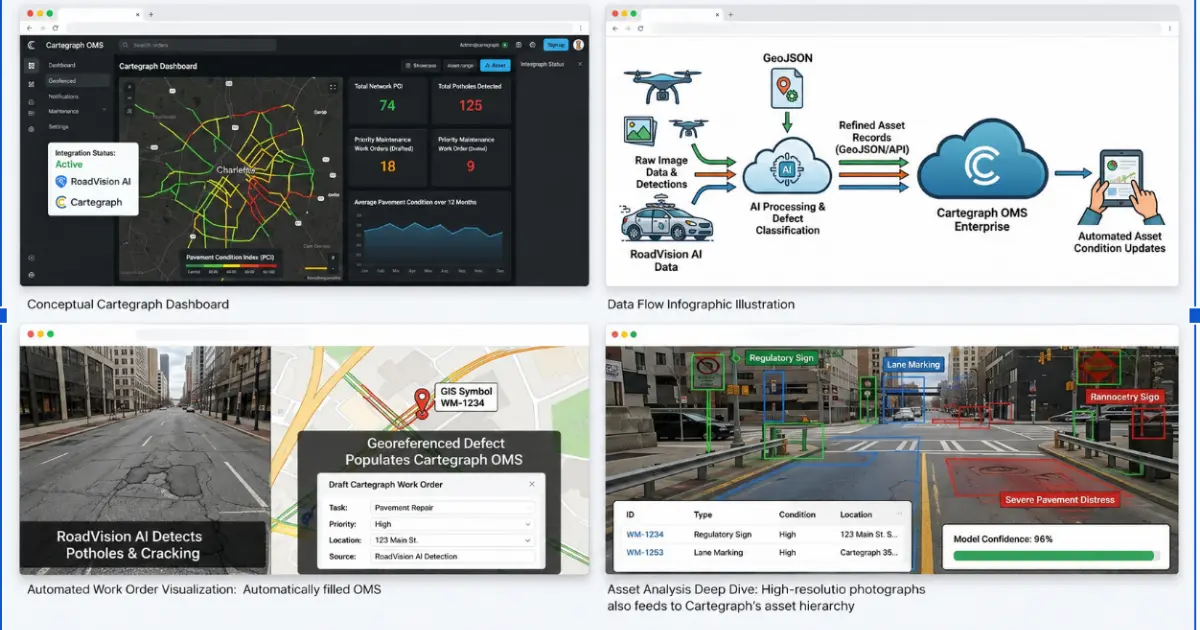
Cartegraph OMS manages road asset data with precision. What it does not do is generate it.
The condition attributes, inspection records, and defect logs in an OMS are only as current as the last time someone physically surveyed the network and entered the results. In practice, for most public works agencies, that means:
The result: a well-structured, accurately managed OMS environment that is populated with data that may be two years out of date and was collected with varying degrees of consistency.
This is not a criticism of Cartegraph OMS. It is a structural limitation of how road condition data has historically been collected. The platform can only work with what it receives.
AI road surveys addresses the data generation problem directly. The approach is operationally simple: a vehicle-mounted dashcam captures geo-tagged, time-stamped video of the road network as the vehicle drives at normal operating speeds. That footage is processed through AI models that detect and classify road conditions and assets automatically, returning structured, geo-referenced results that load directly into the existing OMS environment.
No specialist survey contractor. No LiDAR equipment. No dedicated inspection crew driving at reduced speed with a clipboard. Any fleet vehicle maintenance trucks, inspection vans, existing agency vehicles becomes a survey platform.
RoadVision AI’s models are trained on over 100 million road images from networks across South Asia, the Middle East, Southeast Asia, Europe, and Africa, covering diverse pavement types, climate conditions, road classifications, and asset configurations. The breadth of training data is what determines whether a model performs accurately outside a controlled test environment on worn rural roads, in low-light conditions, on non-standard surface types. It is also what removes the need for agencies to train or fine-tune models themselves, which is typically where AI adoption projects stall.
A single dashcam survey pass, processed through the RoadVision AI pipeline, returns intelligence across the following categories:
Detection and classification of surface distress including potholes, longitudinal cracking, transverse cracking, alligator (fatigue) cracking, rutting, edge deterioration, patching quality, and surface ravelling. Each finding is severity-scored (Low / Medium / High / Critical) and contributes to a per-segment Pavement Condition Index (PCI) aligned to ASTM D6433. An IRI-equivalent roughness value is also returned per 100-metre segment. These outputs map directly to the distress types and severity levels used in Cartegraph OMS’s pavement inspection records.
Automated detection and classification of 80+ road asset types: regulatory signage, warning signs, informational signs, road markings (centreline, edge line, stop bars, pedestrian crossings, chevrons), kerb and edge conditions, guard rails and safety barriers, crash attenuators, drainage structures, culverts, lighting columns, and ITS infrastructure. Every roadside asset inventory detection includes GPS coordinates, asset type, condition grade, and a photographic evidence frame structured to match asset categories in Cartegraph OMS’s inventory module.
Detection of safety deficiencies including faded or absent pavement markings, damaged safety barriers, vegetation encroachment onto carriageway clearances, sight-line obstructions, and right-of-way intrusions. Outputs are structured against PAS 2161, AASHTO, and IRC road safety assessment frameworks.
Identification of roadside vegetation analysis growth that encroaches on carriageway clearance or affects driver visibility, and detection of structures or objects within the right-of-way boundary.
Every detection record includes: defect or asset type, severity or condition grade, confidence score, GPS coordinates, timestamp, and a geo-tagged photographic evidence frame.
Cartegraph OMS manages road assets as discrete inventory items with associated condition scores, inspection records, and work order histories. For AI survey output to integrate natively into this environment, it needs to match the OMS data model structured asset records with condition attributes, evidence photos, and location references. RoadVision AI outputs are structured to do exactly that.
AI survey detections can be configured to create work orders in Cartegraph OMS automatically based on severity thresholds. A pothole detection rated High or Critical severity triggers a Repair Pothole work order against the relevant pavement section asset, pre-populated with defect type, severity, location, and the photographic evidence frame from the survey. A faded stop bar triggers a Marking Reapply work order against the sign and marking asset record. Maintenance managers review a queue of AI-generated work orders rather than manually transcribing field inspection findings into the OMS.
For agencies running regular AI survey cycles, the RoadVision AI pipeline can update pavement inspection records in Cartegraph OMS directly. As survey vehicles complete their routes, processed condition data PCI scores, distress records, IRI values are written into the OMS inspection log for each pavement section, maintaining inspection currency without requiring field crew time for condition data collection. The inspection scheduling cycle in Cartegraph OMS remains as configured; the data feeding it becomes more frequent and consistent.
Cartegraph OMS exposes a REST API for asset and work order management. RoadVision AI delivers processed survey results as structured JSON records matching the Cartegraph asset schema, enabling automated condition attribute updates via PUT /assets/{assetId} calls. Sign condition grades, marking visibility scores, drainage structure assessments, and guard rail integrity records are updated in the OMS asset inventory as each survey cycle completes.
For teams preferring a manual review step before loading results into the OMS, survey outputs are available as CSV, GeoJSON, or Shapefile. These formats allow a GIS or pavement manager to review detection results in ArcGIS or a spreadsheet environment before importing into Cartegraph OMS via the platform’s standard import tools.
Once loaded, the data participates in every downstream workflow the agency already runs: Pavement Management deterioration modelling, capital programme prioritisation, work order scheduling, budget reporting, and regulatory compliance documentation. Teams work in the same Cartegraph OMS environment they have always used; the difference is that the condition attributes are current, comprehensive, and consistently classified.
What does not change: The OMS platform. The team’s workflows. Work order management. Asset inventory structure. Budget and capital planning tools. The reporting structure. Dashboards. Integration with GIS.
What changes: The frequency, coverage, and consistency of the condition and asset data feeding into it.
Survey frequency increases without a proportional cost increase. Because any agency fleet vehicle can serve as a survey platform, the marginal cost of an additional survey pass is low. A pavement network that was assessed every two to three years can be assessed quarterly, or monthly on priority corridors, within a comparable total budget.
Coverage becomes full-network rather than sampled. Traditional inspection methods prioritise high-risk corridors or rely on a representative sample because full-network coverage at high frequency is not operationally feasible for field crews. AI processing of fleet dashcam footage makes comprehensive network coverage at regular intervals achievable.
Work order generation becomes proactive rather than reactive. Instead of relying on citizen complaints or periodic walk-overs to surface maintenance needs, AI survey results continuously populate the Cartegraph OMS work order queue with structured, evidence-backed repair tasks ranked by severity. Field crews work from an asset-specific repair list rather than a reactive call-out schedule.
Asset records become a living inventory. Sign condition, marking visibility, drainage status, and barrier integrity are updated with every survey pass, reducing the gap between the official asset register in Cartegraph OMS and actual field conditions.
Pavement management modelling becomes more accurate. Cartegraph OMS’s deterioration curves and treatment scenario models are only as reliable as the condition data inputs. Consistent, high-frequency PCI data from AI surveys produces more accurate network performance projections and more defensible capital programme recommendations.
The evaluation path is designed to be low-friction:
For road agencies evaluating AI survey tools, the practical question is not whether AI-powered detection is technically viable it demonstrably is. The question is whether it integrates cleanly into the GIS environment the team already operates, without requiring a parallel system, a new interface, or a data re-engineering project. That is what this integration is designed to ensure.
Any GPS-enabled dashcam producing standard MP4 or MOV video at 1080p or above. No proprietary hardware, no calibration rig, no vehicle modifications beyond mounting the camera. Agencies can use existing fleet dashcams if they meet the minimum specification.
No. The models are pre-trained and deployed. There is no model training cost, no annotation project, and no configuration work required on the agency side. If your road network has specific asset types or classification requirements that differ from standard outputs, these are handled as a configuration on the RoadVision AI side.
Integration uses the Cartegraph OMS REST API. RoadVision AI delivers processed detection records as structured JSON matching the Cartegraph asset and inspection data schema. Work orders, inspection records, and asset condition updates are created or updated via API calls. For agencies preferring a review step, results are also available as CSV for manual import through the Cartegraph OMS import tools.
Yes. The default configuration routes AI detections to a review queue in Cartegraph OMS, where a pavement manager or maintenance supervisor approves, modifies, or rejects individual records before they become active work orders. Fully automated work order creation, without a review step, is also available for agencies that prefer it for standard-severity detections.
Standard processing turnaround is 24–48 hours from footage submission, depending on survey volume. For agencies running regular survey cycles with automated API push to Cartegraph OMS, the pipeline is configured to deliver results on a defined schedule nightly, weekly, or per-survey-run.
No upfront implementation project, no AI infrastructure build, and no platform migration. The integration requires API credentials for the agency’s Cartegraph OMS environment and a footage submission process. Most agencies are loading first results into their OMS within days of onboarding.
The models operate at over 97% detection accuracy across core pavement distress and asset categories on standard road network footage. Accuracy varies by defect type, lighting conditions, and camera placement detailed accuracy benchmarks by category are available in the technical documentation provided at onboarding.
The Autonomous Road Engineer
AI-powered road condition monitoring, asset management, & infrastructure intelligence helping agencies move from reactive maintenance to predictive road management.


.webp)
.webp)
.webp)