
Saudi Arabia's transport landscape is undergoing a historic transformation. With national development anchored in Vision 2030, mega-projects expanding at record pace, and more than 200,000 km of roads overseen by authorities such as the Ministry of Transport and Logistic Services (MOTLS) and the Royal Commission for Riyadh City, the Kingdom is building one of the world's most advanced mobility ecosystems.
But as the saying goes, "the bigger the tree, the stronger the winds that shake it." This rapid expansion brings with it significant road maintenance challenges that traditional methods can no longer keep up with. Harsh weather, vast geography, aging infrastructure, and rising traffic volumes are demanding smarter, scalable solutions.
This is where AI-based road management platforms like RoadVision AI are stepping in—not as band-aid fixes but as transformative tools reshaping how the Kingdom monitors, maintains, and future-proofs its road network.
Roads are the backbone of Saudi Arabia's logistics and economic diversification strategy. However, several factors are converging to make maintenance more complex and costly:
When visibility into road conditions decreases, costs and risks rise. Delayed repairs result in higher rehabilitation expenses, safety hazards, and service disruptions—echoing the proverb, "A stitch in time saves nine."
While India uses IRC codes, Saudi Arabia adheres to national highway and construction frameworks such as SHC 101 and SHC 202, along with MOTLS guidelines on safety, pavement management, asset inventory, and maintenance prioritization.
Core principles include:
AI-powered platforms directly reinforce these principles by offering structured, accurate and continuous data—something manual systems simply cannot match at the Kingdom's scale.
AI in road infrastructure is no longer experimental; it is becoming foundational. RoadVision AI operationalizes road maintenance best practices through:
3.1 Automated Pavement Condition Assessment
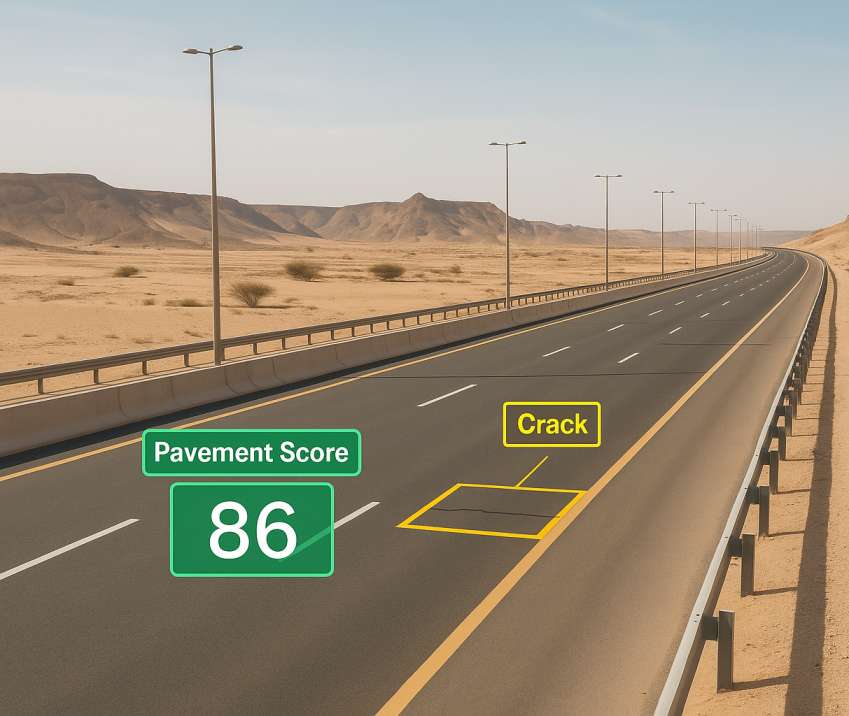
Using vehicle-mounted cameras and GPS, RoadVision AI captures road imagery at highway speeds. Its computer vision engine detects:
The result: real-time Pavement Condition Index (PCI) scoring compatible with national standards like SHC 202.
3.2 Continuous Highway Monitoring
Instead of inspecting roads only quarterly or annually, authorities can now:
This enables proactive, rather than reactive, network management across the Kingdom's vast geography.
3.3 Geo-Tagged Road Inventory Inspection
The Roadside Assets Inventory Agent builds a continuously updated digital map of:
This GIS-ready inventory helps significantly with budget forecasting and lifecycle planning for agencies like MOTLS.
3.4 Scaled and Standardized Road Safety Audits
The Road Safety Audit Agent detects safety-critical issues such as:
This supports compliance with safety frameworks aligned to MOTLS and SHC standards.
3.5 Data-Driven Decision-Making Dashboards
Engineers can instantly visualize:
This enables transparent, defensible planning across agencies and supports evidence-based budget submissions.
4.1 Harsh Climate Conditions
Challenge: Extreme heat reaching 50°C and sand abrasion cause rapid pavement deterioration, with roads degrading faster than in temperate climates.
AI Solution: Automated scans detect early cracking and fatigue before visible failure, allowing timely micro-surfacing and sealing interventions that extend pavement life.
4.2 Rapid Urban Expansion
Challenge: Roads in new cities like NEOM and The Line are being built and used simultaneously, with construction traffic accelerating wear on newly opened sections.
AI Solution: High-frequency monitoring using the Construction Monitoring Agent ensures new corridors are evaluated from day one of operation, capturing baseline data and tracking deterioration.
4.3 Limited Real-Time Data
Challenge: Manual inspections leave long data gaps—sometimes years between surveys—allowing defects to worsen undetected.
AI Solution: Continuous AI-enabled inspections using fleet vehicles ensure up-to-date condition dashboards with monthly or weekly updates at minimal cost.
4.4 Aging Infrastructure
Challenge: Many rural roads in the Kingdom exceed their design life but lack modern asset records, making prioritization difficult.
AI Solution: AI-driven inventory digitizes all assets in a single pass, creating comprehensive records and prioritizing maintenance based on actual condition rather than age alone.
4.5 Safety and Audit Requirements
Challenge: Manual safety audits are slow, inconsistent, and difficult to scale across 200,000+ km of roads.
AI Solution: Automated detection through the Road Safety Audit Agent enhances audit precision and speed, covering more roads with fewer resources while maintaining consistency.
In short, AI transforms maintenance from a reactive scramble into a predictive, continuously optimized process aligned with Vision 2030 goals.
Saudi Arabia's infrastructure ambitions demand maintenance systems that are just as advanced as the highways themselves. AI is no longer a luxury—it is a necessity for scale, precision, and sustainability.
RoadVision AI is enabling this shift by delivering:
As the proverb goes, "The best time to repair the roof is when the sun is shining." With AI, Saudi Arabia can identify risks before they become failures, optimize budgets across agencies, and ensure safer, smoother mobility for millions of residents and visitors.
Ready to modernize your road network and build a data-driven maintenance ecosystem? Book a demo with RoadVision AI today to see how effortlessly your team can monitor, manage, and future-proof every kilometer of your network.
Q1. What are the top road maintenance challenges in Saudi Arabia?
Extreme climate, aging pavements, limited data visibility, and rapid urban growth are among the main challenges.
Q2. How does AI help in highway monitoring?
AI automates defect detection, pavement scoring, safety audits, and inventory mapping to improve accuracy and reduce costs.
Q3. Is RoadVision AI compatible with Saudi transport authorities?
Yes, it offers localized deployment, Arabic dashboard support, and works with national standards and ministry guidelines.

The Autonomous Road Engineer
AI-powered road condition monitoring, asset management, & infrastructure intelligence helping agencies move from reactive maintenance to predictive road management.


.webp)
.webp)
.webp)