
Saudi Arabia's road network is one of the largest and most strategically important in the Gulf. With more than 221,000 kilometres of roads connecting growing cities, industrial hubs, ports, and remote regions, the Kingdom's transportation infrastructure is critical to economic mobility and national development. Yet maintaining this vast network—especially under extreme desert conditions—has always been costly and operationally demanding.
As the Kingdom accelerates digital transformation under Saudi Vision 2030, road agencies now face a clear mandate: reduce maintenance costs, improve safety, and enhance operational efficiency. Traditional maintenance methods can no longer keep pace. This is where AI-powered predictive analytics becomes indispensable.
As the saying goes, "A stitch in time saves nine," and in Saudi Arabia's road sector, AI makes sure the stitches happen long before damage becomes expensive.
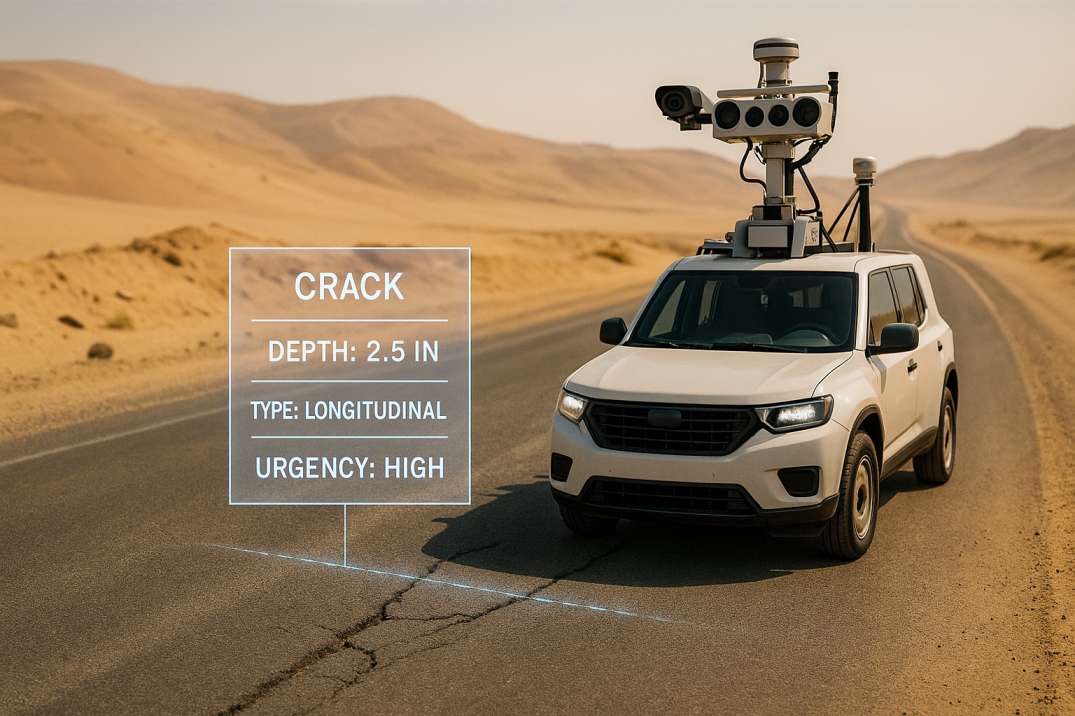
Saudi Arabia's environment poses unique challenges that accelerate pavement deterioration:
Traditionally, inspections were manual and reactive—road crews identified damage only once it was visible or hazardous. This leads to:
With ambitious infrastructure expansion underway under Vision 2030, including mega-projects like NEOM and the Red Sea development, reactive maintenance has become economically unsustainable. AI-based predictive maintenance offers a smarter, more fiscally responsible solution.
While Saudi Arabia follows its national pavement and construction guidelines—such as Ministry of Transport and Logistic Services (MoTLS) specifications, SHC 101, and SHC 202—the foundational principles mirror global best practices:
2.1 Early Detection and Life-Cycle Preservation
Identifying distress at its earliest stage reduces rehabilitation costs drastically and extends pavement life by 30-50%.
2.2 Data-Driven Condition Monitoring
Standards increasingly recommend remote sensing, condition analytics, and automated inspections for accuracy and consistency across large networks.
2.3 Prioritised Maintenance Planning
Repairs must be scheduled based on risk, severity, and long-term asset value—not simply on chronological age or visible failure.
2.4 Performance-Based Contracting
Contractors must meet measurable performance targets; AI helps generate objective metrics for accountability and quality assurance.
These principles align perfectly with predictive AI systems, which detect, classify, and anticipate defects well before conventional inspections can.
RoadVision AI transforms traditional pavement monitoring into a cutting-edge digital process fully aligned with Saudi highway standards through its integrated suite of AI agents.
3.1 Automated, High-Resolution Pavement Surveys
The Pavement Condition Intelligence Agent uses instrumented vehicles, video analytics, and image processing to capture road conditions continuously during normal traffic flow—no lane closures, no traffic disruption, and no dedicated survey vehicles required.
3.2 AI-Based Distress Detection
The platform identifies early-stage defects using computer vision trained specifically for desert conditions:
3.3 Predictive Analytics for Cost Optimisation
Machine learning models forecast which road segments will fail first, allowing agencies to plan maintenance months in advance. By analysing:
Agencies can reduce lifecycle costs by up to 40% through timely, targeted interventions.
3.4 Integrated Dashboards for Engineers and Municipalities
Workflows provide:
3.5 Alignment with Saudi Standards
RoadVision AI delivers outputs consistent with:
3.6 Integration with Safety and Traffic Data
The Road Safety Audit Agent and Traffic Analysis Agent ensure that maintenance planning considers safety risks and usage patterns, not just condition.
The result is a future-ready maintenance ecosystem that saves time, money, and effort while improving safety outcomes.
Even with AI's benefits, some challenges remain:
4.1 Harsh Desert Operating Conditions
Sensors and cameras must withstand heat, dust, and storms—requiring robust hardware calibration and protective enclosures. RoadVision AI's algorithms are designed to maintain accuracy despite environmental challenges.
4.2 Digital Infrastructure Readiness
Large-scale analysis requires reliable cloud infrastructure and secure data channels across municipalities. Saudi Arabia's rapid digital transformation under Vision 2030 is rapidly addressing these requirements.
4.3 Workforce Upskilling
Moving from manual to AI-based workflows requires training engineers, inspectors, and contractors to interpret AI insights effectively and incorporate them into decision-making.
4.4 Variability Across Remote Regions
Roads in remote areas may have sparse historical data, requiring AI models to self-adapt through transfer learning and targeted validation surveys.
4.5 Integration with Legacy Systems
Many agencies operate legacy asset management platforms that require modernisation or integration bridges to accept AI-generated data.
Yet, these challenges are stepping stones—not roadblocks. As the proverb says, "Where there's a will, there's a way," and Saudi Arabia's Vision 2030 shows that the will is strong.
Saudi Arabia's road agencies face a defining moment. With the Kingdom's infrastructure expanding at a rapid pace, traditional maintenance tools can no longer ensure efficiency, safety, and cost control. AI-based predictive analytics offers a transformative alternative—one that predicts failures before they occur, optimises budgets, and enhances road safety.
RoadVision AI is at the forefront of this transition. By integrating AI, digital twin technology, and automated condition monitoring through the Pavement Condition Intelligence Agent, Road Safety Audit Agent, and Roadside Assets Inventory Agent, it empowers government agencies, consultants, and EPC contractors to:
In a nation where "prevention is better than cure," RoadVision AI delivers prevention at scale and precision.
Saudi Arabia's roads are evolving—now the maintenance systems must evolve with them. With intelligent, AI-led asset management, the Kingdom can build not just roads, but resilient pathways to its future under Vision 2030.
If your organisation is ready to transform road maintenance from reactive to predictive, book a demo with RoadVision AI today and discover how intelligent analytics can cut costs while improving safety and performance across your network.
Q1: How does predictive analytics reduce road maintenance costs in Saudi Arabia?
Predictive analytics helps forecast defects before they worsen, enabling early, low-cost repairs and reducing the need for expensive reconstruction.
Q2: Is AI-based road inspection approved for use in Saudi Arabia?
Yes, it aligns with Vision 2030 and Saudi standards for digital transformation and road infrastructure modernization.
Q3: Can RoadVision AI detect subsurface road issues?
Yes, the platform uses advanced imaging and data analytics to detect both surface and sub-surface problems.

The Autonomous Road Engineer
AI-powered road condition monitoring, asset management, & infrastructure intelligence helping agencies move from reactive maintenance to predictive road management.


.webp)
.webp)
.webp)