
Across Australia, road authorities and infrastructure consultants are facing a critical shift. Traditional methods—manual logbooks, paper-based inspections, and siloed data systems—are no longer sufficient to manage increasingly complex and expansive road networks. With growing pressure to improve safety, optimise maintenance budgets, and ensure compliance with national standards, the move toward digitisation is accelerating.
At the center of this transformation lies the Austroads Guide to Pavement Technology (AGPT) and broader asset management frameworks followed across Australia. These guidelines have long provided the technical backbone for pavement design, evaluation, and maintenance.
Today, AI in road asset management is redefining how these guidelines are applied—turning static standards into dynamic, real-time decision systems.
The Austroads AGPT framework outlines best practices for pavement design, condition assessment, and lifecycle optimisation. Traditionally, implementation relied heavily on manual inspections and documentation.
Field engineers conducted visual surveys, recorded defects, and prepared reports manually. This approach created inefficiencies, especially when scaling across large networks.
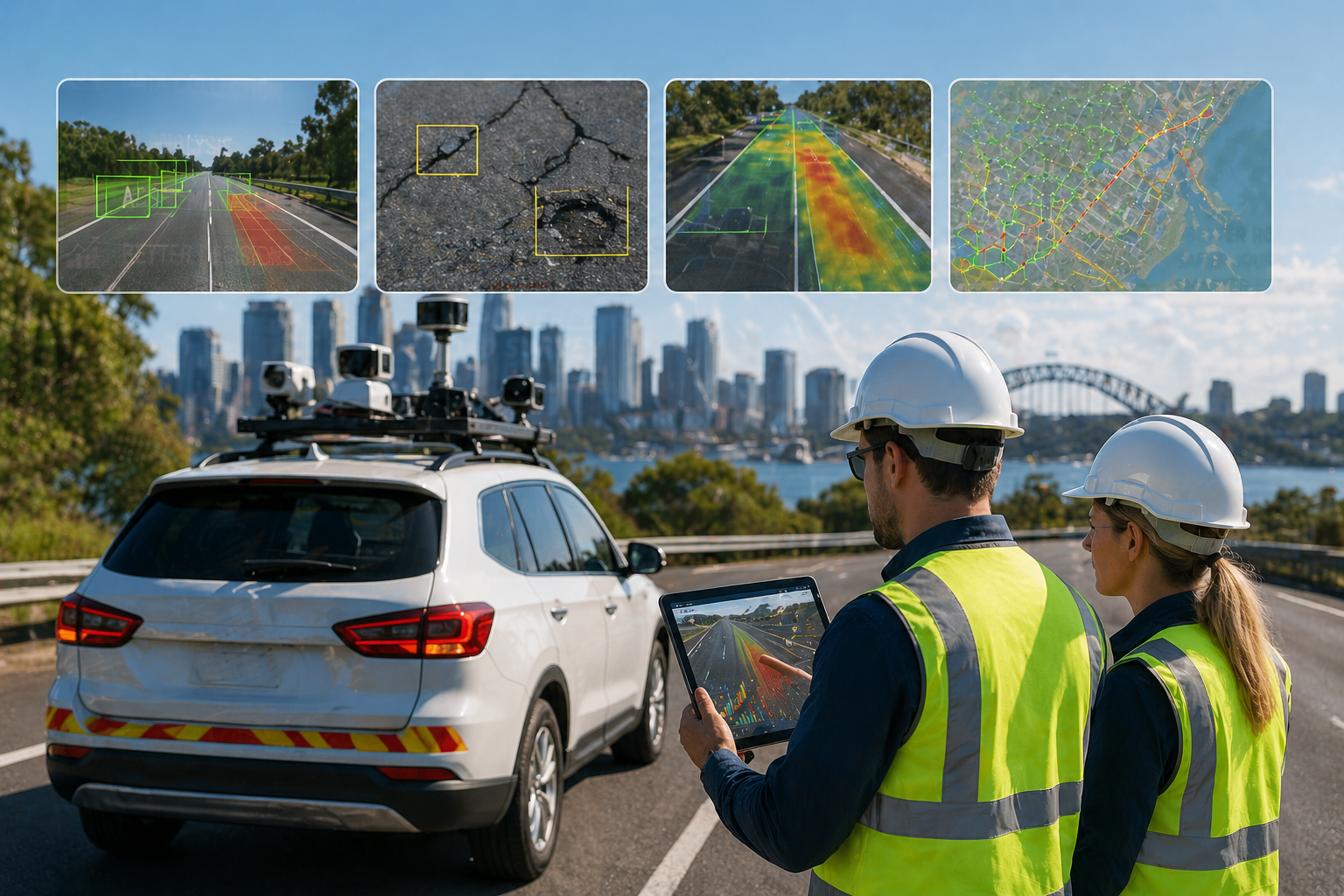
These gaps highlighted the need for digital pavement assessment Australia solutions that can align execution with standards.
Australia’s National Asset Management Strategy (NAMS) emphasises data-driven and lifecycle-focused infrastructure management.
It promotes:
However, achieving these goals at scale requires advanced systems. This is where AI road asset management systems are enabling real-world implementation.
AI is transforming how road data is collected and analysed.
Modern systems use cameras, sensors, and mobile platforms to collect continuous road data. This enables AI road inspection technology to replace manual surveys with scalable, consistent monitoring.
AI models can now:
This leads to more reliable outputs for automated pavement condition survey processes.
Instead of periodic reports, AI delivers:
This directly supports predictive maintenance roads AI, allowing authorities to act before failures occur.
AI enhances AGPT implementation by operationalising its principles.
AI applies computer vision and analytics to standardise condition measurement, enabling consistent application of AGPT across regions.
AI systems identify intervention thresholds and optimise schedules, aligning with lifecycle strategies and supporting road lifecycle management AI.
AI enables simulation and forecasting, helping agencies reduce long-term costs while improving asset performance.
AI is increasingly integrated with GIS platforms, digital twins, and enterprise systems.
This enables:
Such ecosystems are key to building smart infrastructure Australia, where data flows seamlessly across systems.
AI removes subjectivity and standardises assessments.
Real-time insights reduce delays and improve responsiveness.
Entire road networks can be analysed continuously using AI road inspection technology.
Using predictive maintenance roads AI, authorities can reduce unnecessary repairs and extend asset life.
AI ensures alignment with Austroads and national frameworks.
AI supports validation of pavement designs and improves planning accuracy.
Digital tools track progress and detect deviations in real time.
Continuous monitoring enables early detection through automated pavement condition survey systems.
AI identifies high-risk zones using data-driven insights.
While promising, adoption comes with challenges:
Addressing these is critical to fully realise the potential of automated road asset management.
Australia is moving toward a future where AGPT is fully digitised and embedded into intelligent systems.
This includes:
The evolution of AI asset management systems will play a central role in this transformation.
Australia’s shift from manual logbooks to AI is transforming how Austroads AGPT guidelines are applied—making road asset management more proactive, data-driven, and scalable.
Solutions like RoadVision AI are supporting this transition by enabling automated monitoring, analysis, and decision-making aligned with engineering standards, helping authorities move toward smarter and more efficient road networks.
Book a demo to see how AI can digitise your road asset workflows and improve decision-making across your network.
AI helps automate pavement inspections, defect detection, and condition assessments using computer vision and analytics. This enables road authorities to apply Austroads AGPT standards more consistently, generate standardized reports, and make faster maintenance decisions based on real-time data.
AI-based road asset management systems reduce manual effort, improve inspection accuracy, eliminate subjectivity, and enable continuous monitoring across large road networks. They also support predictive maintenance, helping agencies reduce lifecycle costs and improve pavement performance.
Yes. Modern AI road inspection platforms can integrate with GIS systems, digital twins, and enterprise asset management software. This creates a centralized and data-driven workflow for pavement monitoring, maintenance planning, and infrastructure decision-making aligned with Australian standards.

The Autonomous Road Engineer
AI-powered road condition monitoring, asset management, & infrastructure intelligence helping agencies move from reactive maintenance to predictive road management.


.webp)
.webp)
.webp)