
Norway's extensive road network—spanning more than 55,000 km across fjords, mountains, tunnels, and remote rural regions—forms the backbone of national mobility and economic activity. But maintaining this network is no small task. Harsh winters, freeze–thaw cycles, and steep terrain constantly wear down pavements, turning minor defects into safety hazards almost overnight. As Statens vegvesen (the Norwegian Public Roads Administration) frequently emphasizes, poor road conditions can increase accident risk, raise vehicle operating costs, and inflate long-term maintenance budgets.
Traditionally, Norwegian municipalities (kommuner) have relied on manual inspections, which are costly, time-consuming, and often subjective. This is where AI-based condition scoring is emerging as a game-changing solution—helping asset managers "separate the wheat from the chaff" and prioritize road repairs with precision.
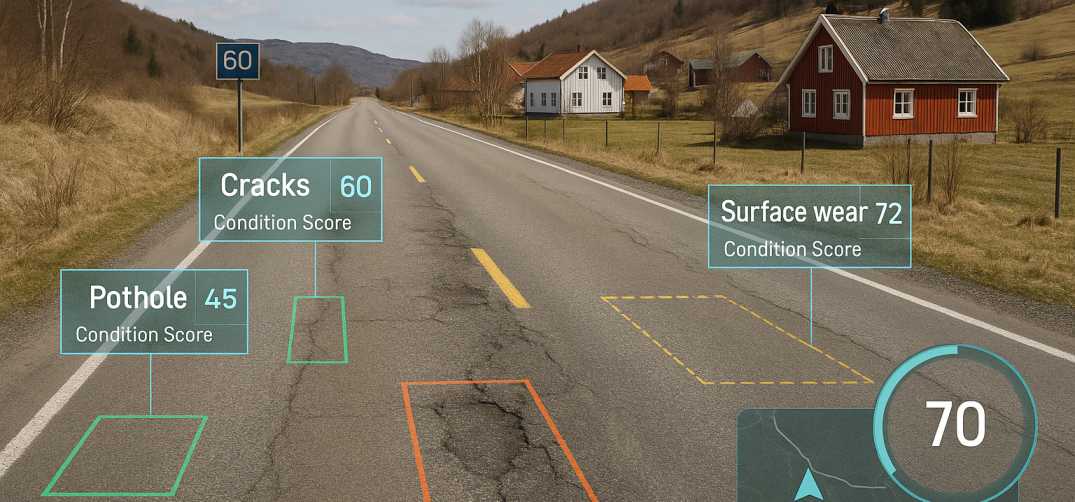
1.1 Harsh Winters and Rapid Surface Deterioration
Norway's climate is unforgiving. Freeze–thaw cycles lead to frost heave, cracking, pothole formation, and rutting. Some roads can degrade from acceptable to unsafe between scheduled manual inspections, creating safety risks for unsuspecting drivers.
1.2 Tight Municipal Budgets
Many small kommuner operate with strict financial limits. AI-based scoring reduces the need for repeated manual surveys and ensures investments are targeted where they deliver the greatest impact—stretching limited kroner further.
1.3 Compliance with National Standards
According to Statens vegvesen Handbook N200, road authorities must ensure specific levels of friction, drainage, geometry, and smoothness. AI helps detect early non-compliance—fixing issues before they escalate into violations that could compromise safety.
1.4 Alignment With National Digitalisation Goals
The Norwegian National Transport Plan (NTP) pushes for smart mobility, digital infrastructure, and Vision Zero goals. AI technologies support these ambitions by providing actionable data for preventive maintenance and risk reduction.
AI-based condition scoring uses computer vision, deep learning models, and high-resolution imagery to analyse pavement surfaces. Tools such as RoadVision AI's Pavement Condition Intelligence Agent can:
Instead of infrequent manual surveys, AI systems can leverage dashcam footage, smartphones, or fleet-mounted cameras, enabling continuous monitoring. This gives municipalities a near real-time digital twin of their road network—a huge leap forward from traditional methods.
As the Norwegian saying goes, "Det er bedre å forebygge enn å reparere"—it is better to prevent than to repair. AI makes that possible.
RoadVision AI operationalizes best practices in modern road asset management through:
3.1 Objective Defect Detection
The platform eliminates subjective variation by detecting defects automatically with high consistency. Critical safety-related issues—like potholes, drainage problems, or severe cracking—are flagged instantly with photo evidence and GPS coordinates.
3.2 Automated Scoring and Transparent Reporting
Every road segment receives a quantified condition score aligned with Statens vegvesen requirements. This helps maintenance teams quickly identify high-risk areas requiring immediate intervention, while providing transparent documentation for budget justifications.
3.3 Cost-Benefit Prioritization
AI models evaluate the rate of deterioration, enabling municipalities to act early on fast-failing segments. This reduces lifecycle costs and avoids expensive reconstruction by addressing problems while repairs are still affordable.
3.4 Historical Trend Analysis
RoadVision AI stores historical condition data, helping asset managers plan multi-year interventions. Long-term modelling supports budgeting for preventive maintenance rather than reactive patching, shifting from crisis management to strategic planning.
3.5 Compliance With Norwegian Road Regulations
RoadVision AI adheres to:
This ensures every flagged defect relates directly to regulatory thresholds, helping municipalities maintain compliance and avoid liability.
3.6 Integrated Traffic and Safety Insights
RoadVision AI's traffic survey tools help identify correlations between surface defects and accident-prone areas—supporting Vision Zero objectives by targeting interventions where they save lives.
Despite its benefits, AI deployment also faces practical challenges:
4.1 Data Variation Across Terrains
Norway's diverse geography—mountain passes, gravel roads, tunnels, and coastal routes—demands robust training datasets to ensure accurate detection under all conditions. RoadVision AI continuously refines its models with local data.
4.2 Integration With Legacy Systems
Municipalities may use older GIS or asset management platforms. Ensuring seamless data integration is key to maximizing AI benefits without disrupting existing workflows.
4.3 Connectivity in Remote Regions
Some Norwegian roads, particularly in Finnmark or the fjord regions, lack stable cellular coverage. RoadVision AI addresses this by enabling offline data capture with later cloud sync, but authorities must plan operational workflows accordingly.
4.4 Change Management
Transitioning from manual to digital workflows requires training and cultural adaptation among staff. With proper onboarding, this shift pays off rapidly through improved efficiency and better outcomes.
As Norwegians say, "Ingen kan alt, men alle kan noe"—no one can do everything, but everyone can do something. AI becomes a partner, not a replacement, for engineering expertise.
AI-based condition scoring is proving to be a transformative enabler for Norway's road infrastructure. By offering objective assessments, faster inspections, and cost-effective prioritization, AI helps road authorities keep pace with demanding weather, strict standards, and tight budgets.
RoadVision AI stands at the forefront of this transformation—leveraging advanced computer vision, digital twins, and automated reporting to modernize road maintenance. From early defect detection to comprehensive safety audits and traffic surveys, the platform supports municipalities, contractors, and transportation agencies in building safer, greener, and more resilient road networks.
In a country where the landscape is dramatic and the weather unpredictable, embracing AI is not just an upgrade—it's a necessity. Or, as the Norwegian proverb puts it: "Veien blir til mens du går"—the road is made as you walk it. With AI, that road becomes smarter, safer, and far better maintained.
Ready to modernize your road repair strategy? Book a demo with RoadVision AI today and take the first step toward intelligent, data-driven road asset management in Norway.
Q1. What is the Pavement Condition Index (PCI) used in Norway?
The PCI is a score between 0 and 100 used to indicate road quality. AI systems like RoadVision generate this automatically from imagery and defect data.
Q2. Is AI road scoring compliant with Norwegian road standards?
Yes. AI-based tools help meet requirements outlined in Statens vegvesen manuals such as N200 for road geometry and safety.
Unlike manual methods done annually or biennially, AI enables monthly or even real-time road inspections, improving responsiveness.
The Autonomous Road Engineer
AI-powered road condition monitoring, asset management, & infrastructure intelligence helping agencies move from reactive maintenance to predictive road management.


.webp)
.webp)
.webp)