
India's national and rural highways navigate complex terrains—steep ghats, rolling plateaus, forest corridors and dense urban outskirts. On such networks, horizontal and vertical curves play an outsized role in safety, influencing visibility, steering stability, braking distance and driver decision-making.
While IRC:73 and IRC:38 offer structured geometric design requirements, many operational highways still experience crash clusters near sharp curves, hidden dips, insufficient superelevation, and inadequate sight distance. Manual inspections often fall short in detecting such real-world deviations.
With India rapidly moving towards digital governance and data-driven mobility infrastructure, AI-powered alignment monitoring has become essential. Solutions like AI horizontal alignment analysis, AI-based curve safety assessment and automated roadway geometry detection now help engineers evaluate curve safety with precision that earlier methods simply couldn't offer.
As the saying goes, "A stitch in time saves nine"—and AI is giving India the tools to stitch problems early.
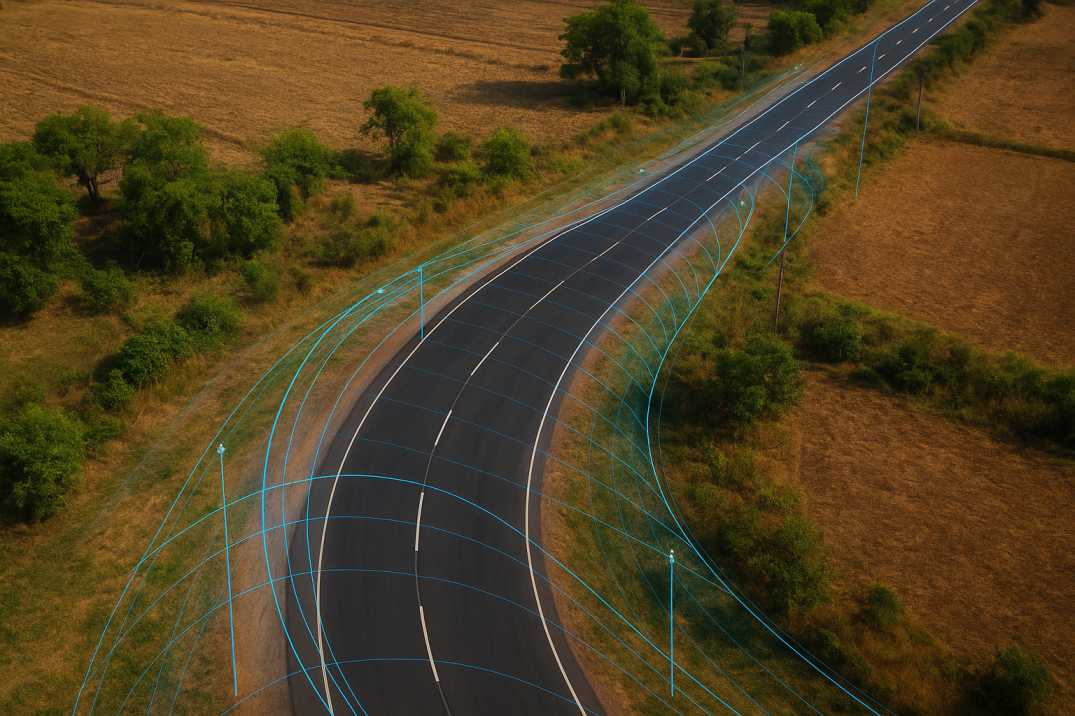
Curve-related crashes account for a significant proportion of India's highway accidents. Key reasons include:
1.1 Increasing Vehicle Speeds
Modern highways see higher speeds, and even small deviations in curve radius or slope can trigger loss of control, especially for heavy vehicles and two-wheelers.
1.2 Terrain Variability
India's diverse topography introduces sudden gradients, concealed dips and sharp curves that demand consistent monitoring across hill districts, ghat sections and plateau transitions.
1.3 Limited Visibility
Vegetation, roadside structures and night-time conditions reduce sight distance, especially on rural and hilly corridors where lighting is minimal.
1.4 Inspection Constraints
Traditional tools rely on:
These are not viable for India's fast-expanding network.
AI through the Road Safety Audit Agent bridges these gaps by providing continuous, objective and geometry-specific evaluations aligned with national standards.
2.1 Horizontal Curves
2.2 Vertical Curves
2.3 Combined Effects
3.1 IRC:73 – Geometric Design of Rural Highways
This standard outlines the design foundations for:
It ensures safe, predictable, and comfortable driving conditions across rural and national corridors.
3.2 IRC:38 – Road Curves and Sight Distance
This guideline focuses specifically on curve safety and visibility:
Both standards aim to reduce crashes by ensuring drivers have adequate visibility, maneuvering space and consistent alignment geometry.
However, compliance depends on reliable monitoring, which AI through the Road Safety Audit Agent now delivers at scale.
4.1 Horizontal Curve Parameters
ParameterIRC RequirementSafety ImpactMinimum radiusBased on design speedPrevents vehicle skiddingSuperelevation2.5% to 7% depending on terrainLateral force balanceTransition lengthAdequate for comfortPrevents abrupt steeringCurve wideningBased on radius and design vehicleAccommodates off-tracking
4.2 Vertical Curve Parameters
ParameterIRC RequirementSafety ImpactCrest curve lengthBased on SSDAdequate visibility over hillsSag curve lengthBased on headlight distanceNight visibilityMaximum grade3% to 7% depending on terrainHeavy vehicle performanceGrade changeLimited per design speedComfort and stability
4.3 Sight Distance Requirements
AI is revolutionising how engineers assess horizontal and vertical alignment. Platforms like RoadVision AI apply the following best practices through its integrated suite of AI agents across India's road networks:
5.1 AI Roadway Curve Detection – Real-Time Geometry Extraction
The Road Safety Audit Agent automatically identifies:
This enables real-time comparison of actual geometry versus IRC requirements—something impossible through manual checks on large networks.
5.2 AI Horizontal Alignment Analysis – Pinpointing High-Risk Curves
Using camera feeds and LiDAR-based analytics, the Road Safety Audit Agent evaluates:
Such insights help engineers detect black-spot curves long before they trigger crashes.
5.3 AI-Based Curve Safety Analysis – Predicting Crash Likelihood
The Road Safety Audit Agent correlates geometry with behavioural and environmental factors:
This comprehensive evaluation supports the intent behind IRC:73 and IRC:38—ensuring alignment safety is auditable and measurable, not just theoretical.
5.4 AI Road Safety Monitoring for Vertical Curves
Vertical geometry failures often cause:
The Road Safety Audit Agent detects these hazards automatically using gradient analytics and 3D reconstruction, ensuring corrective action is taken early.
5.5 Automated Road Inventory Management for Long Corridors
The Roadside Assets Inventory Agent digitises:
This supports national initiatives like Bharatmala and PM Gati Shakti, where network-wide geometric intelligence is essential.
5.6 Traffic Integration for Curve Safety
The Traffic Analysis Agent provides:
5.7 Night Visibility Assessment
AI simulates headlight illumination patterns to evaluate:
6.1 Horizontal Curve Issues
6.2 Vertical Curve Issues
6.3 Combined Issues
Even with strong engineering guidelines, India faces distinct challenges:
7.1 Terrain Complexity
Ghats, forest roads and hill districts have highly variable geometry that changes quickly due to erosion and seasonal conditions.
AI Solution: Continuous monitoring through the Road Safety Audit Agent captures geometry variations.
7.2 Rapid Traffic Growth
Vehicle speeds and axle loads have increased faster than traditional monitoring systems can adapt.
AI Solution: The Traffic Analysis Agent provides current operating speeds for design validation.
7.3 Limited Field Survey Resources
Manual surveys cannot feasibly evaluate thousands of kilometres regularly across India's network.
AI Solution: Automated surveys cover networks at traffic speeds.
7.4 Legacy Highway Sections
Older corridors often do not meet modern IRC standards and require extensive redesign.
AI Solution: AI identifies priority sections for geometric upgrades.
7.5 Variability in Implementation
Contractors and field teams often have inconsistent measurement and reporting practices.
AI Solution: Standardised outputs through RoadVision AI ensure consistency.
7.6 Vegetation Encroachment
Rapid vegetation growth obscures sight distance at curves.
AI Solution: The Roadside Assets Inventory Agent identifies vegetation clearing needs.
AI through RoadVision AI helps overcome these hurdles by providing uniform, scalable and objective curve assessments at a fraction of traditional costs.
8.1 For Engineers
8.2 For Road Authorities
8.3 For Road Users
AI is transforming how India manages curve geometry and alignment safety. By automating the detection of radii deviations, superelevation issues, visibility constraints and vertical gradient hazards through the Road Safety Audit Agent, Pavement Condition Intelligence Agent, and Roadside Assets Inventory Agent, AI enables compliance with IRC:73 and IRC:38 with unmatched accuracy.
The platform's ability to:
transforms how curve safety is monitored across India.
Platforms like RoadVision AI are driving this shift by delivering high-precision curve geometry mapping, real-time safety analytics, pavement distress and behaviour insights, traffic pattern evaluation through the Traffic Analysis Agent, and complete alignment and inventory digitisation.
As the saying goes, "The road to safety is paved with knowledge." AI finally gives India the deep, continuous knowledge required to prevent crashes rather than reacting to them.
For engineering teams and highway authorities aiming to modernise alignment monitoring, reduce crash risks, and meet IRC-compliant performance standards, book a demo with RoadVision AI today to discover how AI-driven platforms offer the most effective path forward.
AI detects horizontal and vertical curves automatically, measures their geometry, and compares them with IRC:73 and IRC:38 requirements.
Yes, AI identifies visibility issues, inadequate superelevation, and dangerous curve radii—helping authorities intervene early.
It ensures accurate curve data, supports maintenance planning, and provides consistent large-scale assessments.
The Autonomous Road Engineer
AI-powered road condition monitoring, asset management, & infrastructure intelligence helping agencies move from reactive maintenance to predictive road management.


.webp)
.webp)
.webp)