
Northern Ireland's road network plays a pivotal role in the broader transport landscape of the United Kingdom, supporting daily commuting, logistics, and tourism. Yet, ageing carriageways, recurrent potholes, and rising maintenance costs continue to challenge road authorities. Traditional inspection methods often detect problems after they have already escalated—resulting in costly repairs, avoidable traffic disruption, and frustrated road users.
With artificial intelligence emerging as a powerful tool in infrastructure management, the region is shifting towards smarter, data-driven practices. AI-enabled pavement monitoring, digital inspections, and predictive analytics are modernising pavement survey approaches across Northern Ireland, proving that "a stitch in time saves nine" is especially true for highways.
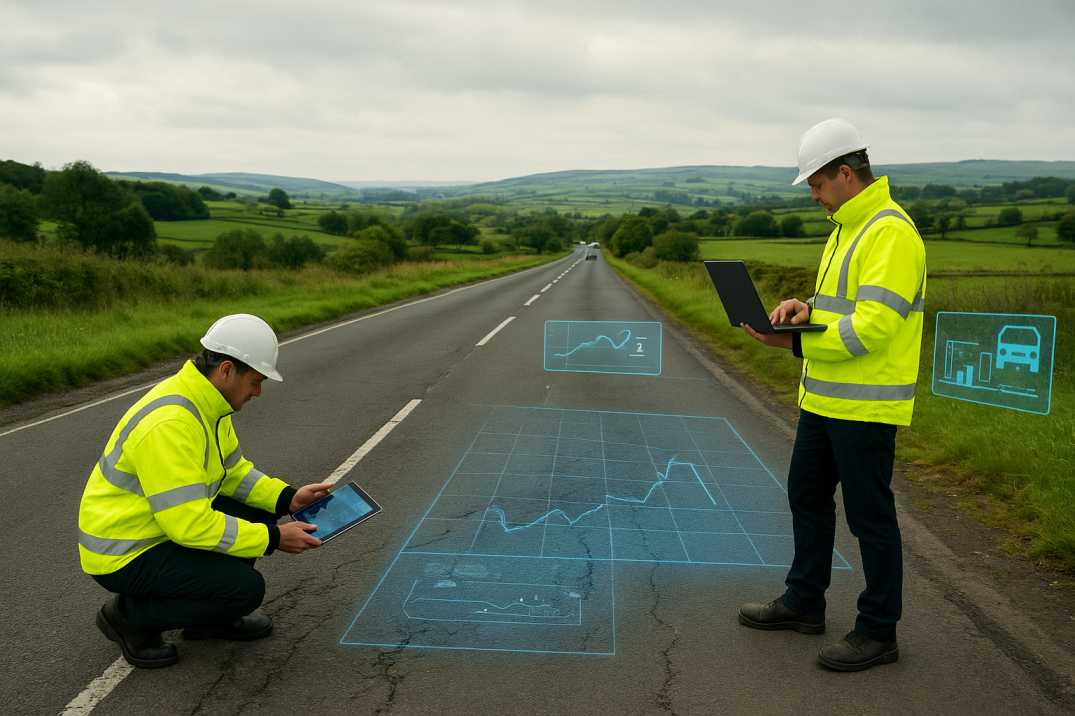
The Department for Infrastructure (DfI) Northern Ireland oversees approximately 25,000 km of public roads. Harsh winters, frost action, surface wear, and heavy freight movement accelerate deterioration across this network. Budget constraints often push councils and contractors into reactive maintenance—fixing defects only when they become severe.
This reactive pattern increases lifecycle costs dramatically:
The region urgently needs a digital road monitoring system capable of delivering real-time, objective condition data to guide maintenance investments with precision.
Artificial intelligence introduces a decisive shift from manual, subjective inspections to automated, analytics-driven highway management through the Pavement Condition Intelligence Agent. AI systems leverage:
Key advantages of AI-based maintenance include:
When combined with modern pavement condition survey tools, AI provides highly accurate ratings that help engineers focus on the most critical assets.
AI adoption becomes even more effective when aligned with established engineering frameworks. In Northern Ireland, compliance with UK highway standards ensures consistent design, maintenance quality, and safety performance. In addition, internationally recognised specifications from bodies like the Indian Roads Congress (IRC) provide robust methodologies for:
AI platforms that integrate these engineering principles through the Road Safety Audit Agent offer:
This engineering-first approach ensures technology complements—not replaces—the fundamentals of pavement engineering.
Industry innovators such as RoadVision AI are transforming the future of pavement survey in Northern Ireland by embedding engineering and compliance into AI systems through its integrated suite of AI agents.
4.1 Automated Pavement Condition Analysis
The Pavement Condition Intelligence Agent uses high-resolution imaging and advanced computer vision to automatically detect:
—eliminating subjectivity and ensuring consistent assessments across the network.
4.2 Predictive Pavement Deterioration Models
AI forecasts where failures will occur and when, based on:
This enables engineers to intervene at the optimal moment—a major contributor to extended pavement life cycles.
4.3 Digital Road Monitoring & Digital Twins
The Roadside Assets Inventory Agent creates continuous surveys that build a dynamic digital twin of the road network, supporting:
4.4 Integrated Traffic Survey Analytics
The Traffic Analysis Agent analyses:
This correlates load stress with fatigue, enhancing structural risk prediction.
4.5 Full Compliance with IRC Guidelines and UK Standards
Reports align with:
—ready for audits, inspections, and project approvals.
By combining engineering rigour with AI automation, RoadVision AI delivers a scalable, future-proof solution for modern road management.
While the benefits are significant, highway authorities face several challenges:
5.1 Data Integration
Large volumes of imaging and sensor data require robust systems for storage, interpretation, and reporting—demanding investment in digital infrastructure.
AI Solution: Cloud-based platforms with scalable storage and edge processing capabilities manage data volumes efficiently.
5.2 Diverse Road Conditions
Northern Ireland's mix of rural roads, urban streets, and high-speed corridors demands AI models that adapt to varied surface types and environmental factors.
AI Solution: Models trained on diverse UK conditions account for regional variations in road types and deterioration patterns.
5.3 Initial Investment Requirements
Although long-term savings are substantial, some councils face short-term budget constraints when adopting new technologies.
AI Solution: Phased deployment allows agencies to start with pilot projects and scale based on demonstrated ROI.
5.4 Skills & Workforce Readiness
Engineers and inspectors must be trained to interpret AI outputs and use them effectively in planning and procurement.
AI Solution: Comprehensive training and user-friendly interfaces ensure successful adoption across teams.
5.5 Standardisation and Consistency
Ensuring AI outputs align seamlessly with UK standards, IRC methodologies, and local authority specifications is critical for regulatory acceptance.
AI Solution: Built-in compliance checks ensure all outputs meet required standards.
5.6 Connectivity in Remote Areas
Some rural locations may have limited internet connectivity for real-time data transmission.
AI Solution: Offline-first data capture with automatic synchronisation ensures no data is lost.
Despite these hurdles, the long-term value proposition makes AI adoption not just worthwhile—but inevitable.
Northern Ireland's road network sits at a crossroads. Without innovation, ageing infrastructure risks falling behind the needs of a modern economy. But with AI-powered pavement monitoring, digital inspections, and predictive maintenance through the Pavement Condition Intelligence Agent, Traffic Analysis Agent, Road Safety Audit Agent, and Roadside Assets Inventory Agent, authorities can intervene early, reduce costs, improve safety, and strengthen long-term resilience.
The platform's ability to:
transforms how road asset management is approached at every level.
As the saying goes, "Fix the roof while the sun is shining." AI gives highway agencies the insight they need to address road issues before they become expensive, dangerous, or disruptive.
RoadVision AI is leading this digital transformation—delivering automated inspections, advanced computer vision, and predictive analytics fully aligned with UK standards and IRC guidelines. From traffic surveys to pothole detection, the platform equips authorities with accurate, timely, and actionable data to futureproof their networks.
If you're ready to modernise your road management strategy, book a demo with RoadVision AI today and see firsthand how AI can reshape the future of highway maintenance across Northern Ireland and the wider UK.
Q1. What is the main benefit of AI in Northern Ireland’s pavement surveys?
AI provides faster, more accurate detection of pavement distress, reducing the need for reactive and costly repairs.
Q2. How does a digital road monitoring system improve road safety?
By offering real-time data, it helps engineers prioritise dangerous sections and prevent accidents caused by deteriorating surfaces.
Q3. Are AI road survey tools cost-effective for local councils?
Yes, they reduce long-term maintenance costs by optimising repairs and extending pavement life cycles.

The Autonomous Road Engineer
AI-powered road condition monitoring, asset management, & infrastructure intelligence helping agencies move from reactive maintenance to predictive road management.


.webp)
.webp)
.webp)