
The UK's motorway network is the backbone of national mobility and commerce. Routes such as the M25 handle extraordinary traffic volumes—often exceeding 200,000+ vehicles per day on certain stretches. Yet with such pressure comes a familiar set of challenges: congestion, safety risks, rapid pavement wear, and the constant need for inspections and repairs. Traditional monitoring methods—manual surveys, periodic inspections, and paper-based reporting—often struggle to keep pace with the dynamic, high-speed nature of modern motorways.
This is where AI-powered motorway monitoring steps into the limelight. By transforming how authorities track pavement health, traffic behaviour, and asset performance, AI is reshaping the future of motorway safety in the UK.
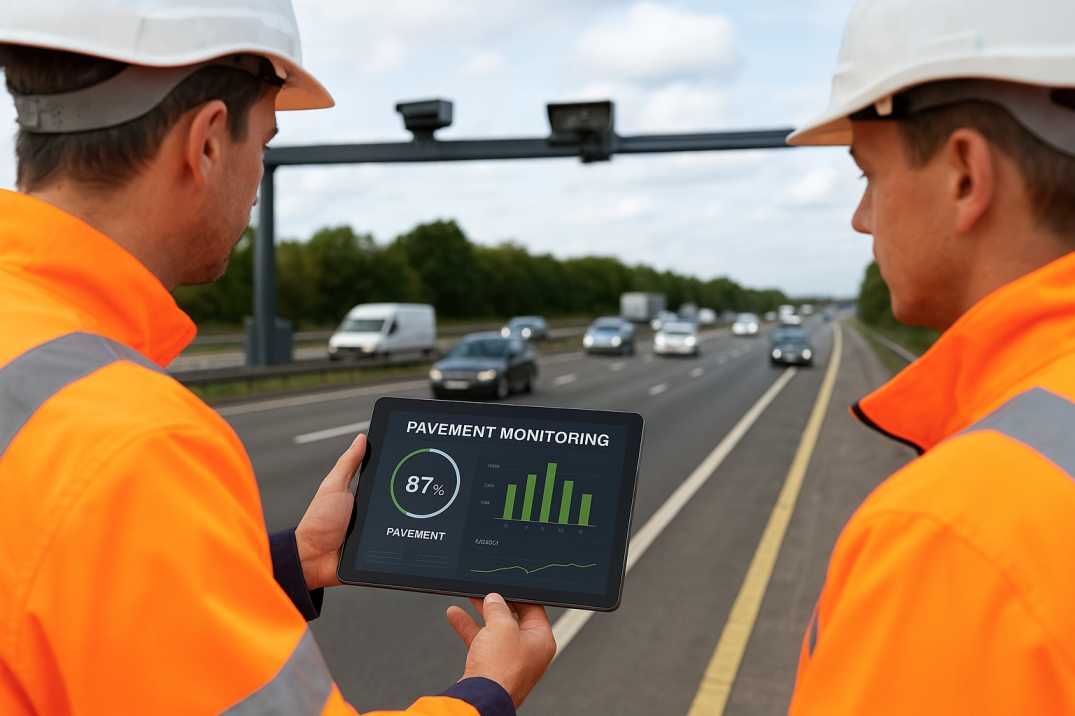
The UK's Strategic Road Network (SRN) is among Europe's busiest, and motorways such as the M1, M6, and M8 carry heavy loads around the clock. The principle is simple: where the traffic goes, the deterioration follows.
Key challenges include:
High speeds, dense flows, and unpredictable driver behaviour demand real-time monitoring—not intermittent checks. Despite motorways being statistically safer than many A-roads, the risks remain high due to speed, volume, and increasingly complex operational configurations.
In short, AI is not a luxury for UK highways; it's a necessity.
UK motorway management is governed by frameworks such as:
Design Manual for Roads and Bridges (DMRB)
Sets technical standards for design, safety, pavement performance, structures, and monitoring across the strategic road network. It provides the engineering foundation for all motorway activities.
AMOR (Asset Maintenance and Operation Requirements)
Outlines how maintenance, inspections, and renewals must be carried out through a lifecycle lens, ensuring consistent asset stewardship across the network.
National Highways Asset Management Policy & Strategy
Emphasises safe, reliable, value-driven maintenance of over 4,000 miles of strategic roads, with clear performance metrics and accountability.
These frameworks mandate:
AI seamlessly supports these principles by delivering the one thing traditional inspections cannot: continuous, objective, real-time oversight across the entire network.
Modern motorway stewardship follows a straightforward mantra: "A stitch in time saves nine." AI systems put this into practice through:
3.1 Automated Pavement Condition Monitoring
The Pavement Condition Intelligence Agent uses high-resolution cameras and machine-learning models to identify:
This transforms reactive maintenance into predictive asset care, aligning directly with DMRB pavement performance requirements and enabling interventions before defects escalate.
3.2 AI-Enhanced Traffic & Safety Monitoring
Smart cameras through the Traffic Analysis Agent detect:
A Devon trial recently observed thousands of violations within weeks—a clear sign of how AI improves enforcement and safety outcomes beyond what manual monitoring can achieve.
3.3 Integrated Road Asset Management
Continuous data streams from the Roadside Assets Inventory Agent feed into asset management platforms, improving:
RoadVision AI aligns with National Highways' asset-led approach, supporting responsible stewardship of taxpayer-funded networks.
3.4 Digital Twins for Smarter Decisions
Creating virtual replicas of road assets helps engineers:
It's the modern equivalent of "measuring twice, cutting once"—ensuring every pound spent delivers maximum value.
3.5 Automated Road Safety Audits
The Road Safety Audit Agent identifies:
3.6 Compliance-Ready Reporting
All outputs are formatted to meet:
4.1 M25 – London Orbital
The UK's busiest motorway carries over 200,000 vehicles daily on some sections. AI monitoring helps manage:
4.2 M6 – The Midlands and North West
Stretching from the Midlands to the Scottish border, the M6 handles significant freight traffic. AI supports:
4.3 M1 – London to Leeds
A key north-south artery, the M1 requires continuous monitoring for:
4.4 M62 – Trans-Pennine Route
Crossing the Pennines, this route faces unique challenges including:
4.5 M8 – Central Scotland
Scotland's busiest motorway connects Glasgow and Edinburgh, requiring:
Even with AI, the UK faces several hurdles:
5.1 Ageing Infrastructure
Many motorway sections date back decades. AI can detect failures early, but structural rehabilitation still requires significant investment and careful prioritisation.
5.2 Smart Motorway Concerns
While evidence shows reduced fatalities, issues around emergency refuge accessibility, public trust, and system reliability remain active areas of development.
5.3 Data Integration & Governance
Blending AI insights with legacy systems requires robust cybersecurity, standardised formats, and skilled personnel to manage complex data environments.
5.4 High Traffic Impacts
With motorways like the M25 already at capacity, even minor faults can trigger major disruptions—making early detection through AI even more critical.
5.5 Winter Weather Challenges
Snow, ice, and flooding create dynamic conditions that require adaptive monitoring and response systems.
5.6 Budget Constraints
Public sector funding pressures demand that every pound spent delivers maximum value—exactly what AI-enabled prioritisation provides.
AI cannot eliminate all challenges—but it significantly narrows the gap between problem identification and corrective action, enabling more efficient use of limited resources.
The UK's busiest motorways carry the weight of the nation's mobility and economic vitality. As traffic volumes grow and infrastructure ages, relying solely on manual inspections is like "bringing a knife to a gunfight." AI-powered monitoring brings the precision, speed, and consistency required to keep these networks safe, smooth, and future-ready.
RoadVision AI is at the forefront of this transformation. The platform delivers through its integrated suite of AI agents:
Fully aligned with UK highway standards including DMRB, AMOR, and National Highways requirements, and supported by proven AI technologies, RoadVision AI helps authorities and engineering teams:
Ensuring the UK's busiest roads remain resilient for decades to come requires the kind of continuous, intelligent oversight that only AI can provide at scale.
To explore how RoadVision AI can elevate your motorway monitoring and asset management strategy, book a demo with RoadVision AI today and discover the future of smart motorway safety.
Q1. What makes a motorway ‘smart’ in the UK?
Smart motorways use features like variable speed limits and all-lane running to boost capacity and manage congestion.
Q2. How do AI systems support pavement management?
AI-powered imaging and sensors help detect surface deterioration—like potholes and cracking—enabling rapid maintenance before costly failures.
Q3. Are AI monitoring tools compliant with UK road regulations?
Yes. These tools support compliance with the DMRB, AMOR, and asset management strategies, enhancing data-driven decision-making and safety oversight.

The Autonomous Road Engineer
AI-powered road condition monitoring, asset management, & infrastructure intelligence helping agencies move from reactive maintenance to predictive road management.


.webp)
.webp)
.webp)