
A full-network deployment of RoadVision AI's road asset inventory and condition assessment technology for a Qatar-based infrastructure programme (project GBDG) covering 2,554.5 km and 110,825 individual road assets across seven categories. The deployment combined customized AI detection models built around Qatar's own asset taxonomy, dedicated pavement marking assessment, a full GIS dashboard, and an integrated AI chatbot (RoadGPT) delivered entirely under the client's own brand, RoadSight AI, and aligned to Qatar's road and construction standards.
The client's road network in Qatar spans 2,554.5 km and carries far more than pavement to manage roadway lighting, pavement markings, directional signage, beautification elements, intelligent transport system (ITS) infrastructure, other infrastructure assets (OIA), and structures all needed to be tracked, condition-rated, and maintained under a single asset management regime aligned to Qatar's road and construction standards.
Off-the-shelf survey tools fall short of that brief in three specific ways. Generic detection models are trained on asset types and signage conventions from other markets and miss Qatar-specific classes, such as gantry directional signage and ITS installations. A vendor-branded dashboard does not give a client its own platform identity for internal rollout and stakeholder use. And a raw data export, however complete, still requires someone who knows how to query it engineers and planners need answers, not another dashboard to learn. RoadVision AI's brief was to solve all three at once: build asset detection specific to this network, and deliver it as the client's own branded platform, with a conversational layer on top.
Roadway lighting, pavement, signage, beautification, ITS, OIA, and structures were tracked, if at all, through separate processes with no single register spanning the full 2,554.5 km network
Off-the-shelf AI models trained on other markets miss Qatar-specific asset classes such as gantry directional signage and ITS infrastructure, and are not built around Qatar's own road and construction standards
A third-party vendor dashboard does not give a client the platform identity it needs for internal rollout, stakeholder reporting, or long-term ownership of its asset data.
Engineers and planners needed a way to query a 110,000+ asset dataset directly, in plain language, without learning a filter structure or waiting on a report request.
RoadVision AI surveyed the client's full 2,554.5 km network, built AI detection models around the client's own seven-category asset taxonomy, and packaged the entire output as a white-labelled platform deployed to the client's users as RoadSight AI, with its own AI chatbot layered on top for direct, conversational access to the data.
The survey scope covered the client's full road network across Roadway Lighting, Pavement, Directional Signage, Beautification, ITS, OIA, and Structures the complete asset taxonomy the client needed managed under one system.
RoadVision AI trained detection models specific to the client's asset classes and naming conventions including Qatar-specific items such as gantry directional signage and ITS infrastructure rather than relying on generic, off-the-shelf defect categories.
Vehicle-mounted dashcam surveys covered the full network, with footage processed through the customized detection models to identify, classify, and geo-locate every asset populating a single register of 110,825 assets across all seven categories.
Every asset, with particular depth on pavement markings points, lines, and polygons was assessed for condition against Qatar's road and construction standards, with each flagged as Good or Defective and rolled up into category-level condition analytics.
The full solution was deployed under the client's own brand as RoadSight AI, with a GIS dashboard, Route Register, Asset and Defect Libraries, Video Library, and the integrated RoadGPT chatbot giving the client a platform it could present, and use, as entirely its own.
The screenshots below show the platform exactly as the client's own users see it branded RoadSight AI, with RoadVision AI's underlying detection and analytics running invisibly behind the client's own interface.
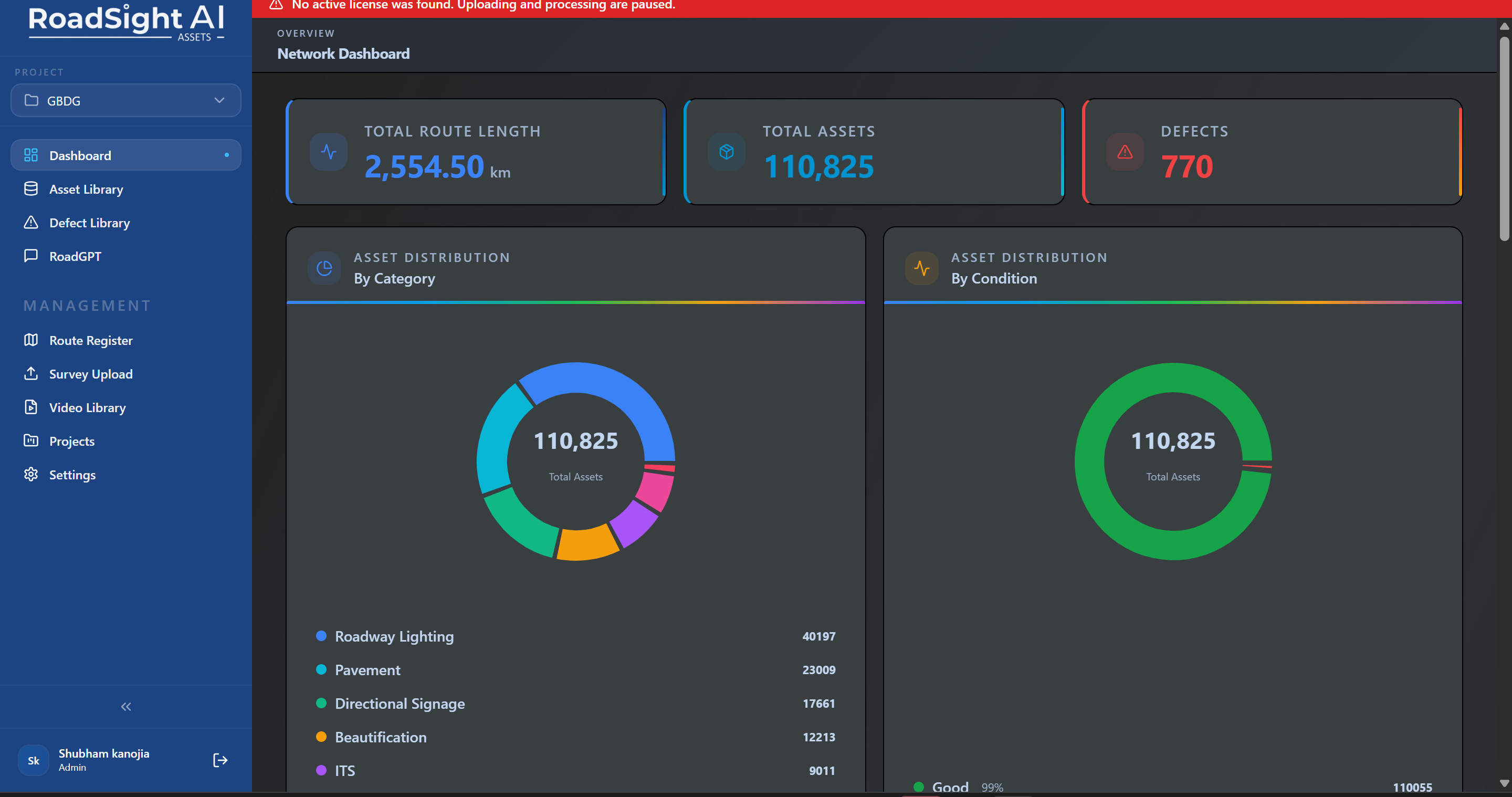
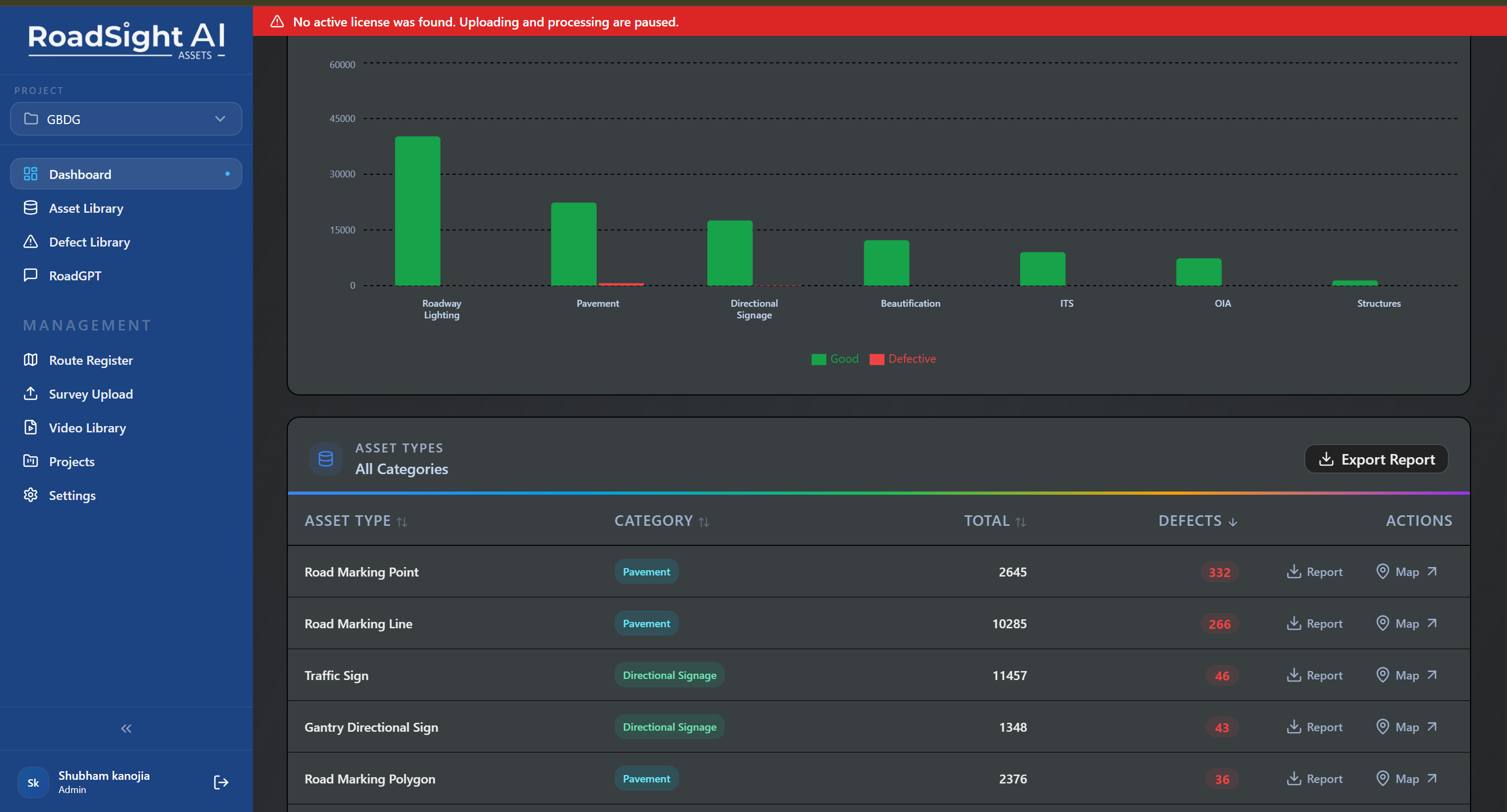
The deployment gave the client its first unified, digital asset register spanning the full 2,554.5 km network. The condition split confirms a fundamentally well-maintained network, while the asset-type breakdown pinpoints exactly which categories need attention first.
RoadVision AI delivered six components that together form a complete, client-owned asset management platform from the underlying detection models to the branded interface and conversational layer the client's own teams use every day
Detection built around the client's own asset classes, not a generic template
110,825+ assets, seven categories, one source of truth
Dedicated depth on the client's highest-defect-rate asset category
Map-linked, report-ready, spanning the full network
Conversational access to the full asset dataset
Delivered as the client's own platform, RoadSight AI
The deployment gave the client more than an asset count it gave them a platform, detection technology, and a conversational interface that all present as entirely their own, running on a foundation purpose-built for their network
110,825 assets across seven categories, and 2,554.5 km of network, now live in one platform the client presents and operates under its own identity, RoadSight AI
Custom-trained models recognise the client's specific asset types including gantry directional signage and ITS infrastructure rather than approximating them from a generic template
Every flagged asset resolves to a report and a map location, letting maintenance teams move directly from dashboard to field without manual translation.
Planning and management staff can query the full asset dataset in plain language through RoadGPT, reducing dependence on technical staff for routine data requests.
For road authorities, asset management contractors, and infrastructure clients evaluating a white-labelled, AI-powered asset management platform.
RoadVision AI surveyed the client's full 2,554.5 km road network in Qatar, building a digital inventory of 110,825 assets across seven categories Roadway Lighting, Pavement, Directional Signage, Beautification, ITS, OIA, and Structures. Every asset was captured, classified, and condition-rated, then delivered through a fully white-labelled platform, RoadSight AI, with an integrated AI chatbot for direct data access.
Rather than applying a generic, off-the-shelf set of defect and asset categories, RoadVision AI trained detection models specifically around the client's own asset taxonomy including Qatar-specific classes such as gantry directional signage and ITS infrastructure and tuned condition classification to Qatar's own road and construction standards. This is what allows the platform to recognise and correctly categorise assets a generic model trained on another market's road network would miss or misclassify.
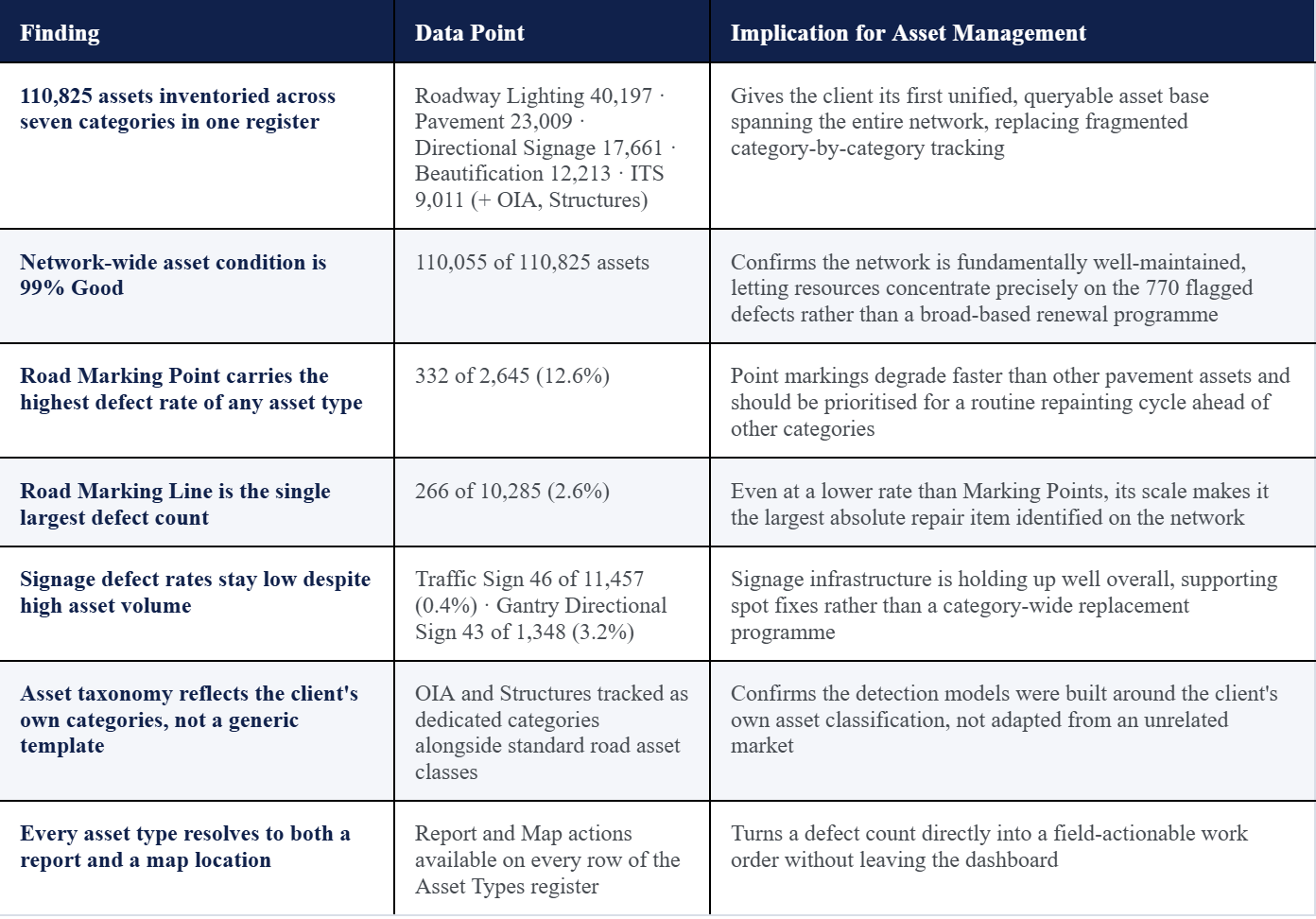
Pavement is tracked as its own asset category and broken down further into specific marking types Road Marking Point, Road Marking Line, and Road Marking Polygon each with its own total count and defect count. This granularity revealed, for example, that Road Marking Points carry a materially higher defect rate (12.6%) than Road Marking Lines (2.6%), a distinction a single combined 'pavement condition' score would have hidden.
RoadGPT is an AI chatbot embedded directly in the platform's navigation, giving users plain-language access to the full 110,825-asset dataset without needing to build a filter query or request a report from a technical team. It sits alongside the Asset Library and Defect Library as a core feature of the platform, letting planning and management staff get answers directly rather than routing every question through an engineering team.
The entire platform login, navigation, branding, and reporting was rebuilt and deployed under the client's own identity, RoadSight AI, rather than carrying RoadVision AI's own branding. For a client managing critical national infrastructure, this matters because the platform needs to be presentable internally and to stakeholders as the client's own system of record, not a third-party tool it happens to use. RoadVision AI's detection and analytics technology runs underneath, invisible to the end user.
The Autonomous Road Engineer
AI-powered road condition monitoring, asset management, & infrastructure intelligence helping agencies move from reactive maintenance to predictive road management.


.webp)
.webp)
.webp)