
State departments of transportation, national road authorities, toll road operators, port authorities, airports, large municipalities, and utility-scale infrastructure operators that run Oracle as their enterprise technology backbone rely on Oracle Enterprise Asset Management (Oracle EAM) within Oracle E-Business Suite (EBS) or Oracle Fusion Cloud Assets and Oracle Mobile Workforce Management (MWM) for the structured management of road asset records, maintenance work orders, field crew dispatch, and the financial reporting that connects maintenance operations to the broader enterprise ledger. Together, Oracle EAM and MWM form the operational and financial backbone of road maintenance management for some of the largest infrastructure organisations in the world. For these organisations, the Oracle environment is not going anywhere.
But one question is coming up consistently across road asset management and operations teams running Oracle: how do we bring AI-generated road condition intelligence into Oracle EAM and MWM automatically creating work requests, updating asset condition records, and activating the preventive maintenance schedules already configured in Oracle without rebuilding the ERP and field service architecture we have spent years configuring?
This guide is written specifically for Oracle EAM functional analysts, road asset managers, MWM administrators, and infrastructure operations directors who are already working within the Oracle ecosystem and are evaluating how AI-powered road condition assessment fits into not on top of their existing enterprise asset and workforce management environment.
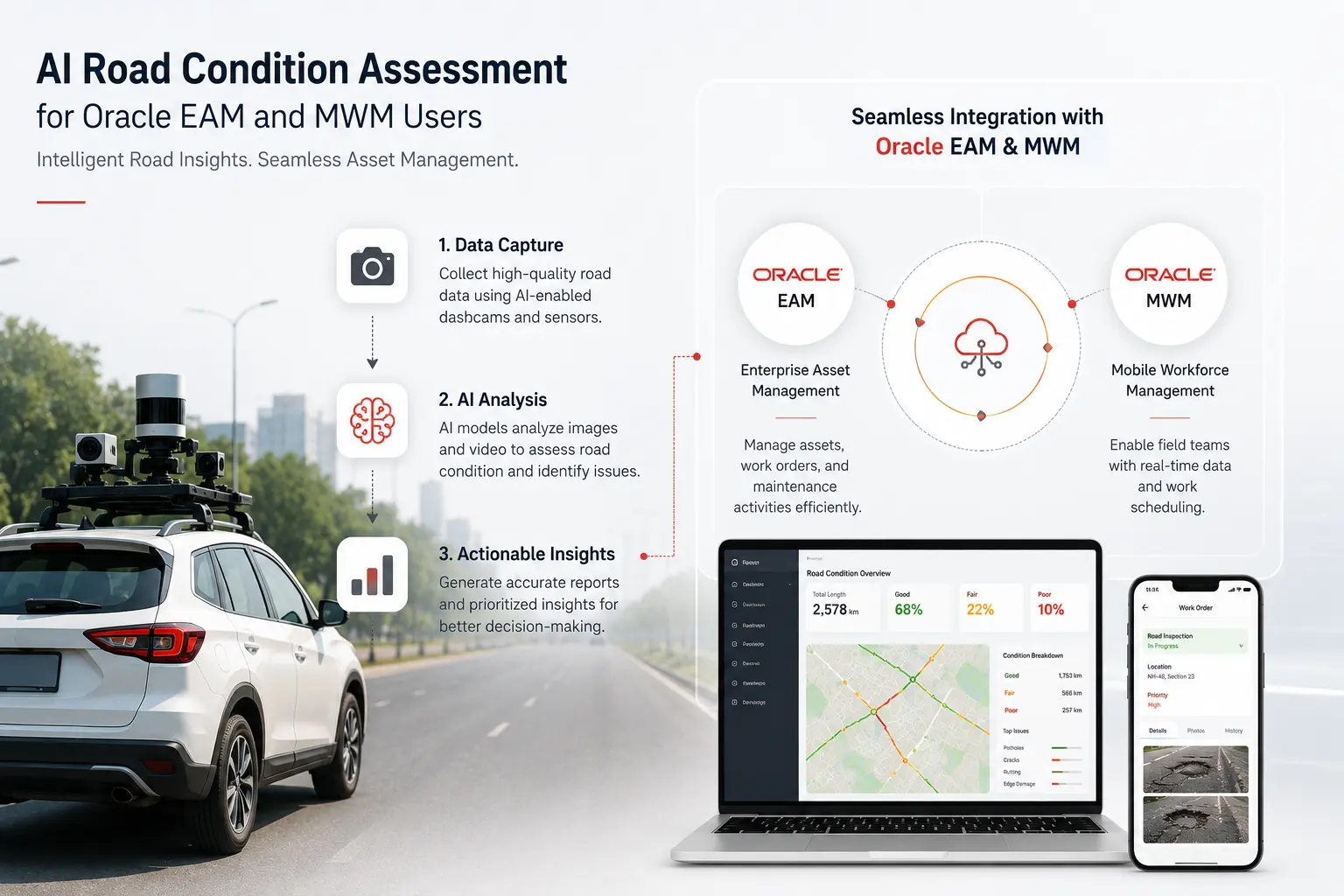
Before covering where AI fits, it is worth being precise about what Oracle EAM and Oracle MWM actually provide for road asset maintenance management because this determines exactly where an AI condition data layer connects and how it integrates with the Oracle data model.
Oracle EAM is the enterprise asset lifecycle and maintenance management module within the Oracle technology stack, managing asset records, work orders, maintenance schedules, and cost tracking across the full lifecycle of physical infrastructure. Oracle MWM extends EAM into the field providing crew scheduling, real-time dispatch, mobile task management, and GPS-based field crew tracking that connects field maintenance execution back to Oracle EAM work orders in real time. Together, they form a vertically integrated asset management and field service system that is deeply connected to Oracle’s broader ERP financial, procurement, and HR modules.
The foundational data structure in Oracle EAM for road infrastructure is the asset hierarchy a parent-child tree of assets that represents the physical organisation of the road network within Oracle. Road networks are typically structured as: network → route → section → road segment, with each node in the hierarchy carrying its own asset number, description, category, location, condition attributes, and maintenance history. Every work order, maintenance schedule, and activity log in Oracle EAM is created against a specific asset number within this hierarchy, making the asset tree the organisational backbone of all road maintenance data in the Oracle environment.
Work orders in Oracle EAM are the execution mechanism for all planned and corrective maintenance activity. A work order specifies the asset, the work to be performed, the operations and resources required, the materials and components needed, and the accounting class and cost centre that governs how the order’s cost is posted to the Oracle general ledger. For road maintenance, every pothole repair, line marking restoration, drainage clearance, barrier replacement, and emergency call-out is executed through an Oracle EAM work order creating a complete, financially integrated maintenance cost record against each road asset. Work requests (eAM Work Requests in EBS, or Service Requests in Oracle Fusion) are the upstream intake mechanism: a structured request for maintenance that is reviewed, prioritised, and converted into a work order by a planner or maintenance supervisor.
Oracle EAM’s preventive maintenance (PM) module automates the generation of work orders based on time-based intervals, meter-based counters (vehicle passes, load cycles), or condition-based triggers. Condition-based PM in Oracle EAM fires a work order when an asset’s condition attribute value crosses a defined threshold the most analytically powerful maintenance scheduling mode for road infrastructure. The effectiveness of condition-based PM, however, is entirely dependent on asset condition attributes being kept current. When condition data is stale, condition-based PM schedules operate on outdated values, generating work orders based on historic condition rather than current field reality.
Oracle EAM supports structured asset condition assessments formal inspection events linked to asset records that record condition ratings, defect findings, inspection notes, and photographic evidence against the asset’s condition assessment history. Condition assessment results update the asset’s current condition score and feed into condition-based PM triggers and capital planning. For road networks, condition assessments represent the bridge between field inspection activity and the analytical functions of the Oracle EAM system and their currency directly determines the quality of every downstream planning and scheduling output.
Oracle MWM (also known as Oracle Utilities Mobile Workforce Management in utility sector deployments) provides the field execution layer that connects Oracle EAM work orders to road maintenance crews in the field. MWM handles crew scheduling and capacity planning, real-time work order dispatch to mobile devices, GPS-based crew location tracking, field completion recording, and work order status synchronisation back to Oracle EAM. For road maintenance organisations managing large field crews across extensive networks, MWM transforms Oracle EAM work orders from a system record into an operational dispatch and field execution tool.
Oracle EAM supports capital planning and asset lifecycle tracking through its integration with Oracle Projects, Oracle Fixed Assets, and Oracle Financials. Asset condition data recorded against road segments feeds into capital renewal planning workflows identifying road sections approaching the end of their effective maintenance life and flagging them for capital rehabilitation or reconstruction project initiation. The financial integration means that the full cost of maintaining a road asset over its lifecycle routine maintenance, periodic rehabilitation, and eventual reconstruction is tracked in a single Oracle financial record.
For organisations that have migrated to Oracle Fusion Cloud, asset management is delivered through Oracle Fusion Cloud Assets with REST API integration, Oracle Integration Cloud (OIC) for enterprise connectivity, and Oracle Analytics Cloud (OAC) for maintenance performance reporting. AI road condition data connects to the Oracle Fusion environment through the same REST API and OIC integration patterns already used for IoT and field data integration treating AI survey results as a structured condition data stream that updates asset records and creates work requests without requiring custom Oracle development.
Oracle EAM manages road asset maintenance with enterprise-grade financial integration, audit trail rigour, and field execution capability that very few specialised road asset management platforms can match. What Oracle EAM does not do and is not designed to do is generate the road condition data that its asset condition assessments, condition-based PM triggers, and capital planning functions depend on.
The condition scores, assessment records, and defect findings in Oracle EAM are only as current as the last time someone surveyed the road network and entered the results. In practice, for most large road infrastructure operators running Oracle, this means:
The result: a comprehensive enterprise asset and workforce management environment in which Oracle EAM’s most powerful road maintenance capabilities condition-based PM scheduling, data-driven MWM dispatch, and capital lifecycle planning are systematically constrained by condition data that is too infrequently updated, too administratively burdensome to maintain, and too inconsistently collected to reliably activate the analytical functions Oracle EAM is architected to deliver.
This is not a limitation of Oracle EAM or Oracle MWM. It is a structural limitation of how road condition data has historically been collected and entered into enterprise systems. Oracle can only manage, plan, and dispatch against what it knows about the current state of the road network.
AI-based computer vision for road surveys addresses the road condition data generation and Oracle entry problem directly and does so in a way specifically suited to the Oracle EAM asset data model. The approach is operationally straightforward: a vehicle-mounted dashcam captures geo-tagged, time-stamped video of the road network as the vehicle drives at normal operating speeds. That footage is processed through AI models that detect and classify road conditions and assets automatically, returning structured results formatted for direct loading into Oracle EAM as condition assessment records, work requests, and asset attribute updates without manual data entry, without survey scheduling overhead, and without the Oracle administration backlog that traditional condition assessment entry creates.
No specialist survey vehicle. No dedicated survey crew. No manual Oracle data entry. Any fleet vehicle already operating on the road network a maintenance truck, a patrol vehicle, a supervisor’s car already driving the routes daily becomes a continuous survey platform. For road organisations where the binding constraint on Oracle condition data currency is administrative capacity rather than field access, this changes what is operationally and financially achievable without additional Oracle administration staffing.
RoadVision AI’s models are trained on over 100 million road images from networks across South Asia, the Middle East, Southeast Asia, Europe, and Africa, covering diverse pavement types, climate conditions, road classifications, and asset configurations. The consistency of AI-generated condition scores across successive survey cycles is particularly important for Oracle EAM integration: condition-based PM thresholds that fire when a condition score crosses a defined value depend on that score being measured on a consistent scale over time so that a score of 65 in this quarter means the same thing as a score of 65 last year, triggering the same maintenance response at the same point in the road’s deterioration trajectory.
A single dashcam survey pass, processed through the RoadVision AI pipeline, returns structured condition intelligence across the following categories each mapped to the relevant Oracle EAM and MWM data objects:
Detection and classification of surface distress including potholes, longitudinal cracking, transverse cracking, alligator (fatigue) cracking, rutting, edge deterioration, patching quality, and surface ravelling. Each finding is severity-scored (Low / Medium / High / Critical) and contributes to a per-segment Pavement Condition Index (PCI) aligned to ASTM D6433 and IRC:116. An IRI-equivalent roughness value is also returned per 100-metre segment. These outputs map directly to Oracle EAM asset condition assessment records against road segment asset numbers in the asset hierarchy populating the condition score time-series that Oracle EAM’s condition-based PM schedules and capital lifecycle planning functions monitor.
Automated detection and classification of 80+ road asset types: regulatory signage, warning signs, informational signs, road markings (centreline, edge line, stop bars, pedestrian crossings, chevrons), kerb and edge conditions, guard rails and safety barriers, crash attenuators, drainage structures, culverts, lighting columns, overhead gantries, variable message signs, and ITS infrastructure. Every detection includes GPS coordinates, asset type, condition grade, and a photographic evidence frame structured to create or update Oracle EAM asset records within the road network asset hierarchy, keeping the Oracle asset master current between dedicated inventory campaigns.
Detection of safety deficiencies including faded or absent pavement markings, damaged or missing safety barriers, obstructed sight lines, vegetation encroachment onto the carriageway, and right-of-way intrusions. Each safety finding is geo-tagged and severity-scored, providing the structured evidence needed to raise an Oracle EAM work request immediately creating the dated, asset-referenced, photographic-evidence-backed Oracle record that demonstrates the organisation’s systematic awareness of the deficiency and the timely initiation of a maintenance response, directly supporting statutory duty of care and compliance audit requirements.
Detection of visible drainage deficiencies blocked or damaged culvert inlets and outlets, failed drainage channels, and shoulder erosion adjacent to drainage structures alongside condition grading of roadside infrastructure including barriers, lighting columns, and ITS equipment. Drainage and infrastructure condition detections map to the corresponding Oracle EAM asset records, generating work requests and updating asset condition assessments for drainage and roadside assets within the Oracle asset hierarchy.
Every detection record includes: defect or asset type, severity or condition grade, confidence score, GPS coordinates, asset number reference, route chainage, timestamp, and a geo-tagged photographic evidence frame structured for direct creation of Oracle EAM condition assessments, work requests, and asset attribute updates via Oracle’s REST API, Oracle Integration Cloud, or direct database interface.
Oracle EAM manages road asset condition and maintenance through a well-defined data model asset hierarchy, condition assessments, work requests, work orders, PM schedules, and activity completion records with REST API and integration platform interfaces that allow external systems to create and update these objects programmatically. RoadVision AI outputs are structured to map directly to the Oracle EAM data model, enabling AI-generated road condition data to enter the Oracle maintenance management and field dispatch workflow as native Oracle objects rather than as an external data set requiring manual transcription.
This is the integration point that directly activates Oracle EAM’s condition-based maintenance planning. RoadVision AI delivers AI-derived condition scores PCI, IRI roughness, defect class presence, and asset condition grades as Oracle EAM condition assessment records created against the road segment asset numbers in the asset hierarchy, via the Oracle EAM REST API (eAM_Condition_Assessment) or the equivalent Oracle Fusion Cloud Assets REST endpoint. As condition assessment records are created with updated condition scores, Oracle EAM evaluates the new values against the thresholds configured in associated PM schedules automatically generating planned work orders for road segments where the AI-measured condition has crossed the defined intervention point. The entire survey-to-work-order cycle executes within Oracle without manual planner intervention.
For defects detected above a configured severity threshold Critical or High severity potholes, damaged barriers, absent safety markings, blocked drainage RoadVision AI delivers Oracle EAM work requests via the work request creation API. Each work request includes: asset number, work request type, description, priority classification, asset condition finding, location reference, GPS coordinates, detection timestamp, and attached photographic evidence. Work requests appear in the Oracle EAM planner queue with the same structure as manually created requests, routing through the existing priority assessment, resource planning, and work order conversion workflow without any configuration change.
Once AI-generated work requests are converted to work orders in Oracle EAM, they flow into Oracle MWM for field crew scheduling and dispatch. Because Oracle EAM work orders created from AI condition detections carry the same asset reference, work type, priority, and location information as manually created orders, they are treated identically by MWM’s scheduling engine — appearing in crew dispatch queues, being assigned to field crews based on skill, location, and capacity, and receiving GPS navigation to the exact defect location derived from the AI survey coordinates. MWM’s field completion recording and status synchronisation back to Oracle EAM operates on AI-sourced work orders exactly as it does on any other order type.
Updated asset condition scores, loaded as Oracle EAM condition assessment records, directly activate Oracle EAM PM schedule triggers configured against each road asset class. When a road segment’s AI-measured PCI drops below the PM threshold configured for crack sealing or surface treatment, Oracle EAM automatically generates the planned preventive work order for the appropriate treatment without planner intervention. For organisations where condition-based PM has historically been configured but rarely activated due to stale condition data, AI survey integration is the operational change that makes the PM schedule architecture function as designed.
For new assets detected by the AI survey not yet in Oracle EAM a sign installed since the last inventory, a drainage structure not previously recorded RoadVision AI outputs include the attributes required to create a new asset record within the Oracle EAM asset hierarchy: asset category, description, GPS location, parent asset reference, condition grade, and detection date. For existing assets, AI condition outputs update the asset’s current condition score and classification attributes keeping the Oracle asset master aligned with field reality between dedicated inventory campaigns.
For Oracle Cloud deployments, RoadVision AI connects through Oracle Integration Cloud (OIC) using pre-built integration flows that route AI survey results to Oracle EAM condition assessment and work request APIs without requiring custom development. For on-premises Oracle EBS deployments, direct Oracle EBS Open Interface (eAM_WORK_REQUEST_PUB and eAM_CONDITION_ASSESSMENT_PUB) integration is available. For hybrid architectures, Oracle API Gateway manages the connection between the RoadVision AI delivery endpoint and the appropriate Oracle interface layer.
For organisations using Oracle Analytics Cloud (OAC) for maintenance performance reporting, AI-generated condition data loaded as condition assessment records in Oracle EAM is immediately available as a reporting dimension in OAC dashboards: condition trend by asset and road section, work request generation rate by AI-detected severity, preventive-versus-reactive maintenance ratio, cost per condition-point improvement, and MWM crew utilisation against AI-sourced work orders. These are the road maintenance performance metrics that infrastructure directors and finance leadership review in OAC and AI survey data populates them without additional reporting configuration.
Once integrated, AI survey data participates in every downstream Oracle EAM and MWM workflow the organisation already runs: condition-based PM schedule triggering, work request queue management, planner work order conversion, MWM crew dispatch, field completion recording, Oracle Financials cost posting, capital lifecycle planning, and Oracle Analytics Cloud performance reporting. Maintenance planners, field supervisors, and finance staff work in the same Oracle environment they have always used the difference is that road asset condition records are updated systematically and consistently after every survey cycle rather than sporadically between infrequent manual assessments.
What does not change: The Oracle EAM system. The asset hierarchy configuration. The work request and work order types. The PM schedule structure and condition thresholds. The accounting classes and cost centre assignments. The Oracle MWM crew scheduling and dispatch configuration. The Oracle Financials cost reporting. The Oracle Analytics Cloud dashboards.
What changes: The frequency, consistency, and administrative cost of the road condition data entering the Oracle EAM condition assessment record structure and through it, the operational effectiveness of every condition-based PM trigger, work request workflow, MWM dispatch operation, and cost reporting function that Oracle EAM and MWM are built to provide.
Condition-based PM schedules fire on current field conditions for the first time. Oracle EAM’s condition-based PM scheduling is architecturally designed to generate maintenance orders when road asset condition crosses a defined threshold. With AI surveys providing frequent, consistent condition assessment updates, PM schedules fire on current AI-measured asset condition rather than on values recorded one or two years ago. Preventive work orders replace a significant proportion of reactive corrective orders, and Oracle Financials cost reporting reflects the financial improvement in planned-versus-reactive maintenance ratio.
Oracle MWM dispatch queues become systematically condition-driven. When AI surveys detect and severity-score defects across the full road network, condition-triggered work orders populate MWM dispatch queues from systematic observed conditions rather than from reactive complaints, incident reports, and emergency calls. MWM’s crew scheduling, capacity planning, and route optimisation tools operate on a planned maintenance programme rather than a reactive one improving crew utilisation and reducing the emergency overtime that reactive maintenance organisations disproportionately incur.
The Oracle condition assessment backlog is eliminated. In most road organisations running Oracle EAM, there is a persistent gap between field survey data and condition assessment records in the system. AI survey processing, with structured output delivered directly to Oracle via API, eliminates this gap: condition data flows into Oracle EAM condition assessment records within 24 to 48 hours of a survey pass, without manual entry, without transcription errors, and without the administrative overhead that has historically kept Oracle condition data perpetually out of date.
Duty of care and compliance documentation becomes systematic. Every AI detection creates a dated, geo-tagged, evidence-backed record that enters Oracle EAM as a condition assessment or work request. The Oracle audit trail defect detected, work request raised, work order created, MWM crew dispatched, maintenance completed is complete, consistent, and defensible. For road operators with statutory maintenance obligations, this systematic documentation record significantly reduces the compliance and liability exposure created by gaps in manual inspection coverage.
Capital lifecycle planning gains current condition inputs. Oracle EAM’s integration with Oracle Projects and Oracle Fixed Assets for capital lifecycle planning and asset valuation is strengthened when the condition assessment data feeding those calculations is current and consistently measured. Road sections approaching capital renewal thresholds are identified with current AI-measured condition data rather than ageing assessment scores, improving the accuracy of capital budget forecasts and the credibility of capital renewal programme submissions to finance and executive leadership.
Oracle asset master data stays aligned with field reality. AI surveys update asset condition scores, classification attributes, and, where new assets are detected, asset master records within the Oracle EAM hierarchy on every survey cycle. The Oracle asset register reflects current physical network conditions rather than a snapshot from the last dedicated inventory campaign — keeping asset valuation, maintenance planning, and financial reporting grounded in accurate field data.

The Autonomous Road Engineer
AI-powered road condition monitoring, asset management, & infrastructure intelligence helping agencies move from reactive maintenance to predictive road management.


.webp)
.webp)
.webp)