
National highway authorities, toll road operators, metropolitan transport agencies, and major infrastructure concessionaires managing complex, capital-intensive road portfolios rely on Bentley AssetWise as the platform that connects engineering design data, physical asset condition, and whole-of-life cost analysis across the full infrastructure lifecycle. Built on Bentley’s iTwin digital twin ecosystem, AssetWise is the platform of choice for organisations where road infrastructure management cannot be separated from the lifecycle cost models, engineering records, and capital renewal planning that determine the long-run financial and performance outcomes of the infrastructure portfolio. For agencies managing at this scale and complexity, AssetWise is not going anywhere.
But one question is coming up consistently across infrastructure lifecycle and asset management teams: how do we feed AI road condition intelligence into AssetWise’s lifecycle models and capital renewal planning engine without disrupting the engineering data architecture and long-range investment framework we have already built?
This guide is written specifically for infrastructure lifecycle managers, asset management programme leads, capital planning engineers, and AssetWise administrators who are already working within the Bentley ecosystem and are evaluating how AI-powered road condition assessment fits into not on top of their existing infrastructure lifecycle management environment.
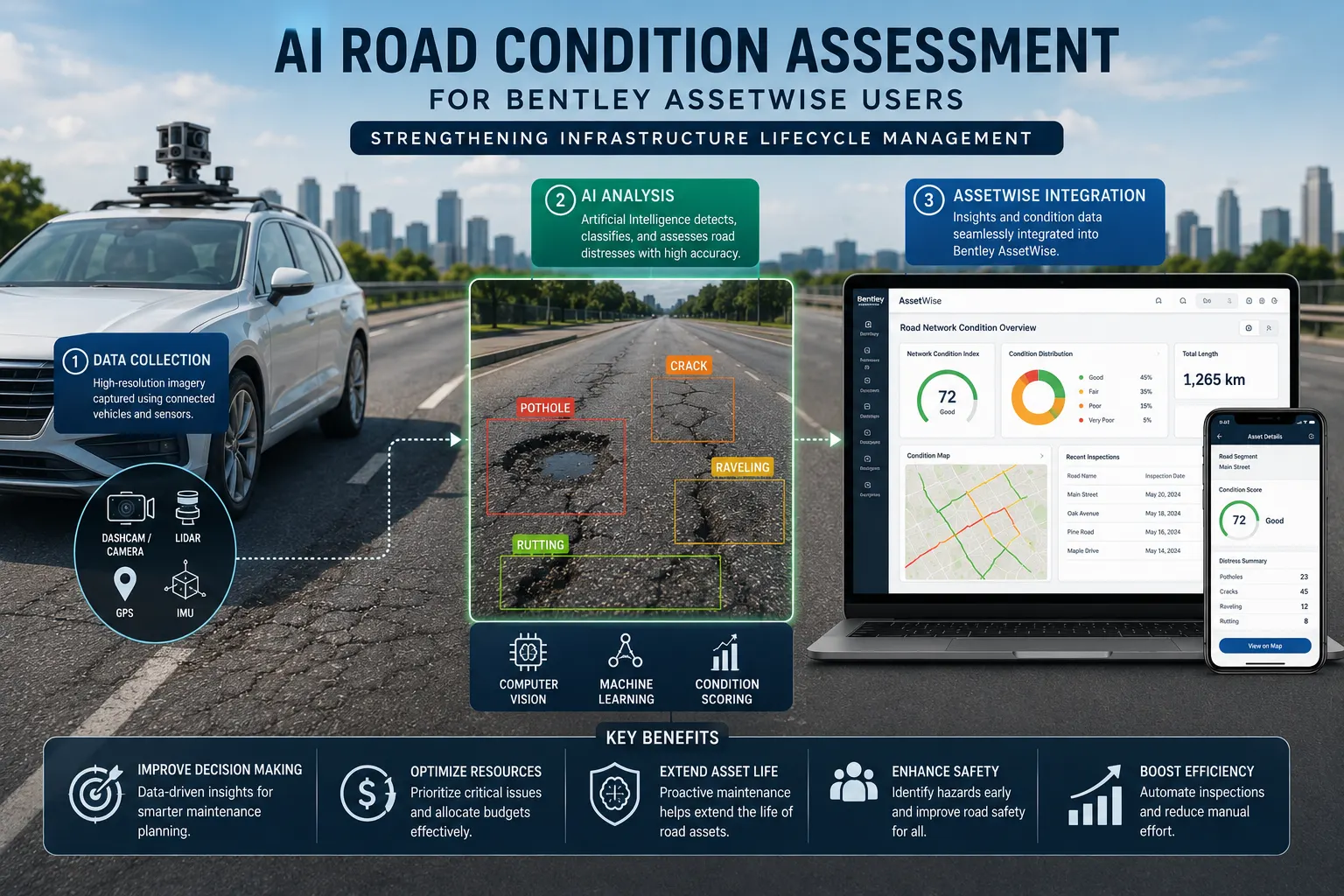
Before covering where AI fits, it is worth being precise about what Bentley AssetWise actually provides for infrastructure lifecycle management — because this determines exactly where an AI condition data layer connects and how it strengthens the lifecycle analytical framework.
Bentley AssetWise is an enterprise infrastructure lifecycle management platform built to manage the full lifecycle of large, engineered infrastructure assets roads, bridges, tunnels, structures, and the connected networks that link them from design and construction through operation, maintenance, rehabilitation, and renewal. Its defining characteristic, relative to simpler asset management tools, is the integration of whole-of-life cost modelling, engineering design data, and physical condition information into a single analytical environment where capital investment decisions are grounded in both current asset condition and long-run lifecycle cost projections, not just short-run maintenance backlog.
At the core of AssetWise’s infrastructure lifecycle capability is its whole-of-life (WoL) cost modelling engine. Rather than optimising for minimum annual maintenance spend, AssetWise models the total cost of owning and managing each infrastructure asset over its full design life combining capital renewal costs, routine and periodic maintenance costs, risk-of-failure costs, and user costs (delay, detour, and network disruption) into a single lifecycle cost framework. For road agencies, this means investment decisions about pavement rehabilitation, structural renewal, and drainage improvement are evaluated not on their short-run cost but on their contribution to minimising total lifecycle cost over a 20, 30, or 50-year planning horizon.
AssetWise connects to Bentley iTwin, the digital twin platform that aggregates engineering data, reality capture (point clouds, photogrammetry), IoT sensor feeds, and asset condition data into a unified, queryable digital representation of physical infrastructure. For road networks managed alongside structures bridges, overpasses, tunnels, retaining walls, drainage systems the iTwin environment allows infrastructure lifecycle managers to view and analyse pavement condition data in the same spatial and engineering context as the structural, geotechnical, and environmental data for the assets the road network connects to. This integration is what enables cross-asset lifecycle optimisation rather than siloed road-only or structure-only decision-making.
AssetWise maintains structured asset registers with condition data, inspection history, and maintenance records linked to each road and structure asset. Deterioration models within the platform project how condition will change over time under different maintenance and investment scenarios enabling lifecycle managers to identify the optimal intervention timing for each asset: the point at which a maintenance treatment delivers the greatest extension of asset life at the lowest lifecycle cost. Accurate deterioration modelling is the foundation of credible long-range capital renewal planning and it depends entirely on the quality and frequency of the condition data feeding into it.
AssetWise generates multi-year capital renewal programmes typically 10 to 30 years that sequence maintenance, rehabilitation, and reconstruction interventions across the asset portfolio to achieve defined lifecycle performance targets within annual capital budget constraints. These programmes are the primary output that infrastructure agencies present to government treasury bodies, infrastructure investors, toll concession oversight authorities, and regulatory agencies to justify long-range infrastructure investment levels. The credibility of the programme depends directly on the accuracy of the condition data and deterioration models that underpin it.
AssetWise combines condition data with consequence-of-failure analysis to prioritise maintenance and capital investment based on overall infrastructure risk rather than condition score alone. For complex infrastructure portfolios where a deteriorating pavement section adjacent to a critical bridge approach or a high-traffic interchange carries fundamentally different failure consequences than equivalent deterioration on a low-volume local road, this risk-weighted lifecycle analysis is the analytical capability that makes AssetWise’s capital programmes defensible to oversight bodies and financiers.
Through its connection to Bentley’s engineering software ecosystem including OpenRoads for roadway design, OpenBridge for structural engineering, and ProjectWise for engineering content management AssetWise links operational condition data back to the original design specifications, construction records, and as-built engineering models for each asset. This engineering data connection means that a pavement condition trend identified by AssetWise’s lifecycle model can be traced back to the original pavement design specification and the construction records that delivered it informing whether observed deterioration reflects design adequacy, construction quality, or traffic loading beyond original specification.
AssetWise produces the condition reporting, lifecycle cost analysis, and investment justification outputs that large infrastructure operators submit to government oversight bodies, toll concession authorities, infrastructure investors, and international financing institutions. For organisations managing assets under performance-based contracts, PPP arrangements, or concession agreements common in major toll road and national highway networks the credibility and audit-trail quality of AssetWise’s lifecycle reporting is directly tied to contractual performance obligations and financial outcomes.
AssetWise manages infrastructure lifecycle data with an analytical depth and engineering integration that very few platforms match. What it does not do and is not designed to do is generate the road condition data that its lifecycle models and capital renewal planning engine depend on.
The pavement condition indices, deterioration observations, and road asset inventory records in AssetWise are only as current and accurate as the last time the network was surveyed. In a lifecycle management context, this matters more than in a simple maintenance scheduling context: deterioration model accuracy, whole-of-life cost projection reliability, and capital renewal programme credibility are all directly functions of condition data quality and frequency.
The result: a sophisticated infrastructure lifecycle management platform whose whole-of-life cost models and capital renewal programmes are only as reliable as the pavement condition data feeding them and that data is, for most organisations, the least current, least consistent, and most infrequently refreshed layer in an otherwise highly sophisticated analytical environment.
This is not a limitation of Bentley AssetWise. It is a structural limitation of how road pavement condition data has historically been collected a limitation that becomes more analytically consequential, not less, in a platform built for precision lifecycle optimisation.
AI-based computer vision for road surveys addresses the pavement condition data generation problem directly and does so in a way specifically suited to closing the condition data currency and consistency gaps that constrain AssetWise’s lifecycle modelling capability. The approach is operationally straightforward: a vehicle-mounted dashcam captures geo-tagged, time-stamped video of the road network as the vehicle drives at normal operating speeds. That footage is processed through AI models that detect and classify road conditions and assets automatically, returning structured, geo-referenced results formatted for direct input into AssetWise’s lifecycle management and iTwin digital twin environment.
No specialist survey vehicle. No high-speed laser profiler. No dedicated inspection crew competing for resources with structural inspection programmes. Any fleet vehicle already covering the corridor maintenance trucks, toll road patrol vehicles, inspection vans, concession monitoring vehicles becomes a pavement condition survey platform capable of producing lifecycle-quality condition data at a frequency that matches, rather than lags, the structural and engineering data layers already current in the AssetWise environment.
RoadVision AI’s models are trained on over 100 million road images from networks across South Asia, the Middle East, Southeast Asia, Europe, and Africa, covering diverse pavement types, climate conditions, traffic loading profiles, and road classifications including the high-specification expressway, motorway, and toll road surfaces common to the capital-intensive corridor assets that AssetWise-based infrastructure lifecycle programmes typically manage. The training breadth is what determines whether model outputs are consistent enough to calibrate deterioration curves accurately across successive survey cycles the most demanding data quality requirement in a lifecycle modelling context.
A single dashcam survey pass, processed through the RoadVision AI pipeline, returns infrastructure condition intelligence across the following categories structured for direct integration into AssetWise asset records, deterioration models, and the iTwin digital twin:
Detection and classification of road surface distress including potholes, longitudinal cracking, transverse cracking, alligator (fatigue) cracking, rutting, edge deterioration, patching quality, and surface ravelling. Each finding is severity-scored (Low / Medium / High / Critical) and contributes to a per-segment Pavement Condition Index (PCI) aligned to ASTM D6433 and IRC:116. An IRI-equivalent roughness value is also returned per 100-metre segment — directly compatible with AssetWise condition data inputs and the ride quality performance measures common in toll concession and PPP agreements.
Automated detection and classification of 80+ road asset types: regulatory signage, warning signs, informational signs, road markings (centreline, edge line, stop bars, pedestrian crossings, chevrons), kerb and edge conditions, guard rails and safety barriers, crash attenuators, drainage structures, culverts, lighting columns, overhead gantries, variable message signs, and ITS infrastructure. Every asset detection includes GPS coordinates, asset type, condition grade, and a photographic evidence frame structured to populate or update AssetWise asset lifecycle records at the corresponding location in the digital twin.
Detection of safety deficiencies in road corridors including faded or absent pavement markings, damaged safety barriers, vegetation encroachment onto carriageway clearances, sight-line obstructions at bridge approaches and interchange ramps, and right-of-way intrusions. In a lifecycle management context, safety deficiency records feed directly into AssetWise’s risk-based assessment, where they contribute to consequence-of-failure scoring alongside structural and pavement condition data.
Detection of visible drainage deficiencies blocked culvert inlets and outlets, failed ditch grades, shoulder erosion adjacent to drainage structures, and standing water indicators that are early signals of subsurface deterioration risk on road pavements. In a lifecycle management context, drainage deficiencies are particularly significant because they are leading indicators of accelerated pavement deterioration: identifying them early enables low-cost drainage intervention before subsurface moisture damage escalates to pavement structural failure requiring expensive reconstruction.
Every detection record includes: defect or asset type, severity or condition grade, confidence score, GPS coordinates, route chainage, timestamp, and a geo-tagged photographic evidence frame delivered in formats aligned to AssetWise’s import schema and the iTwin spatial referencing system used for the corridor.
AssetWise manages infrastructure lifecycle data through structured asset records connected to engineering models, deterioration databases, and the iTwin digital twin environment with defined attribute schemas and lifecycle modelling inputs that determine how condition data flows into the platform’s capital planning and whole-of-life cost functions. RoadVision AI outputs are structured to align with these schemas, enabling AI-generated pavement condition data to enter the AssetWise lifecycle environment in a form that directly strengthens, rather than merely populates, the platform’s analytical capability.\
This is the most significant lifecycle impact of AI survey integration, and the one most directly relevant to AssetWise’s value proposition. AssetWise’s deterioration models are calibrated against observed condition trajectories at the segment level. When AI surveys provide annual or quarterly condition observations rather than biennial or triennial ones, deterioration curves are fitted to significantly denser data series reducing prediction error in both rate-of-deterioration estimates and intervention timing recommendations. More accurate deterioration models produce more reliable whole-of-life cost projections, more precisely timed capital renewal recommendations, and more credible long-range capital programmes. The lifecycle optimisation capability that AssetWise is built to deliver becomes measurably more accurate as its condition data inputs become more frequent and consistent.
AssetWise’s whole-of-life cost models combine condition trajectories with treatment cost data, traffic loading, and consequence-of-failure values to project total lifecycle cost under different investment scenarios. Every improvement in deterioration model accuracy directly reduces the uncertainty band on lifecycle cost projections the range between optimistic and pessimistic long-run cost outcomes that funding bodies scrutinise in capital programme submissions. AI condition data, delivered consistently over successive survey cycles, narrows this uncertainty band by grounding the model’s deterioration assumptions in observed data rather than interpolated or assumed trajectories.
AI survey results update condition attributes on existing AssetWise road asset records: PCI score, IRI roughness, individual distress type presence and severity, drainage condition indicators, and overall condition grade. Each update is date-stamped and appended to the asset’s condition history, building a continuous, consistently measured pavement condition time-series within AssetWise. Detection results are simultaneously delivered with linear referencing system (LRS) chainage aligned to the spatial referencing already used in the organisation’s iTwin environment, positioning pavement condition data correctly within the 3D digital twin co-located with reality mesh data, structural BIM models, and engineering records for the same corridor.
AI-derived condition data feeds directly into AssetWise’s capital renewal planning module, where it contributes to intervention timing optimisation identifying the pavement sections approaching the lifecycle cost-optimal treatment threshold and sequencing them into the multi-year renewal programme accordingly. For organisations whose capital renewal programmes are submitted to treasury, concession authority, or international financier review, condition data collected by a systematic, auditable AI process with defined accuracy benchmarks provides stronger data provenance than manual survey results a consideration that is increasingly relevant in infrastructure funding due diligence.
Updated pavement condition data feeds into AssetWise’s risk-based asset management calculations, combining with consequence-of-failure modelling and structural condition data to produce network-level lifecycle risk prioritisation. With pavement condition refreshed on a cycle comparable to structural inspection data, the risk model reflects a balanced, current picture of total corridor risk rather than being weighted by the fact that structural data is current while pavement data is ageing. Cross-asset lifecycle risk prioritisation, one of AssetWise’s most powerful analytical capabilities, becomes more reliable as both of its primary condition data inputs achieve comparable currency.
Where the organisation’s pavement design records are managed in OpenRoads or ProjectWise, AI-detected condition data referenced to the same chainage and asset identifiers can be cross-referenced against original design specifications and construction records. This supports engineering analysis of whether observed pavement deterioration patterns reflect design adequacy, construction quality variance, traffic loading beyond original specification, or drainage performance issues that a lifecycle model built on condition data alone would not identify.
Once integrated, AI survey data participates in every downstream AssetWise lifecycle management workflow the organisation already runs: deterioration curve calibration, whole-of-life cost optimisation, risk-based capital renewal prioritisation, multi-year programme generation, regulatory and concession reporting, and iTwin digital twin visualisation. Infrastructure lifecycle teams continue working in the same AssetWise environment they have built their programme around the difference is that the pavement condition layer feeding the lifecycle models is as current, consistent, and analytically reliable as the engineering and structural data layers already in place around it.
What does not change: The AssetWise platform. The iTwin digital twin architecture. The whole-of-life cost modelling methodology. The deterioration model framework. The capital renewal planning process. The risk-based prioritisation approach. The engineering data connections to OpenRoads and ProjectWise. The regulatory and concession reporting structure.
What changes: The frequency, consistency, and analytical reliability of the pavement condition data feeding into an infrastructure lifecycle management environment built for precision and the downstream improvements in lifecycle model accuracy, capital programme credibility, and risk-based prioritisation quality that follow.
Lifecycle model accuracy improves as condition data frequency increases. AssetWise’s deterioration models and whole-of-life cost projections become more accurate as the condition time-series they are calibrated against becomes denser. Moving from biennial to annual AI surveys adds condition observations that refine deterioration rate estimates, reduce lifecycle cost projection uncertainty, and improve the precision of optimal intervention timing recommendations directly strengthening the analytical foundation of the capital renewal programme.
The digital twin currency asymmetry closes. For organisations that have invested in current structural health monitoring, annual bridge inspections, and regular reality capture for their major structures, AI pavement surveys allow the connecting road network condition data to be refreshed at a comparable frequency so the iTwin digital twin reflects a uniformly current picture of the managed infrastructure portfolio, not a high-resolution structural model sitting alongside ageing pavement data.
Optimal intervention windows are identified and acted on rather than missed. Frequent AI surveys catch pavement sections approaching the lifecycle cost-optimal treatment threshold in time for the lifecycle model to schedule the preventive treatment before the section deteriorates into a more expensive rehabilitation requirement. On high-traffic corridors where the cost of reactive reconstruction including traffic management, detours, and user delay is orders of magnitude higher than preventive treatment, this operational precision directly reduces total lifecycle cost.
Capital renewal programmes submitted to funding bodies gain data provenance strength. AI-generated condition data, collected by a systematic, reproducible process with documented accuracy benchmarks and consistent methodology across survey cycles, provides stronger data provenance for capital programme submissions than manual survey data assembled from multiple contracted survey providers over several years. Funding bodies increasingly scrutinise the data quality and consistency underlying capital programme justifications; AI survey data addresses this directly.
Concession and PPP performance reporting becomes more evidenced. For toll road operators and concession holders required to report pavement condition and ride quality performance against contracted targets, frequent AI surveys provide a dense, auditable evidence base for performance reporting rather than the sparse, interpolated record that infrequent manual surveys produce between reporting periods.
The evaluation path is designed to fit the technical rigour of an enterprise infrastructure lifecycle programme:
For infrastructure organisations using Bentley AssetWise, the question is not whether AI pavement surveys are technically viable they demonstrably are. The question is whether the resulting condition data is consistent enough in methodology, frequent enough in cadence, and precisely enough referenced spatially to strengthen rather than simply populate the lifecycle models, whole-of-life cost analyses, and capital renewal programmes that AssetWise is specifically built to produce. That is what this integration is designed to deliver.
Any GPS-enabled dashcam producing standard MP4 or MOV video at 1080p or above. No proprietary hardware, no calibration rig, no vehicle modifications beyond mounting the camera. For high-specification corridors such as motorways, expressways, and toll roads, the same standard consumer dashcam equipment applies no specialist survey vehicle is required for routine lifecycle-quality pavement condition assessment.
No. The models are pre-trained and deployed, including specific coverage of high-specification motorway, expressway, and toll road surfaces at the traffic loading and pavement specification levels common to capital-intensive corridor assets managed in AssetWise. There is no model training cost, no annotation project, and no configuration work required on the organisation side.
AssetWise’s deterioration models are calibrated by fitting curves to observed condition trajectories at the asset level. Annual or more frequent AI surveys provide significantly more data points per segment per calibration cycle than biennial or triennial specialist surveys. More data points produce better-fitted deterioration curves, which in turn produce more accurate lifecycle cost projections, more precisely timed capital renewal recommendations, and narrower uncertainty bands on the whole-of-life cost analyses submitted to funding bodies and concession authorities.
AI detection results are delivered with GPS coordinates and, where required, linear referencing system (LRS) chainage aligned to the spatial referencing already used in the organisation’s iTwin environment. This positions pavement condition data correctly within the 3D digital twin — spatially co-located with reality mesh data, BIM models, and structural asset data for the same corridor enabling the integrated cross-asset lifecycle analysis that is one of AssetWise’s core capabilities to operate on uniformly current condition data across all asset types.

The Autonomous Road Engineer
AI-powered road condition monitoring, asset management, & infrastructure intelligence helping agencies move from reactive maintenance to predictive road management.


.webp)
.webp)
.webp)