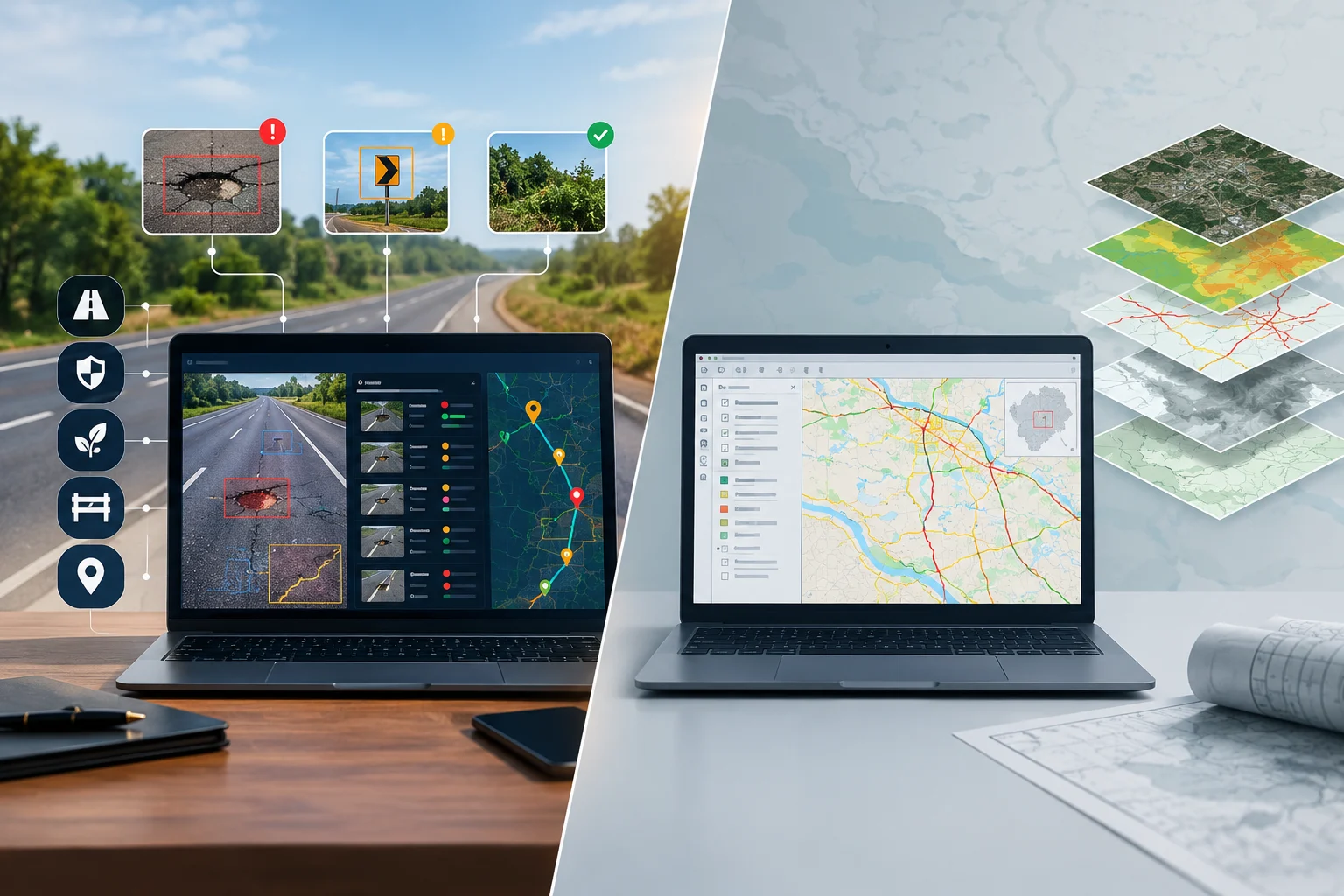
AI pavement inspection uses cameras, sensors, and computer vision to detect and classify pavement defects automatically, while manual pavement inspection relies on trained inspectors visually assessing the road and recording what they see. AI inspection is generally faster, cheaper per kilometer, more consistent, and safer for staff, which makes it the better fit for broad, frequent, network-level monitoring. Manual inspection remains stronger for detailed, judgment-heavy work such as investigating ambiguous defects, diagnosing structural causes, and project-level assessment of a specific site. For most agencies the practical answer isn't choosing one over the other: it's using AI for coverage and manual expertise for depth.
Almost every agency evaluating AI-based road inspection asks the same question: is it actually better than what we do now? It's a fair question, and the honest answer is "it depends on what you're asking each method to do." Framing the decision as AI versus humans misses the point. The two approaches have different strengths, and the interesting question is where each one earns its place in an inspection program.
Manual inspection is the traditional method. A trained inspector, often an engineer or technician, walks the road or drives it slowly, visually identifies defects such as cracking, rutting, potholes, and raveling, rates their severity against a standard scheme, and records the findings on a form or handheld device. In many jurisdictions this follows a defined methodology, such as coarse or detailed visual inspection categories, and the records feed into maintenance planning and, in some cases, liability defense.
Its strengths are real. A skilled inspector brings contextual judgment that no algorithm fully replicates: noticing that a crack pattern near a culvert suggests a drainage problem, recognizing an unusual failure mode, or deciding that a defect that looks minor on paper is a genuine hazard at a particular curve. Manual inspection also requires no specialized equipment, which makes it accessible to any agency.
Its limits are equally real, and they mostly come down to scale and variability. An inspector can only cover so much road in a day. Two inspectors can rate the same defect differently, and the same inspector can rate it differently on different days. Large networks tend to be inspected infrequently as a result, and the findings arrive as paper or spreadsheet records that take time to compile and are hard to compare year over year.
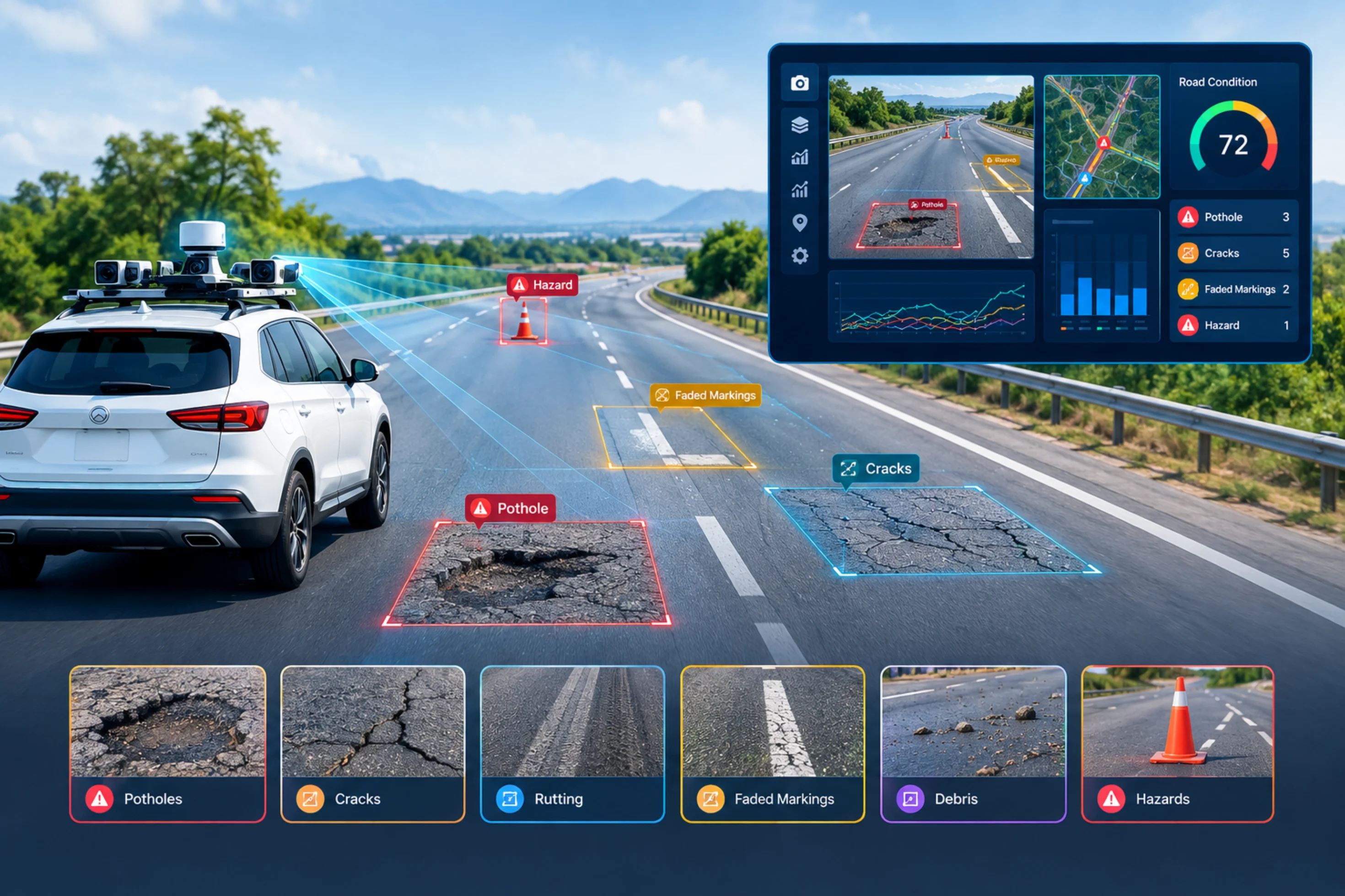
AI inspection replaces the visual assessment step with automated analysis. Cameras mounted on survey vehicles, fleet vehicles, or drones capture imagery of the road at normal driving speed, often alongside accelerometer or LiDAR data. Computer vision models then detect and classify defects, score their severity, and tag each finding with a precise GPS location. Results flow into dashboards, GIS systems, or maintenance platforms in structured form.
Its strengths are speed, coverage, and consistency. The same model applies the same criteria to every frame it analyzes, whether it's the first kilometer of the survey or the five hundredth. Because data collection happens at traffic speed and can use vehicles already on the road, networks can be assessed far more often than manual crews allow, and the structured output makes trend analysis straightforward.
Its limits are worth stating plainly too. Detection accuracy depends on training data, camera quality, and conditions such as weather and lighting. AI handles surface-visible distress well but can't directly assess what's happening beneath the surface. And it doesn't bring the situational judgment a seasoned engineer applies to a specific site.
Manual inspection moves at walking or crawling pace, so coverage is bounded by crew size and time. AI inspection collects data at normal traffic speed, and fleet-based approaches can cover large parts of a network as a byproduct of vehicles doing their regular routes. For an agency responsible for hundreds or thousands of kilometers, this is typically the single biggest difference: the gap between sampling the network and covering it.
Manual ratings carry inspector-to-inspector variability, even with training and standardized criteria. AI applies identical detection logic every time, which makes comparisons between segments, surveys, and years more reliable. That consistency matters most when you're tracking deterioration trends or defending a prioritization decision, since you can show the criteria didn't shift between observations.
Manual inspection has low equipment costs but high and recurring labor costs, which scale directly with network length and inspection frequency. AI inspection involves technology costs, whether dedicated vehicles, dashcams, or a software subscription, but the marginal cost of covering an additional kilometer, or of surveying again, is generally much lower. Actual costs vary widely by vendor, scope, and region, so the fair comparison is a fully loaded one: include the labor, travel, reporting time, and the cost of inspecting less often than you'd like.
This is the most nuanced comparison, and blanket claims in either direction should be treated with suspicion. Well-trained AI models can detect common surface defects reliably and, importantly, consistently. Skilled inspectors can outperform AI on ambiguous, unusual, or context-dependent cases. Accuracy for AI systems varies with training data diversity, sensor fusion, camera setup, and conditions, so the right move is to ask any vendor for documented performance on conditions like yours and to validate it with a pilot rather than relying on a headline number.
Manual inspection often means personnel working on or beside live traffic, which carries genuine injury risk, particularly on high-speed roads. AI inspection from a moving vehicle keeps people off the roadside for routine survey work. For agencies with safety obligations to their staff, this is a meaningful benefit beyond speed or cost.
Here manual inspection keeps its edge. Investigating why a defect formed, assessing structural condition, deciding how to treat a specific problem, and handling the unusual case all benefit from an engineer on site. AI is a powerful way to find and flag where attention is needed; it's a weaker substitute for the diagnosis that follows.
AI inspection produces timestamped, geotagged, structured records automatically, which are easy to search, compare, and audit. Manual records can be just as defensible when done carefully, but they take more effort to produce and maintain, and quality depends on the individual inspector's diligence.
Because manual inspection is labor-bound, most agencies inspect on fixed, relatively infrequent cycles. Pavement deterioration is non-linear, so a long gap between inspections can mean missing the window when cheap preventive treatment would have worked. AI's lower marginal cost makes more frequent assessment realistic, which is often where it pays back most.
There are situations where manual inspection should lead. Detailed project-level assessment, where an engineer is deciding on a specific treatment for a specific segment, benefits from on-site judgment. Structural investigations often need specialized testing that neither visual nor AI methods replace. Ambiguous or high-stakes findings flagged by an AI system deserve human verification. And where a formal standard or contract specifies a particular manual methodology for certification, that requirement governs until it's updated to recognize other methods. Small networks with modest inspection needs may also find manual methods perfectly adequate and not worth changing.
AI inspection earns its place when the goal is broad, repeated, consistent coverage. Network-level condition monitoring across large road systems, frequent re-surveys to catch fast-developing damage such as after monsoon or freeze-thaw seasons, building a historical dataset for deterioration modeling, and reducing roadside exposure for staff all play to its strengths. It's particularly compelling for agencies that currently inspect only a fraction of their network, or only infrequently, because the constraint on their current program is coverage, not expertise.
In practice, the strongest inspection programs layer the two. AI handles the continuous, network-wide first pass: detecting, classifying, scoring, and prioritizing. That output tells engineers where to look. Manual inspection then focuses on the flagged segments, verifying ambiguous findings, diagnosing causes, and making the treatment decisions that call for professional judgment. This division uses each method where it's strongest, and it typically produces better outcomes than either approach alone, with less total manual effort aimed at less productive routine survey work.
A sensible transition keeps the existing manual program running while AI is introduced alongside it. Start with a pilot on a representative section of the network, collecting AI-based data on the same segments your inspectors have already rated. Compare the results, look at where they agree and where they diverge, and investigate the differences. That comparison builds confidence in where AI performs well on your roads and shows where manual verification should remain in the loop. From there, expand coverage gradually, adjust inspector roles toward verification and diagnosis rather than routine survey, and confirm that any data used for formal certification or compliance is accepted under the relevant standards and contracts.
AI pavement inspection and manual inspection aren't rivals so much as complementary tools with different strengths. AI wins on speed, coverage, consistency, frequency, and staff safety, which makes it the natural backbone for network-level monitoring. Manual inspection wins on depth, judgment, and diagnosis, which keeps it essential for project-level decisions and ambiguous cases. The agencies getting the best results aren't picking a side; they're using AI to see the whole network continuously and trained engineers to decide what to do about what it finds.
RoadVision AI gives your inspection team an AI-powered first pass across the entire network, detecting and classifying pavement distress at scale so engineers can spend their time on verification and decisions instead of routine survey work.
Want to compare AI inspection against your current process on your own roads? Talk to the RoadVision AI team to learn more or set up a pilot.
Manual inspection relies on trained inspectors visually assessing and recording defects, while AI inspection uses cameras, sensors, and computer vision to detect and classify defects automatically at traffic speed.
t depends on the task. AI is highly consistent on common surface defects, while skilled inspectors can do better on ambiguous or context-dependent cases. Accuracy for AI varies with training data and conditions, so a pilot on your own roads is the best way to validate performance.
Generally it has a lower marginal cost per kilometer, especially for frequent surveys, though technology costs vary by vendor and scope. A fair comparison includes the full cost of manual labor, travel, and reporting.
Much more often. Fleet-based AI data collection can run continuously or on frequent cycles, while manual inspection is typically limited to infrequent fixed cycles by labor capacity.
This depends on the applicable standards and contracts. Some require specific methodologies, so confirm how AI-generated data is recognized before using it for formal certification.
Run a pilot alongside your existing manual program on a representative segment, compare results, and expand gradually, using AI for network-level coverage and manual inspection for verification and detailed assessment.

The Autonomous Road Engineer
AI-powered road condition monitoring, asset management, & infrastructure intelligence helping agencies move from reactive maintenance to predictive road management.