
Dubai is rapidly evolving into a global benchmark for smart mobility. With high traffic volumes, expanding expressways, and the rise of autonomous mobility initiatives, the emirate depends on precise, real-time traffic intelligence to maintain safety, efficiency, and sustainability. The Roads and Transport Authority (RTA) has been at the forefront of digitizing mobility systems using drones, dashcams, and AI-driven road monitoring.
But as Dubai pushes forward with smart city ambitions—including intelligent intersections, autonomous corridors, and predictive traffic management—the need for reliable, automated traffic monitoring grows exponentially. After all, "you can't manage what you can't measure."
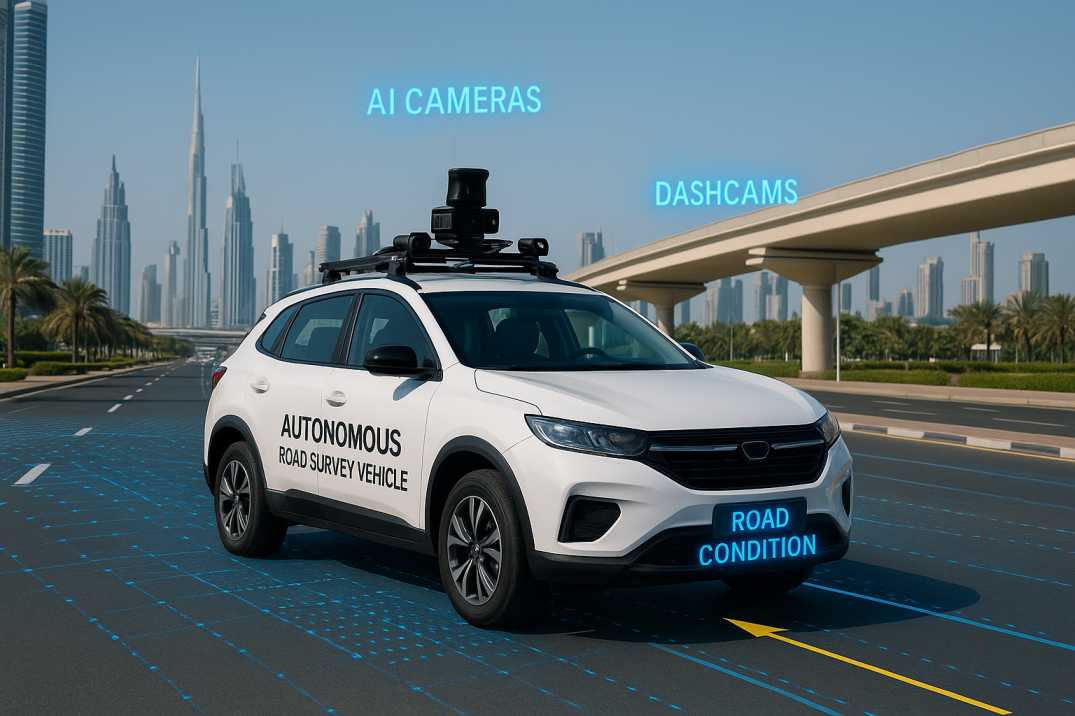
Several factors make AI-based traffic monitoring essential for Dubai's mobility landscape:
Manual traffic surveys and traditional CCTV networks alone cannot keep pace with these demands. Dubai requires continuous, high-resolution data—captured at road level and skyline level—to enable smarter decisions.
Although Dubai follows UAE-specific regulations, engineering and safety consultants often reference Indian technical frameworks such as those published by the Indian Roads Congress (IRC) for interoperability in international projects.
Key applicable principles include:
2.1 Continuous, High-Fidelity Data Collection
Traffic flow and road conditions must be monitored consistently—not in periodic snapshots—to support dynamic decision-making and real-time response.
2.2 Standardised Visibility and Condition Assessment
Frameworks such as IRC guidelines emphasise uniform inspection of pavement condition, markings, and safety elements—principles that apply equally to Dubai's smart mobility systems.
2.3 Predictive Maintenance and Early Warning Detection
Both IRC and UAE engineering standards highlight proactive maintenance, requiring reliable data to identify early deterioration and safety risks before they escalate.
2.4 Integration With Road Safety Audits
Safety audits must incorporate digital evidence, video data, and automated defect detection models through the Road Safety Audit Agent, ensuring consistent engineering judgment across all assessments.
2.5 Multi-Modal Traffic Considerations
Modern traffic monitoring must account for all road users—private vehicles, public transport, pedestrians, and cyclists—with appropriate detection and analysis.
Dubai's adoption of AI aligns directly with these principles—delivering objective, scalable, and continuous monitoring capabilities that support its world-class infrastructure ambitions.
RoadVision AI operationalises global engineering standards through a unified digital ecosystem tailored for Dubai's mobility needs, leveraging its integrated suite of AI agents.
3.1 AI-Enhanced Digital Traffic Surveys
The Traffic Analysis Agent uses dashcam-based and vehicle-mounted sensors to collect granular traffic data continuously—including:
All data is captured without disrupting traffic operations, providing a continuous stream of intelligence for decision-makers.
3.2 Drone-Based Aerial Traffic Intelligence
Aerial drones provide real-time coverage of:
This bird's-eye perspective strengthens decision accuracy, especially during peak times and special events, complementing ground-level data collection.
3.3 Predictive Traffic Flow and Signal Optimisation
AI models simulate traffic scenarios to:
This improves corridor efficiency across Dubai's expanding network, reducing travel times and emissions.
3.4 Automated Road Condition Monitoring
The Pavement Condition Intelligence Agent uses sensors and computer vision to detect:
This offers up to 70% faster and more consistent results than manual inspections, with objective, repeatable measurements.
3.5 Integrated Digital Twin for Road Assets
The Roadside Assets Inventory Agent creates a dynamic digital twin that consolidates all road asset data, enabling engineers to:
3.6 Compliance Alignment
RoadVision AI aligns with:
In essence, RoadVision AI ensures that decision-makers never have to "drive in the dark"—data lights the way for smarter, safer mobility.
Despite the advancements, several challenges remain:
4.1 Extreme Weather Conditions
High temperatures exceeding 50°C, sandstorms, and humidity can affect sensors, cameras, and drone flight viability.
AI Solution: RoadVision AI's systems are designed for Middle Eastern conditions, with robust hardware specifications and algorithms calibrated for environmental challenges.
4.2 Dense Urban Infrastructure
Tall buildings in areas like Dubai Marina and Business Bay can block GPS signals and interfere with both aerial and ground-based monitoring systems.
AI Solution: Multi-sensor fusion and redundant positioning systems ensure accurate data collection even in challenging urban canyons.
4.3 Data Volume Overload
With vast amounts of real-time data from drones, dashcams, and fixed sensors, authorities must ensure robust processing, storage, and analysis frameworks.
AI Solution: Cloud-based processing with edge computing capabilities ensures scalable data handling without overwhelming central systems.
4.4 Integrating Multiple Data Sources
Merging drone footage, dashcam analytics, road condition data, and traffic flow patterns requires seamless standardization and interoperability.
AI Solution: Unified data models ensure all sources contribute to a coherent, integrated view of network performance.
4.5 Ensuring Regulatory Compliance
Systems must satisfy RTA and UAE federal laws on data privacy, airspace usage, and autonomous operations.
AI Solution: Built-in compliance features ensure all data collection and processing meets local regulatory requirements.
4.6 Public Acceptance and Trust
Automated monitoring must maintain public confidence through transparent data usage policies and demonstrated safety benefits.
Addressing these challenges demands intelligent automation, resilient digital systems, and adaptable AI models—areas where RoadVision AI excels.
Dubai is setting global benchmarks for smart transport infrastructure. By integrating drones, dashcams, digital twins, and AI-powered analytics through the Traffic Analysis Agent, Pavement Condition Intelligence Agent, Road Safety Audit Agent, and Roadside Assets Inventory Agent, the emirate is reshaping how mobility is monitored, managed, and optimized. Autonomous traffic monitoring is no longer an experimental concept—it is now a core pillar of Dubai's transportation strategy.
RoadVision AI strengthens this transformation by:
As the proverb goes, "A stitch in time saves nine"—and with AI, Dubai is stitching its mobility future proactively, not reactively. The platform's ability to integrate diverse data sources, operate in challenging conditions, and deliver actionable intelligence ensures that Dubai's roads remain among the safest and most efficient in the world.
If your organisation is ready to embrace the future of autonomous traffic monitoring and smart mobility, book a demo with RoadVision AI today and discover how our platform can accelerate Dubai's journey toward smarter, safer, and fully digital mobility systems.
Q1. How is Dubai using AI in traffic management?
Dubai integrates traffic monitoring and digital traffic survey tools to detect congestion, adjust signal timings, and ensure smooth road operations.
Q2. What role do drones play in traffic monitoring?
Drones provide aerial insights for AI-based traffic survey and help authorities spot congestion, accidents, and road conditions in real time.
Q3. Why is road asset management important for Dubai?
Road asset management Dubai ensures timely maintenance, longer asset life, and reduced infrastructure costs.

The Autonomous Road Engineer
AI-powered road condition monitoring, asset management, & infrastructure intelligence helping agencies move from reactive maintenance to predictive road management.


.webp)
.webp)
.webp)